Seeds – ordering, not starting

A couple years ago I did a big seed order and started lots of seeds indoors.  Truly, lots of work and not such a big jump on the season that it made a huge difference, in my estimation.  So this year I decided to, first, do an inventory of what I already had (brilliant plan), then, choose seeds that could mostly be sowed outdoors, and finally, that I actually had a spot for (brilliant plans  two and three).

Above is the array of seed catalogs and reference books I used to select what will again be too many seeds.  And yes, the selecting is at least as much fun as actually growing them.

Thompson & Morgan:  Lemon gem marigold and Italian white sunflower.  These can go hither and yon in the front, the sunflowers in the sunny bed.

Pinetree Garden: purple Trionfo Violetto bean and round black radish.  In the raised bed (radish) and on a teepee (beans).

Johnny’s: Ruby Moon hyacinth bean, Heavenly blue morning glory and lemon gem marigold (I got confused and ordered them twice, but no matter).  The two annual vines to wreath around the mailbox (MG) and to add a purple accent to the pink bed at the side of the house (HB).

Kitchen Garden Seeds: Yaya carrots, Genovese Basil and Shirley poppies, plus fingerling potatoes.  These will go in the raised bed along with the Tuscan kale I “imported” from Italy.  The potatoes will probably go in the potato bag again, but I’ll pay more attention to water this time.  I promise.

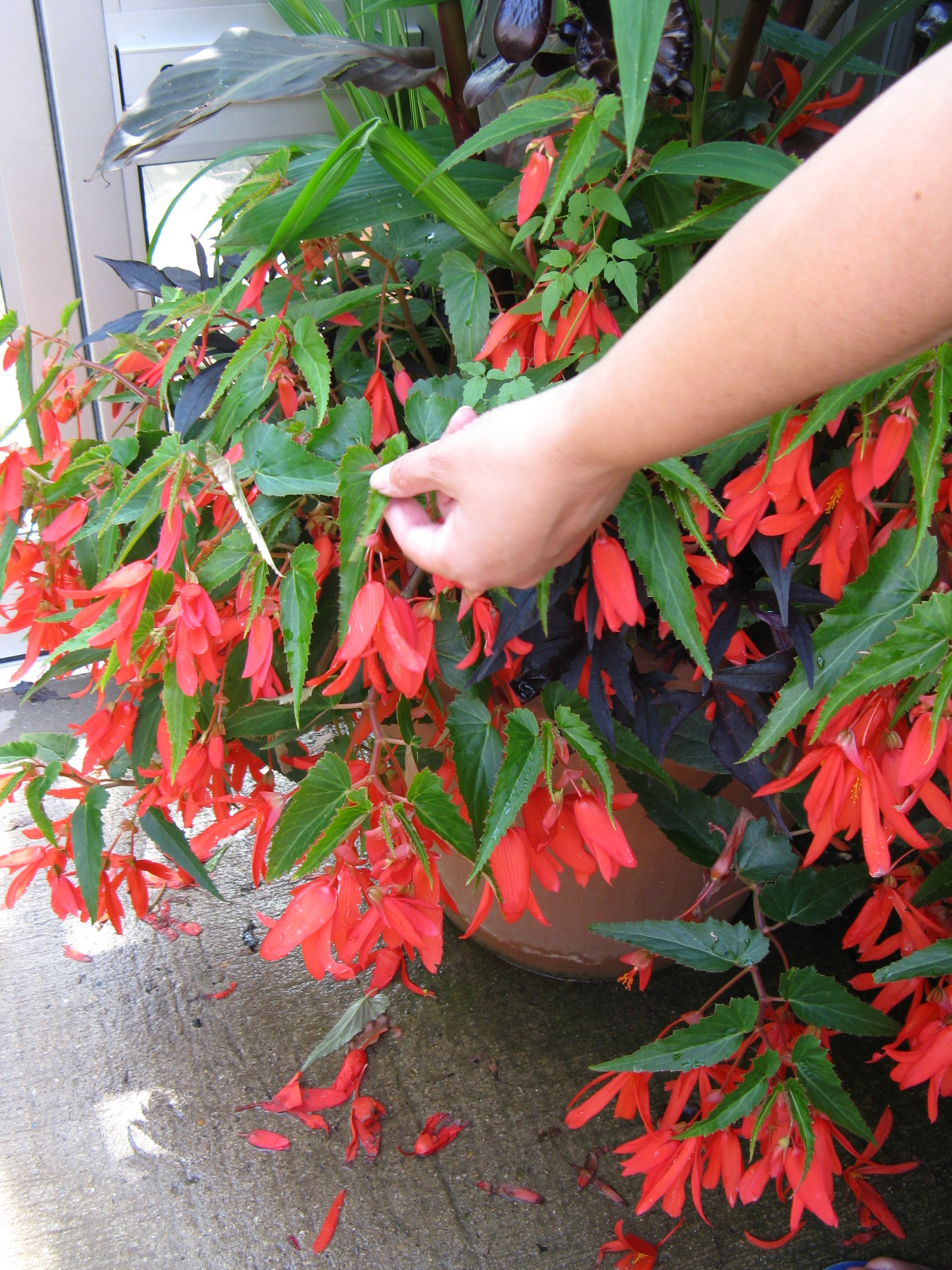
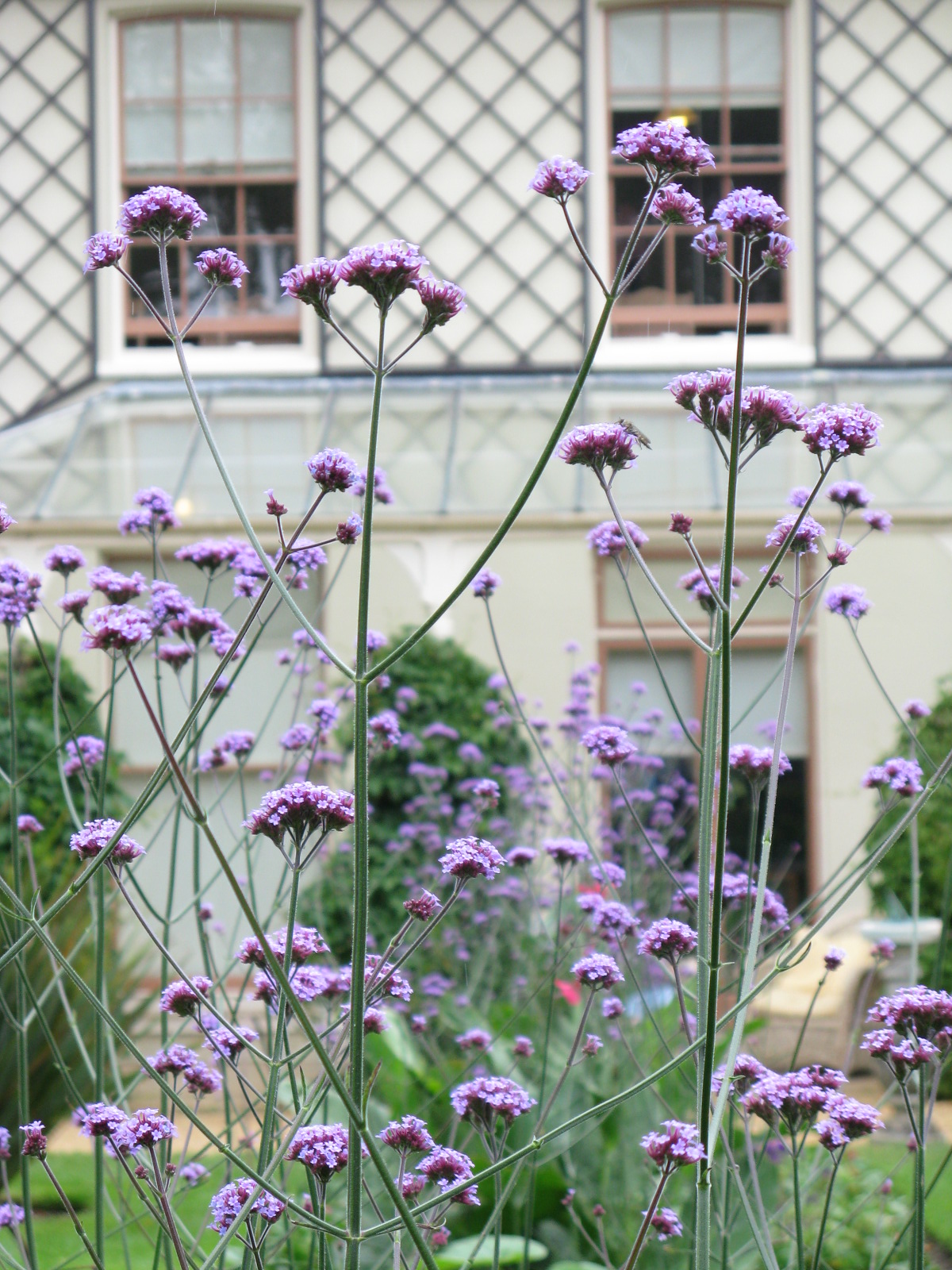
White Flower Farms:  because they are too hard to start from seed, three verbena bonariensis and one Bonfire begonia, both plants I had admired in Oxford.  Here’s the Bonfire begonia in the greenhouse at the Botanical Gardens in Oxford

and here’s the verbena at Darwin’s house

The begonia in a pot, and the verbena to twine amongst everything else in the sunny border.

New Year’s Day reading

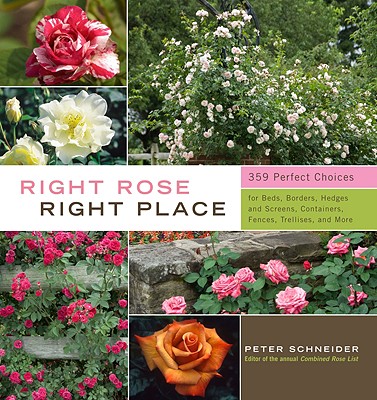
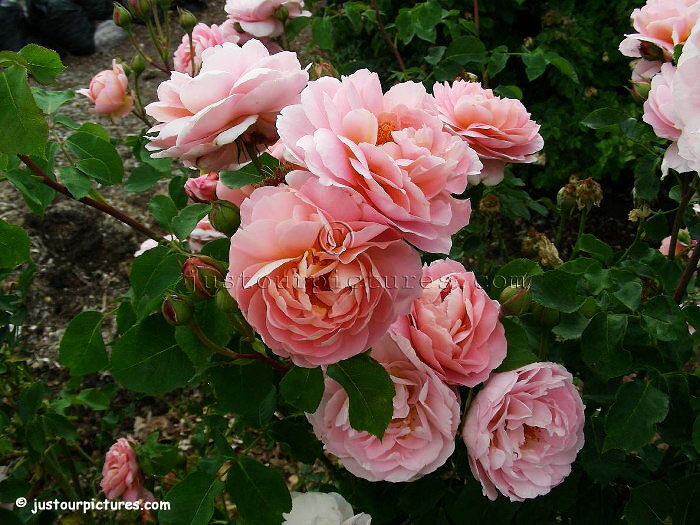
My shelf of unread gardening books from the library is getting too big, so I plucked one at random and read through it this afternoon.  Schneider is clearly knowledgeable and very helpful, especially if you garden in Zone 5 (which I don’t).  But he does pay attention to how drought-proof roses are as well as other attributes that help you to choose the right rose.  I’ve made note of three:  Belle  Story, 4×4;


Mary Rose, a  four-foot drought-tolerant variety;


and Queen Mother, a container rose that tolerates partial shade (front steps?).


The idea is to place a small rose in the new front garden bed, but I also like the idea of putting the Queen Mother by the front door.  Will I follow through? Only time will tell…

One last thing, or maybe two

We’ve been home for weeks now, but I never posted anything about our first big art day.  We started out right around the corner at the Duomo.  There was a long line to get in, but it moved quickly once they opened.  The line set the tone for Florence:  lots and lots of different nationalities, many of them students, all here for the art.

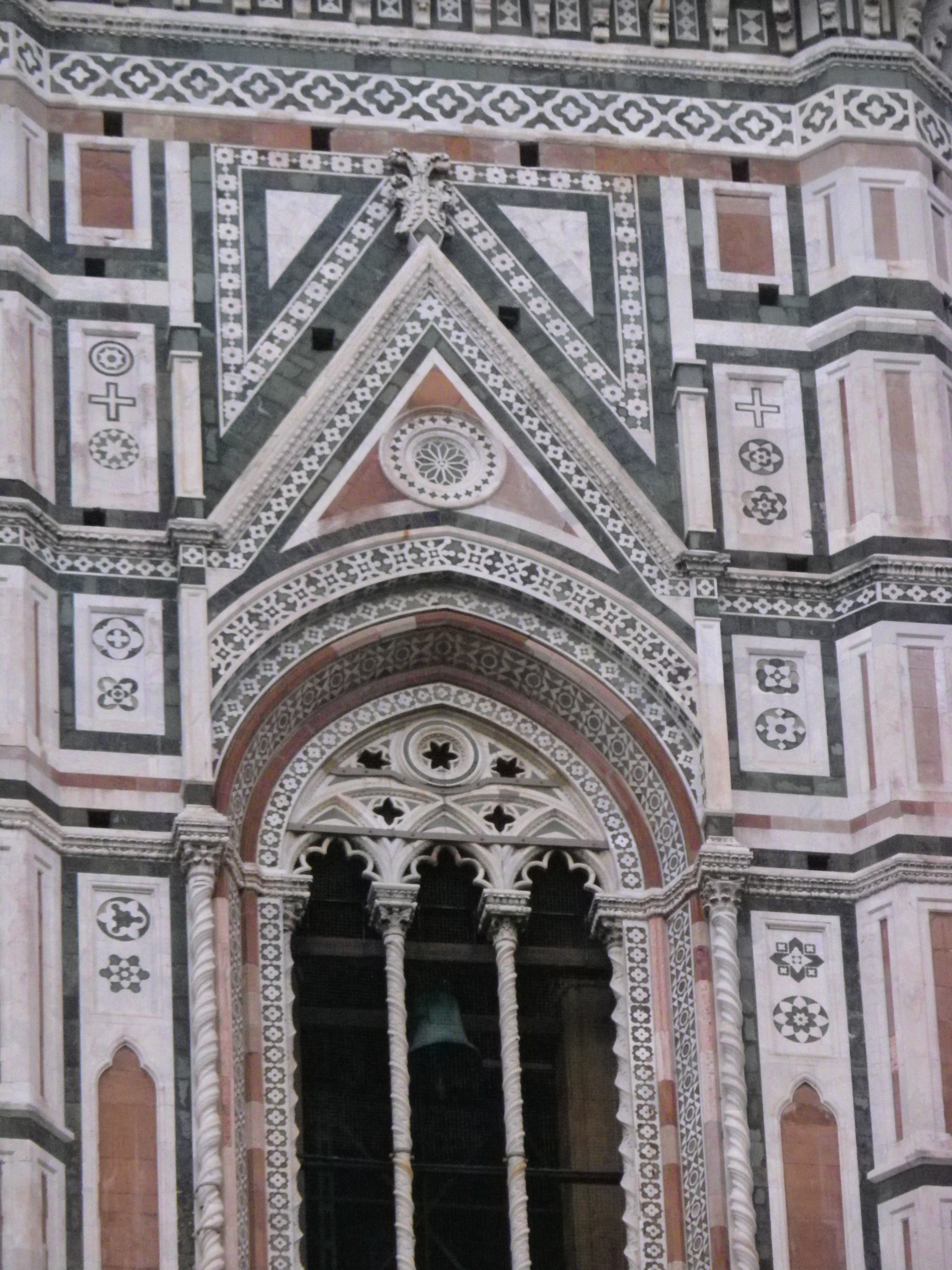
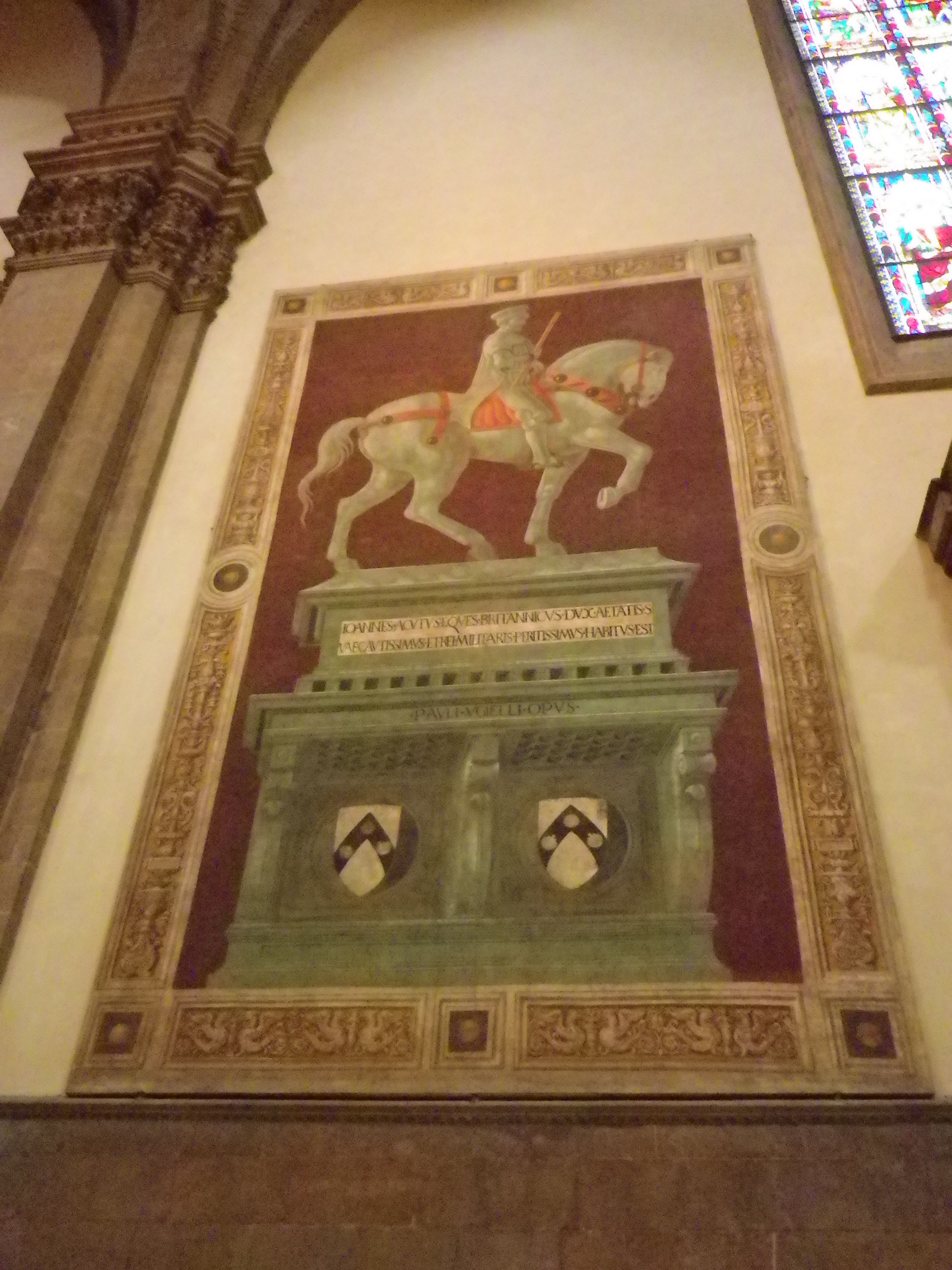
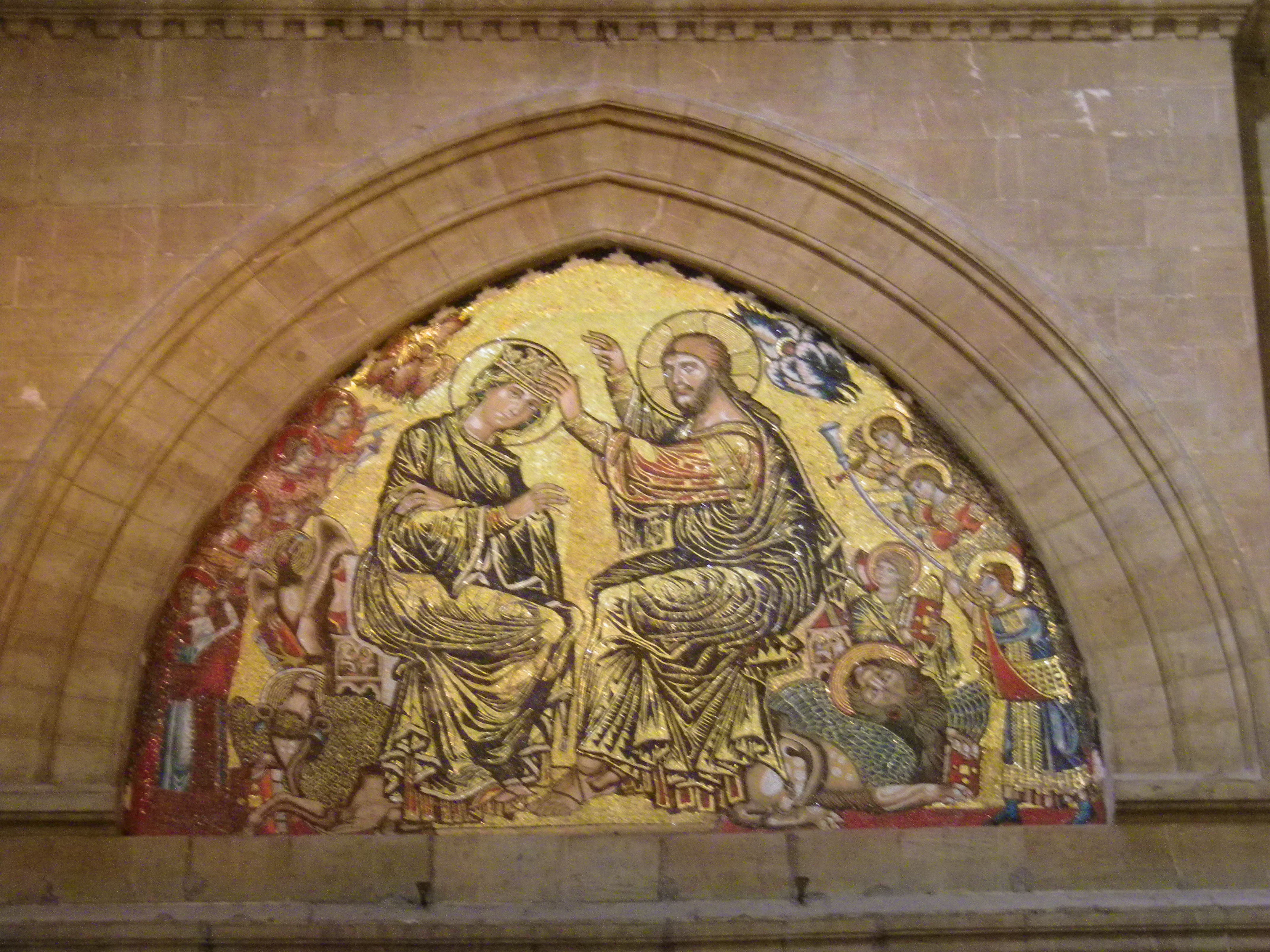
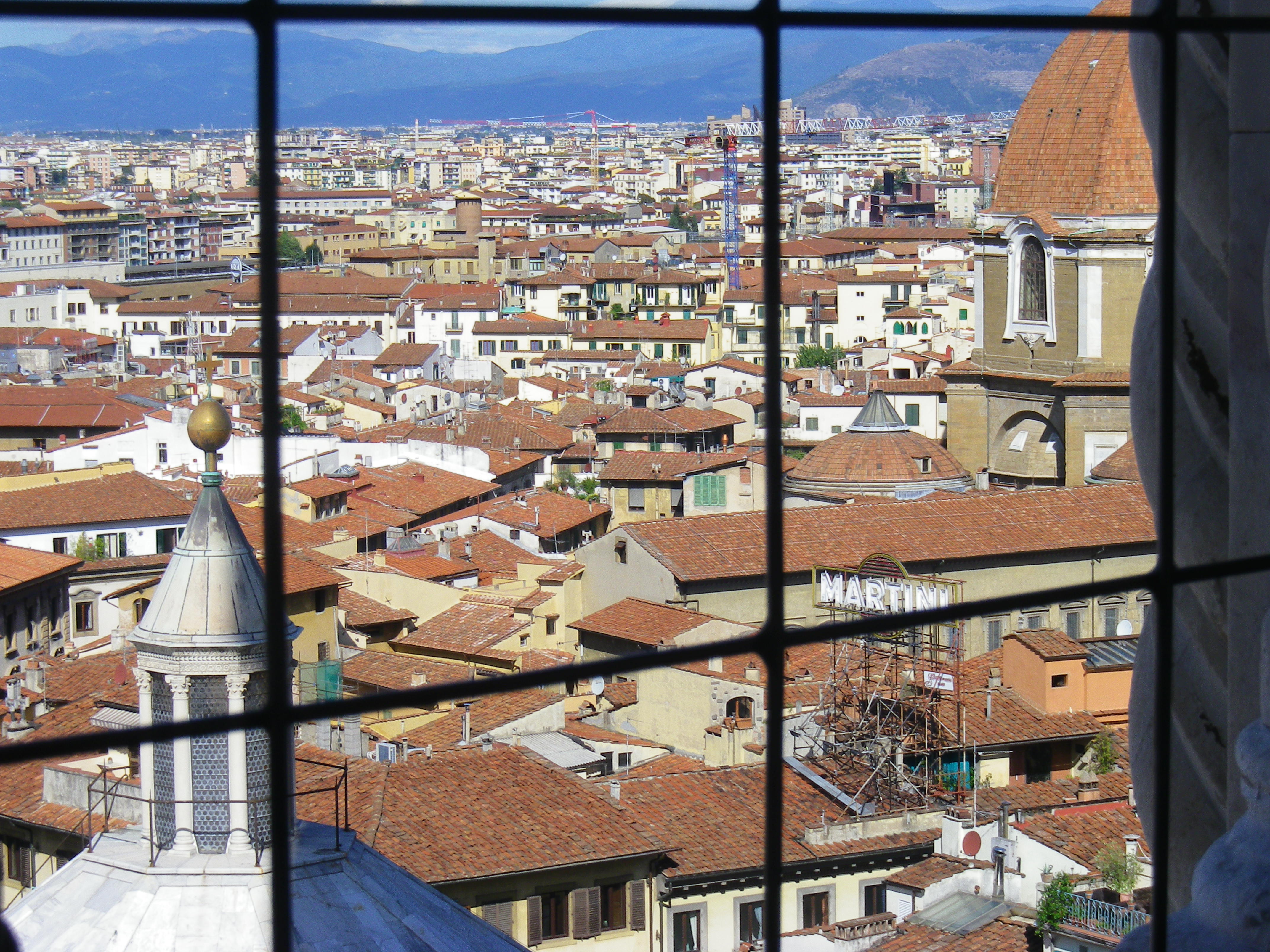
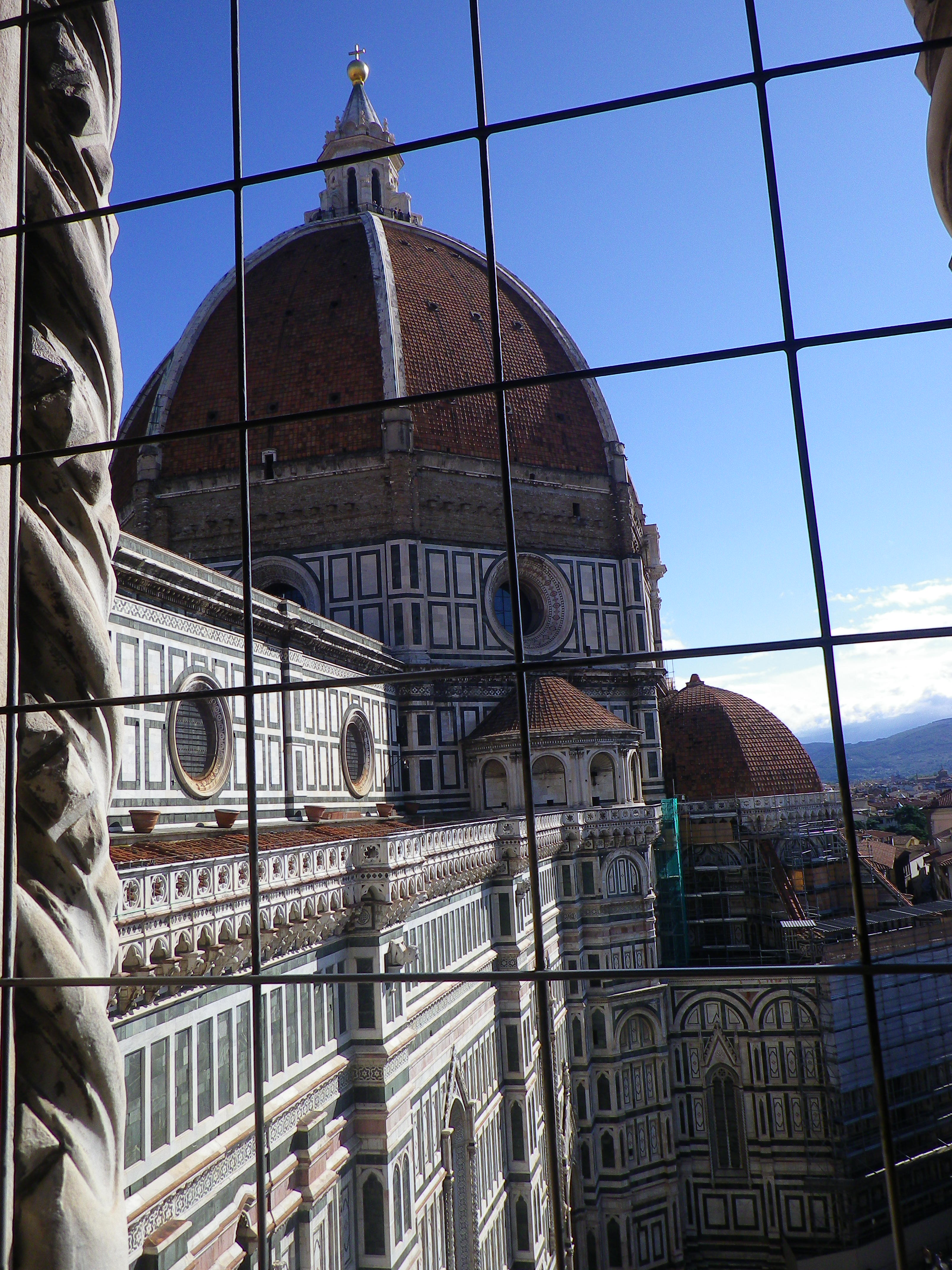
Here’s the facade, highly decorated as you can see and much more recent than the interior.The Duomo is oddly bare inside because most of its most precious possessions have been moved to the Duomo Museum (q.v.).  I was delighted to find that bandit Sir John Hawkwood, aka Giovanni Acuto (since Italians have no H, W or K in their language), just as Frances Saunders had promised, displayed on one wall just as if he had not changed sides dozens of times and been responsible for lots of Italian deaths during his career as a mercenary. Here is Alison lighting a candle .See the tiled floor?  It would make a great quilt design.I know that Renaissance art is more realistic than Byzantine, but I have a fondness for the stiff draperies and simple outlines of Byzantine art, like this.We left the Duomo and proceeded to the Campanile, which you can climb if you are so inclined.  I was inclined, but the higher I got the more scared I got, despite the fact that it’s made of stone and is perfectly sturdy.  I did get a few pictures of the city before turning around and stumbling back down.  Here are the tiled roofs of Florence, with the mountains in the background.And above, another view of the Duomo’s roof, which is never too far away no matter where you go in Florence.

I climbed about three-quarters of the way up.  See how high??

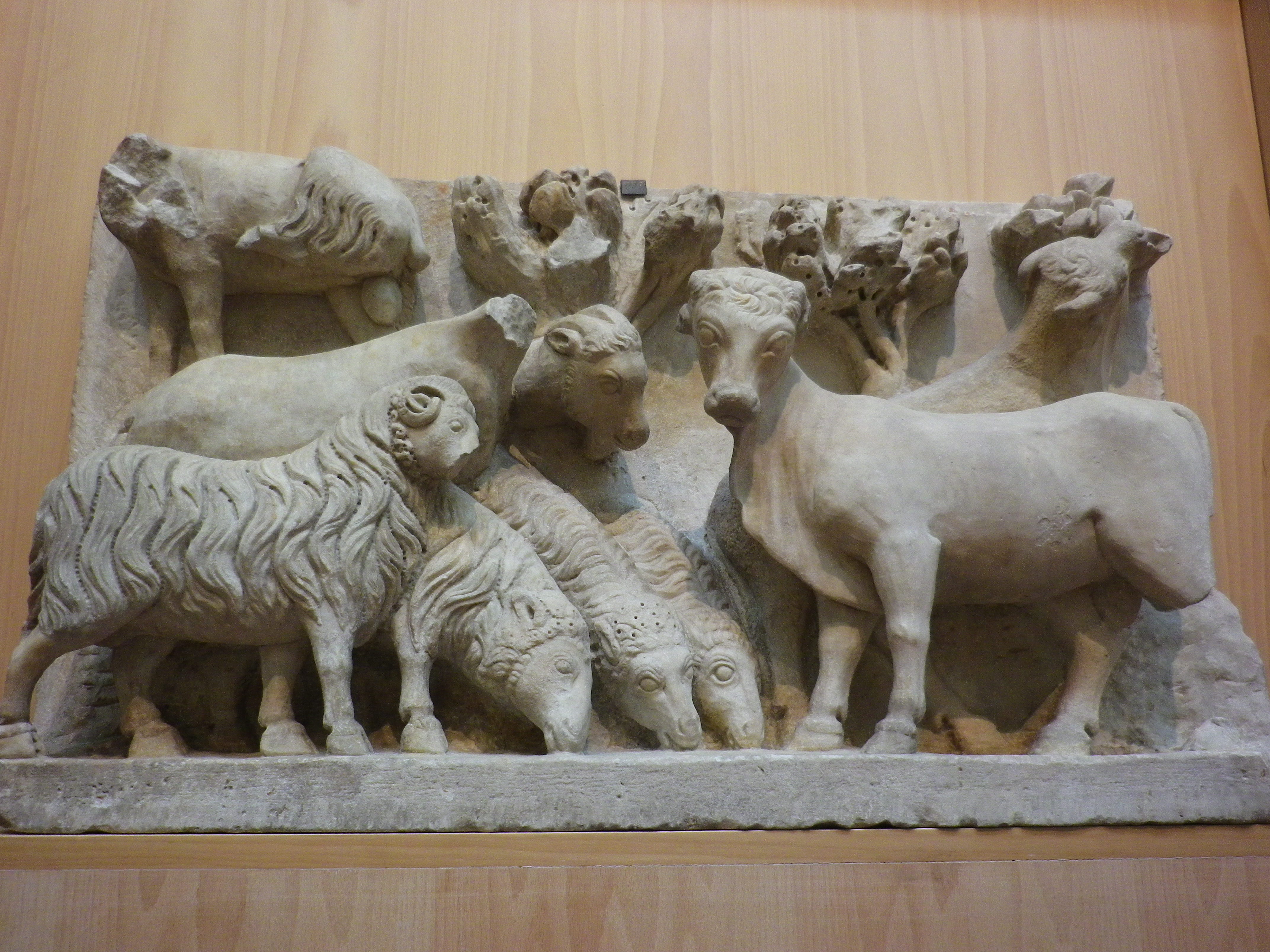
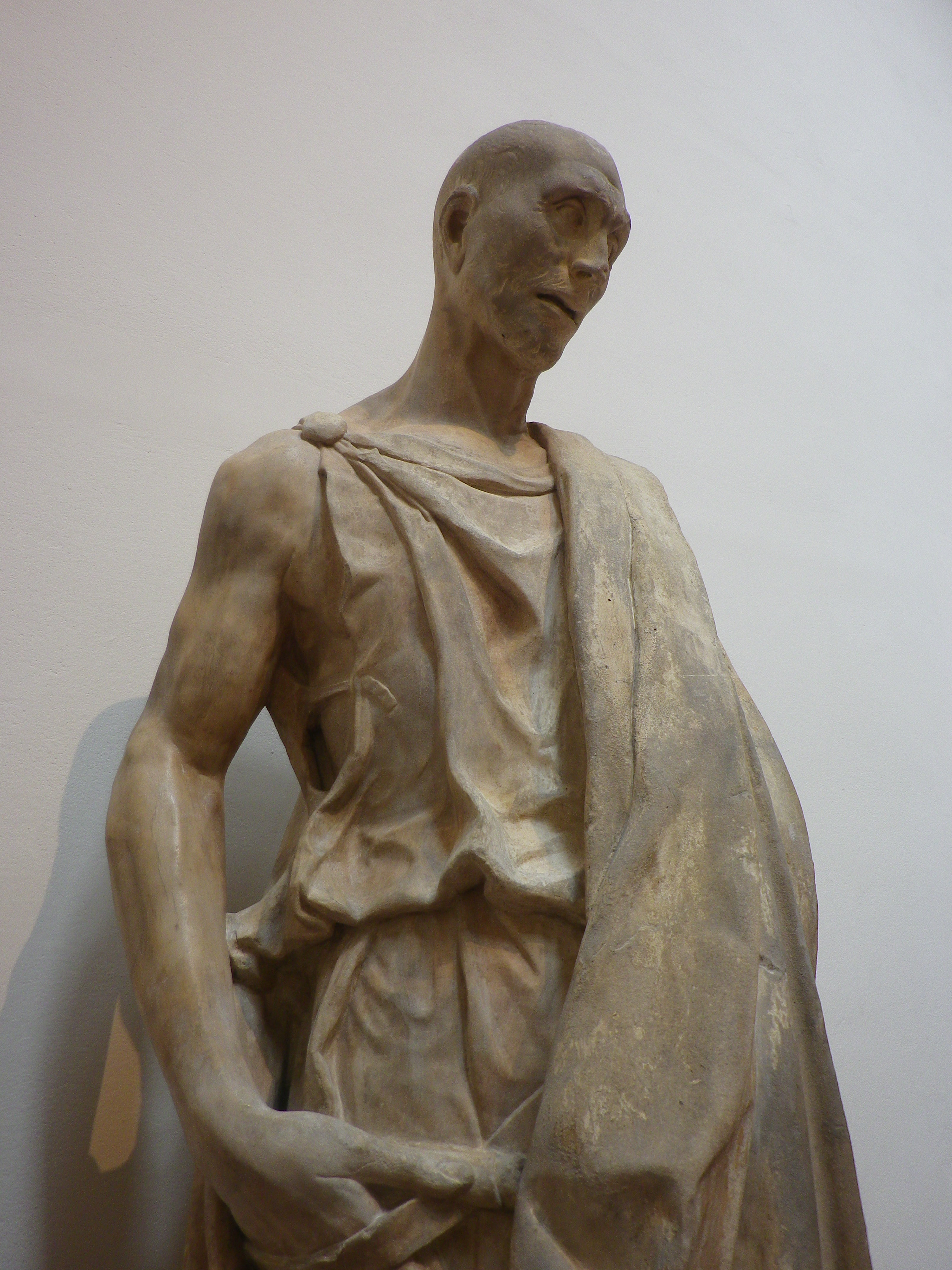
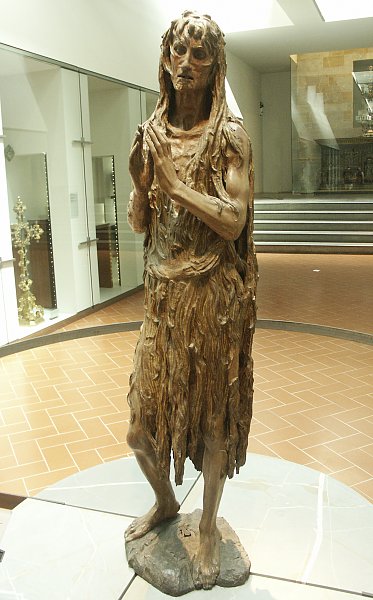
On to the Museum of the Duomo, filled with amazing sculptures.  We both liked this pastoral scene.On an entirely different note, Donatello’s Habakkuk, an Old Testament prophet.The starkness of this sculpture prepared me for his masterpiece (in my opinion), Mary Magdalene.  I didn’t take a picture of it, but other people did.Her face is haunting.

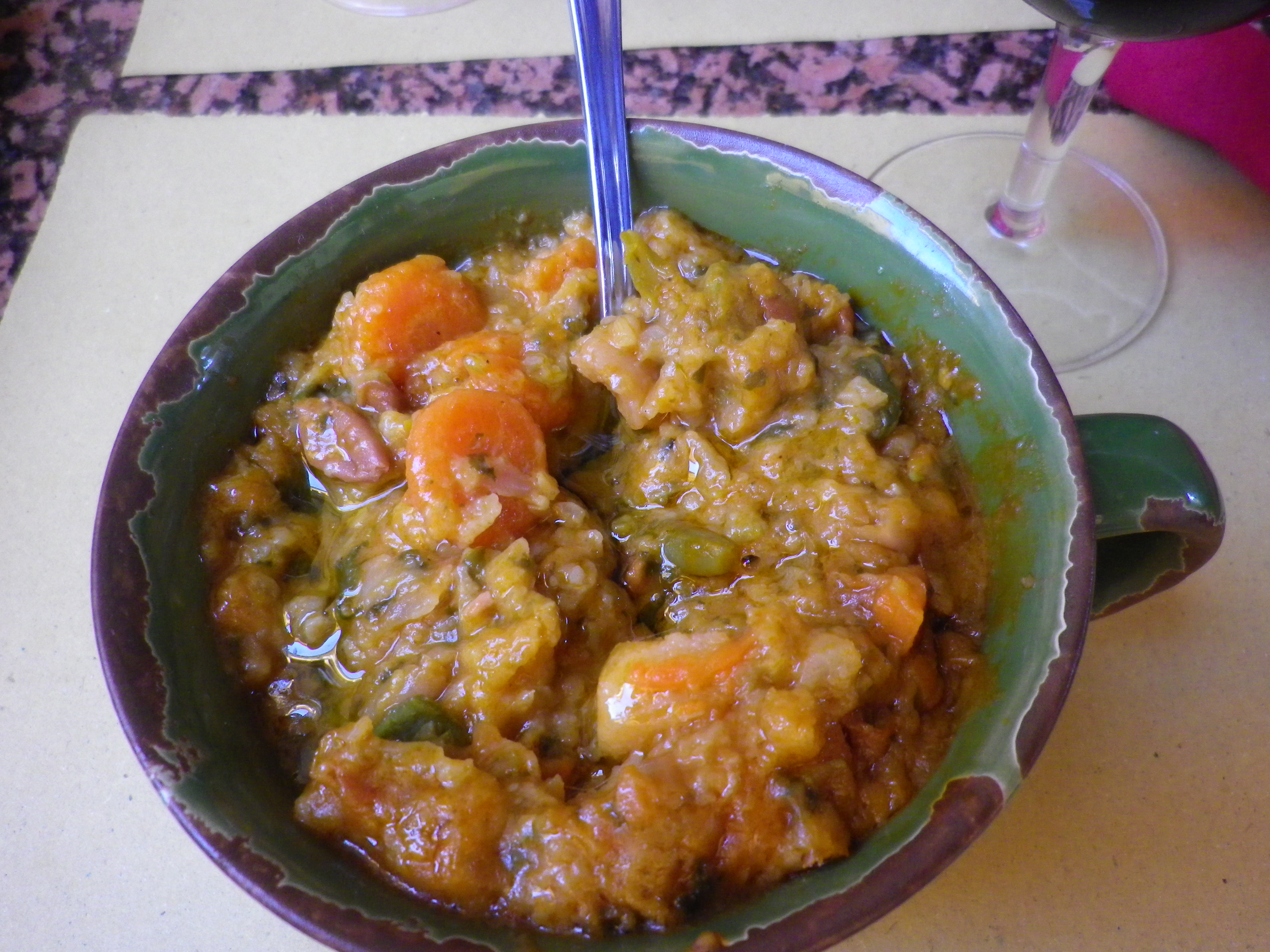
One more stop, this time at the Baptistery.  Also fairly empty, but gorgeously decorated.  It’s really all about the doors, but I was taken with the mosaic ceiling that tells the story of Jesus, among many others, and includes a terrific Last Judgment scene with a famously horned devil.The doors were usually thronged with tourists, but we did get close up one evening.  Here is Moses receiving the tablets, with angels rejoicing.  This is from the door by Pisano.Time for a rest!  We headed to the Piazza della Repubblica, where we sat down at one of the touristy restaurants right on the piazza.  The waiter was charming, looking out for his “two ladies.”  Corny, but who cares.  We had ribolitta (bread soup) and a glass of wine and shared a pizza with funghi and prosciutto.  Yum.But we weren’t done yet…read on.

Bells

We heard morning church bells in both Florence and Siena, but in Florence they were right outside our windows.  Here’s our Florence view from the Residenza Giotto.

You can just about see the bells in the big window at the top of the campanile.  They rang at 7:00, 7:30 and 7:45, and Giorgio told Alison they were supposed to wake up the city and send them to mass.

You’d think that having these bells ring right outside your window every morning would be awful, but it was wonderful.  The bells were very gentle.  Take a listen.

Now, why isn’t my alarm clock as pleasant on a dark weekday morning??


It’s still a garden blog

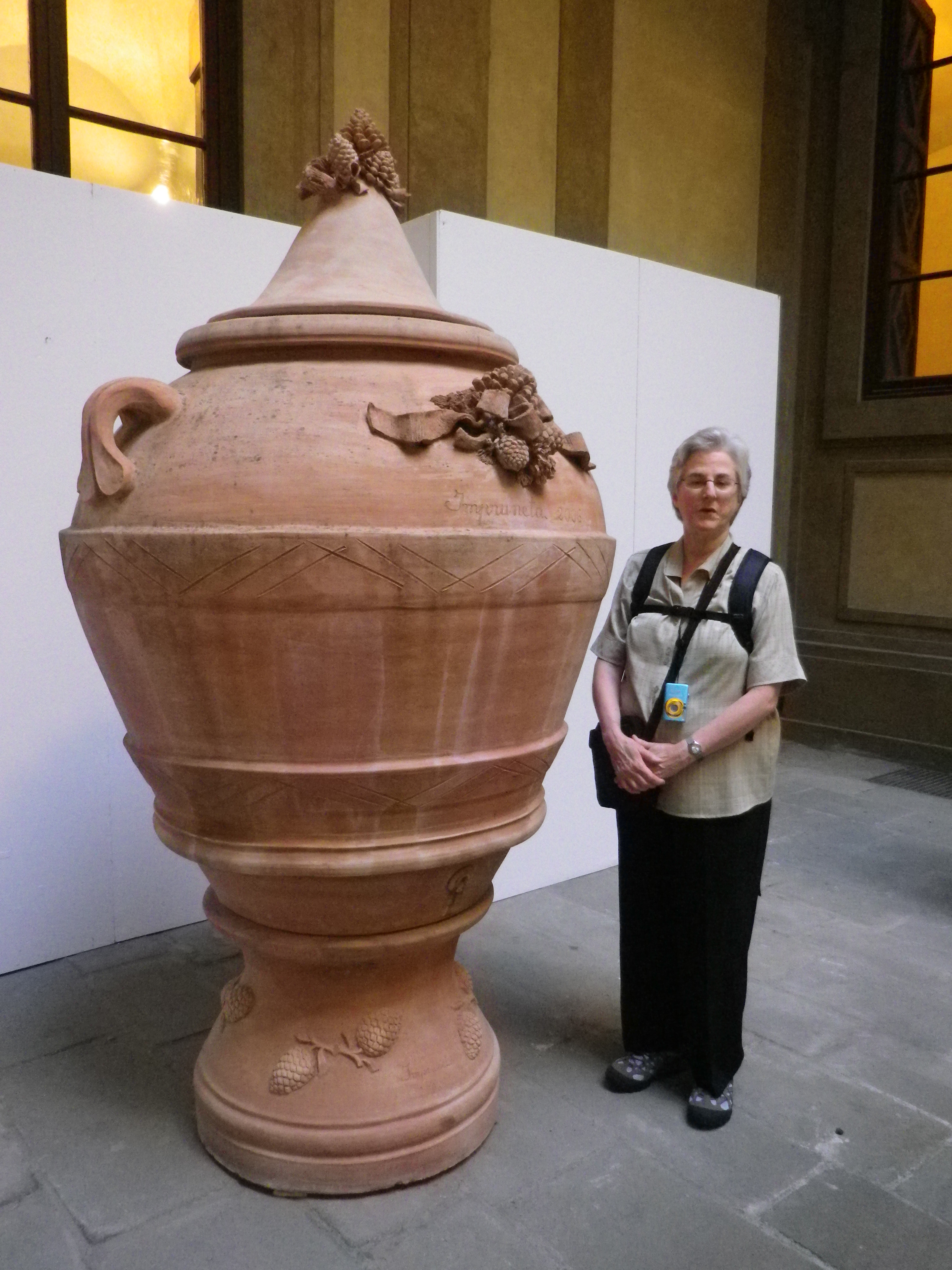
Most of the time, anyway… Although we didn’t visit any gardens, not even the Boboli in Florence (lack of time and energy, sadly), we saw lots and lots of container gardens everywhere we went.  Let’s start with a huge pot from Impruneta, this one found in a courtyard at the Palazzo Riccardo-Medici in Florence. Okay, not a container garden, but it sets the tone for classic terracotta pots.

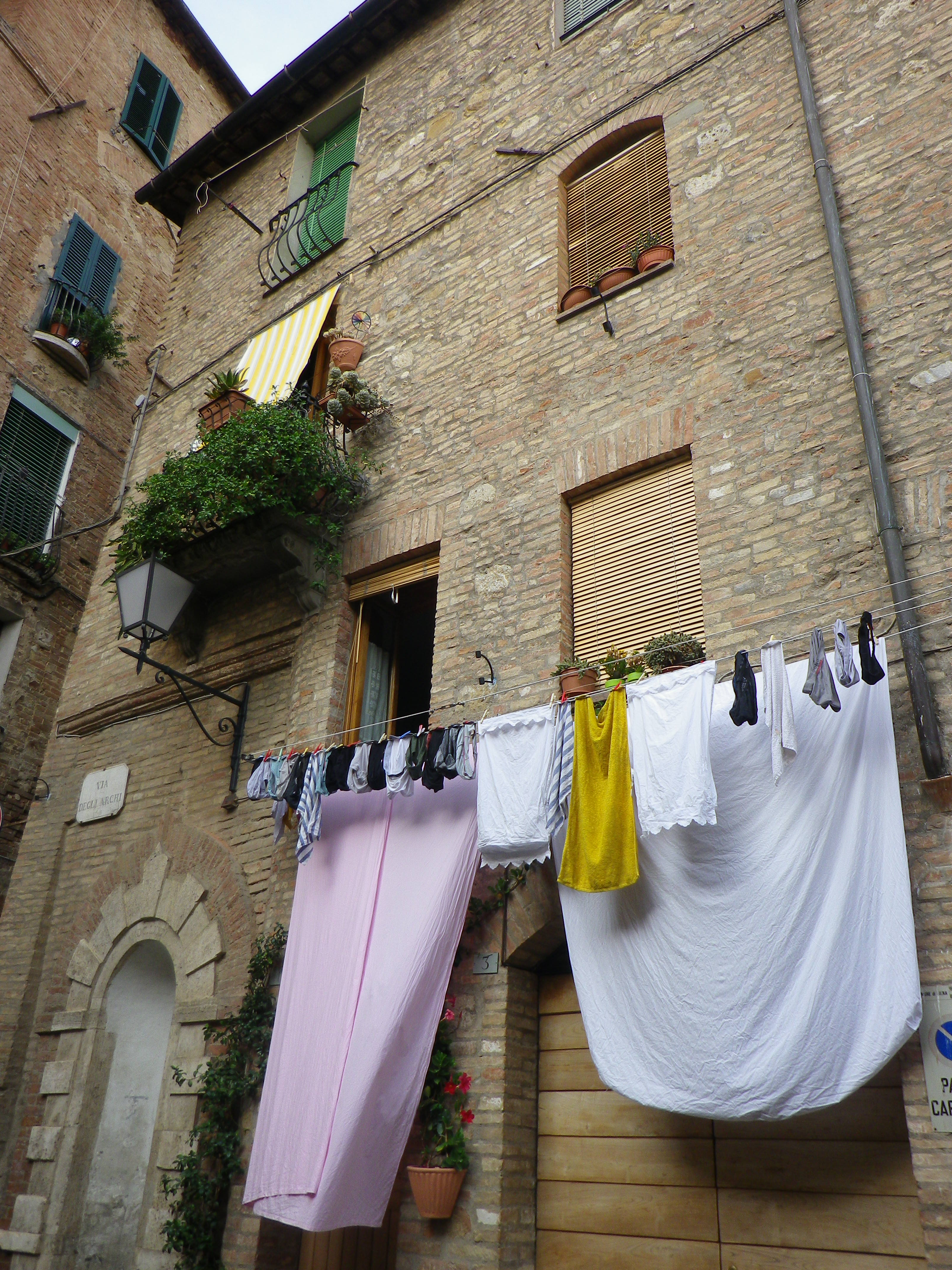
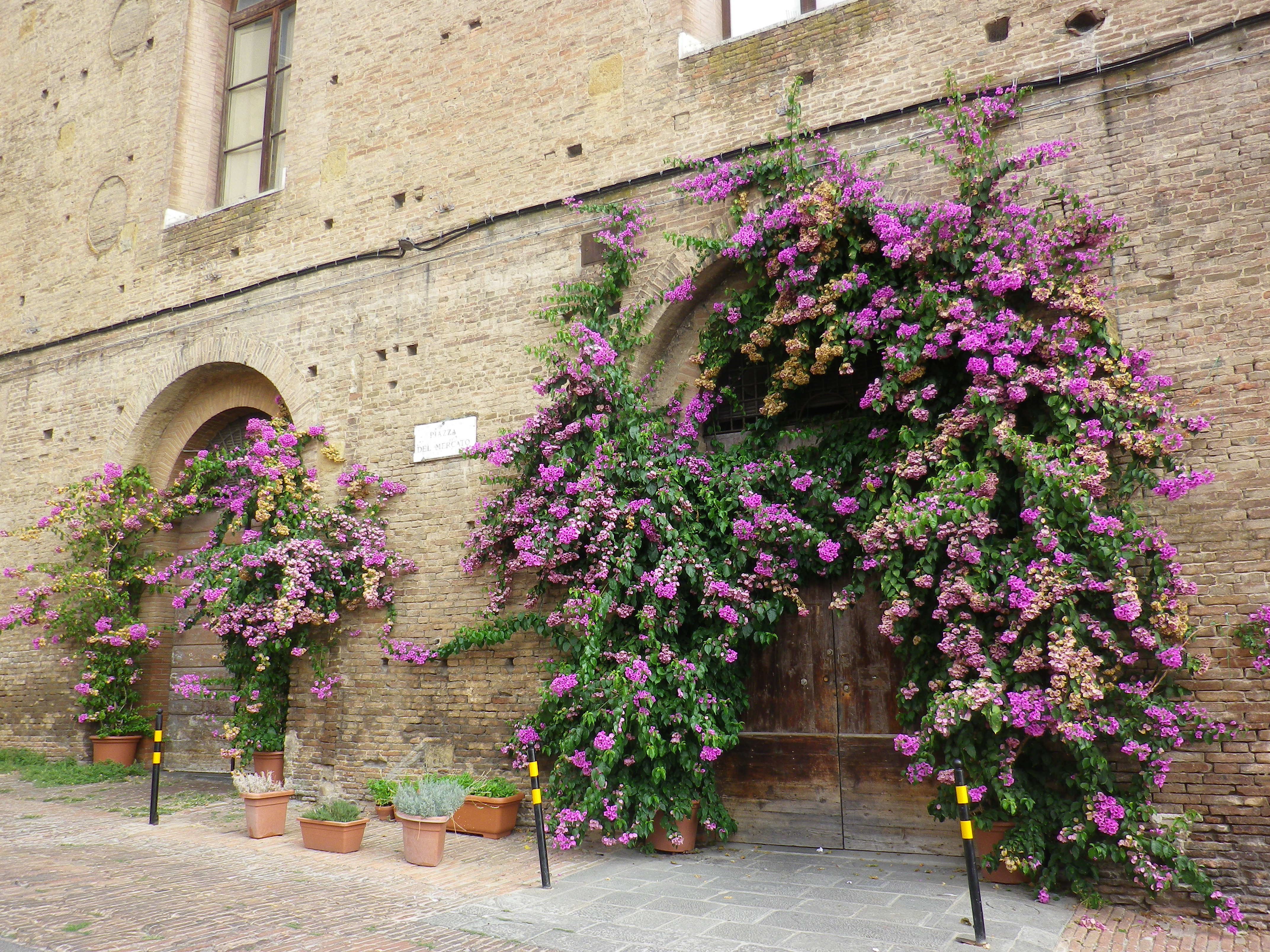
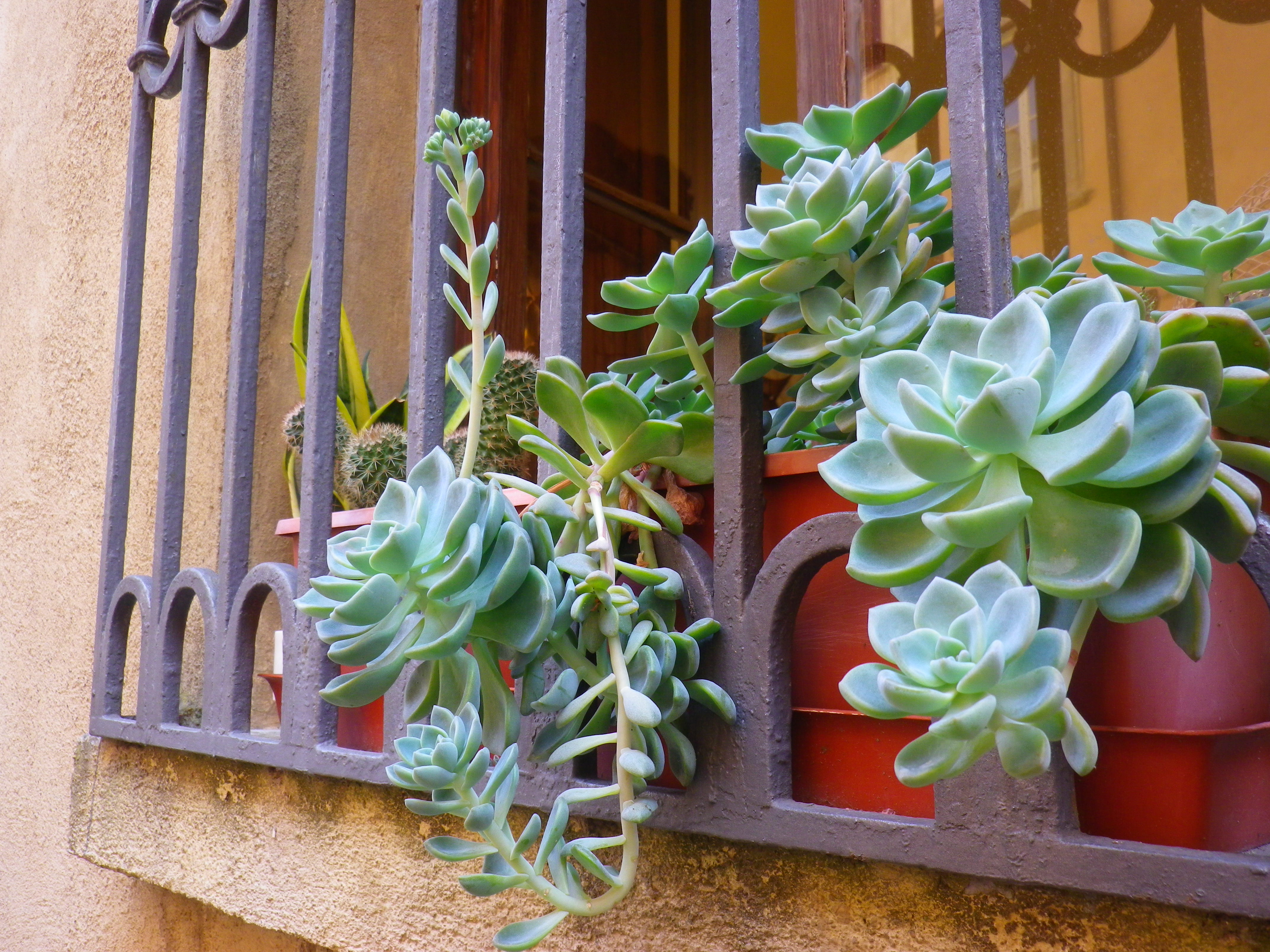
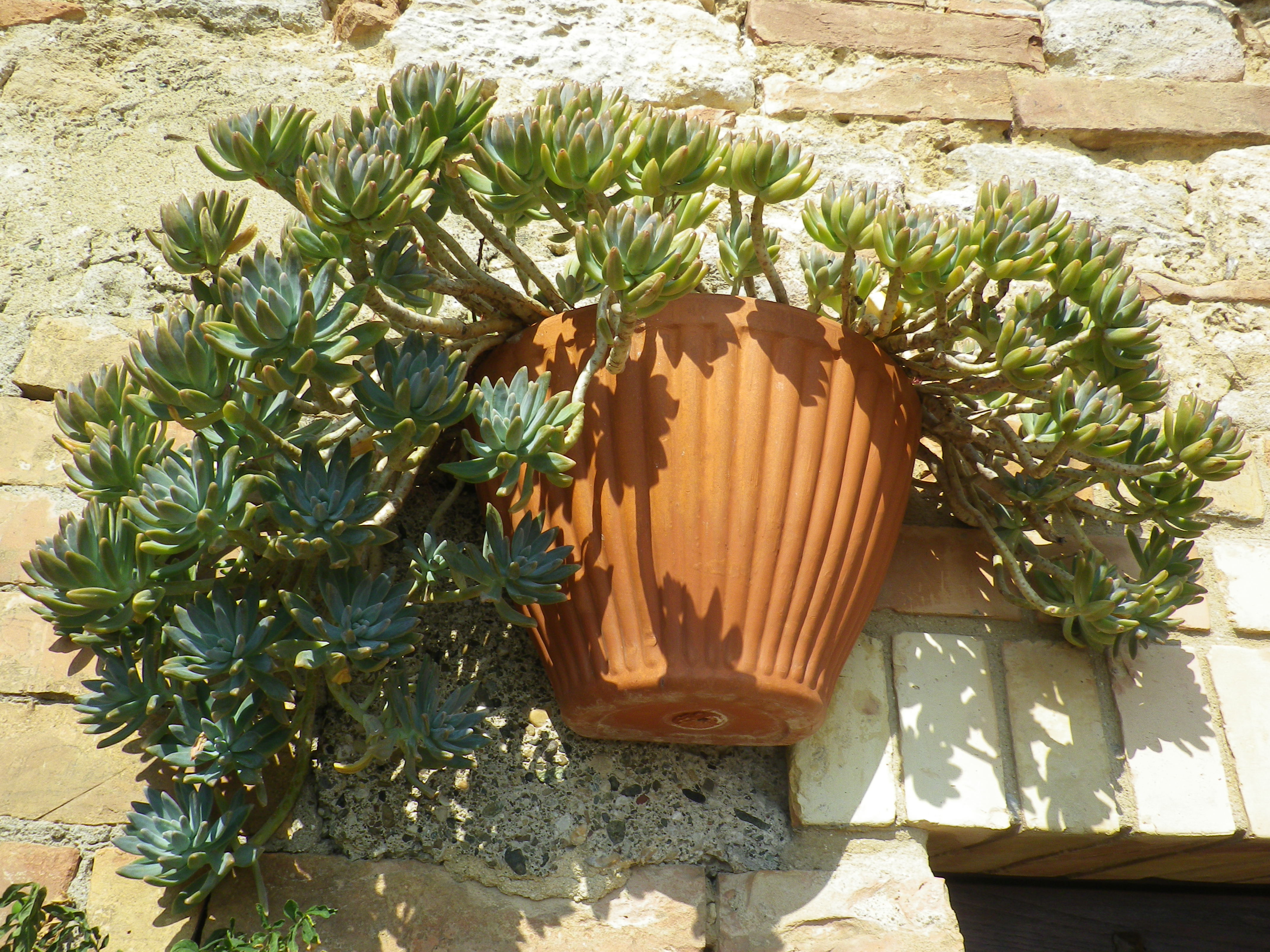
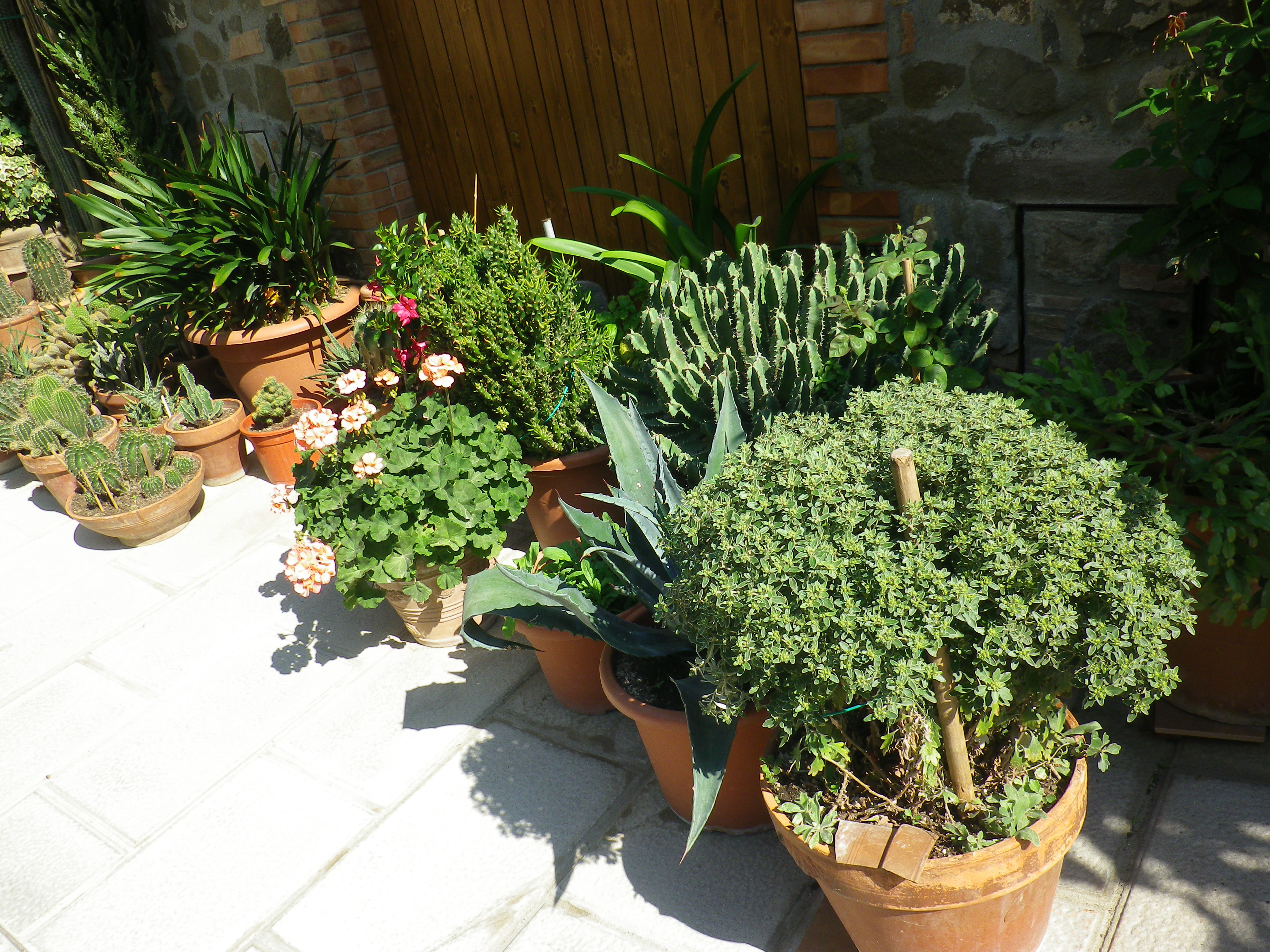
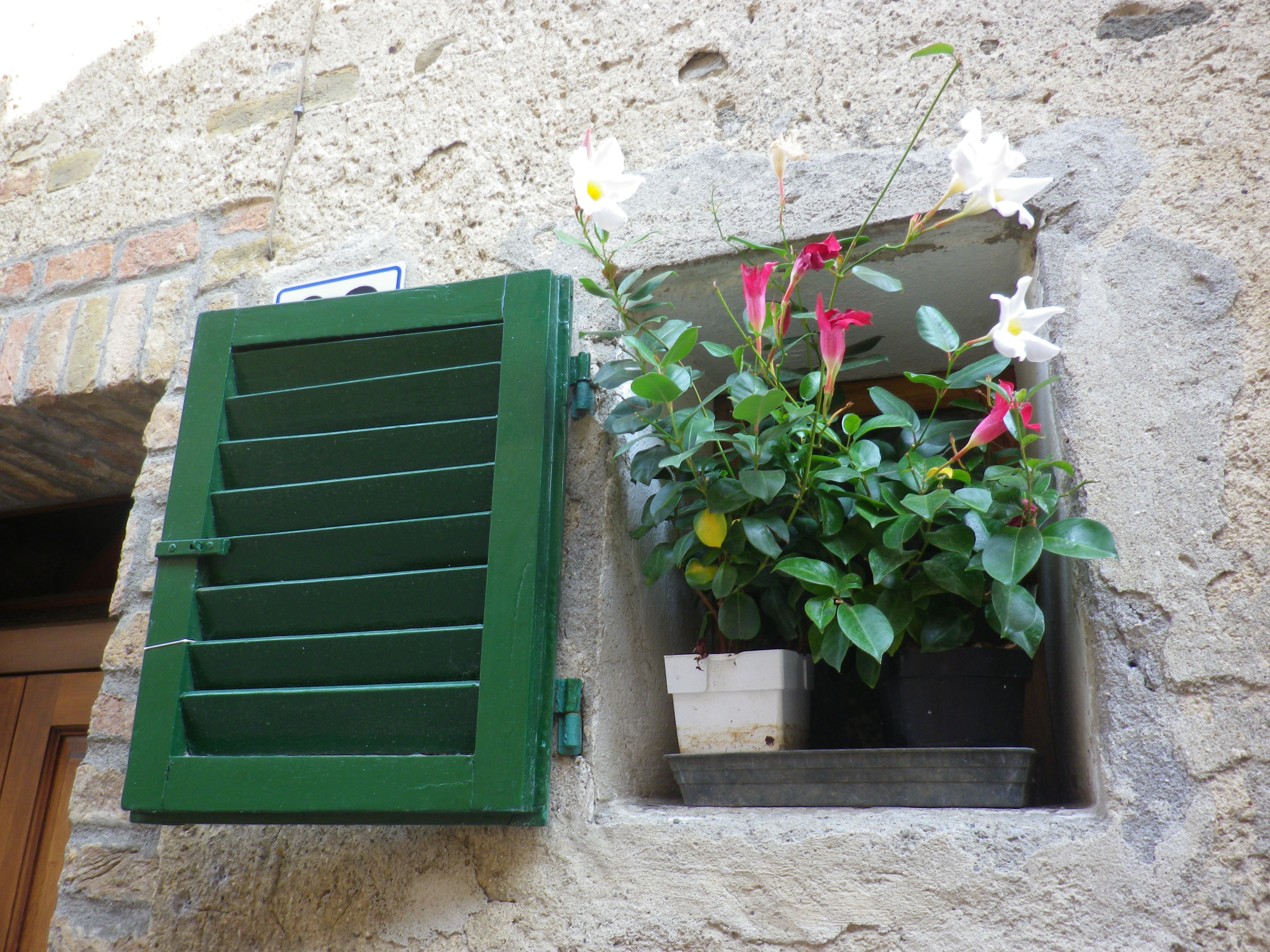
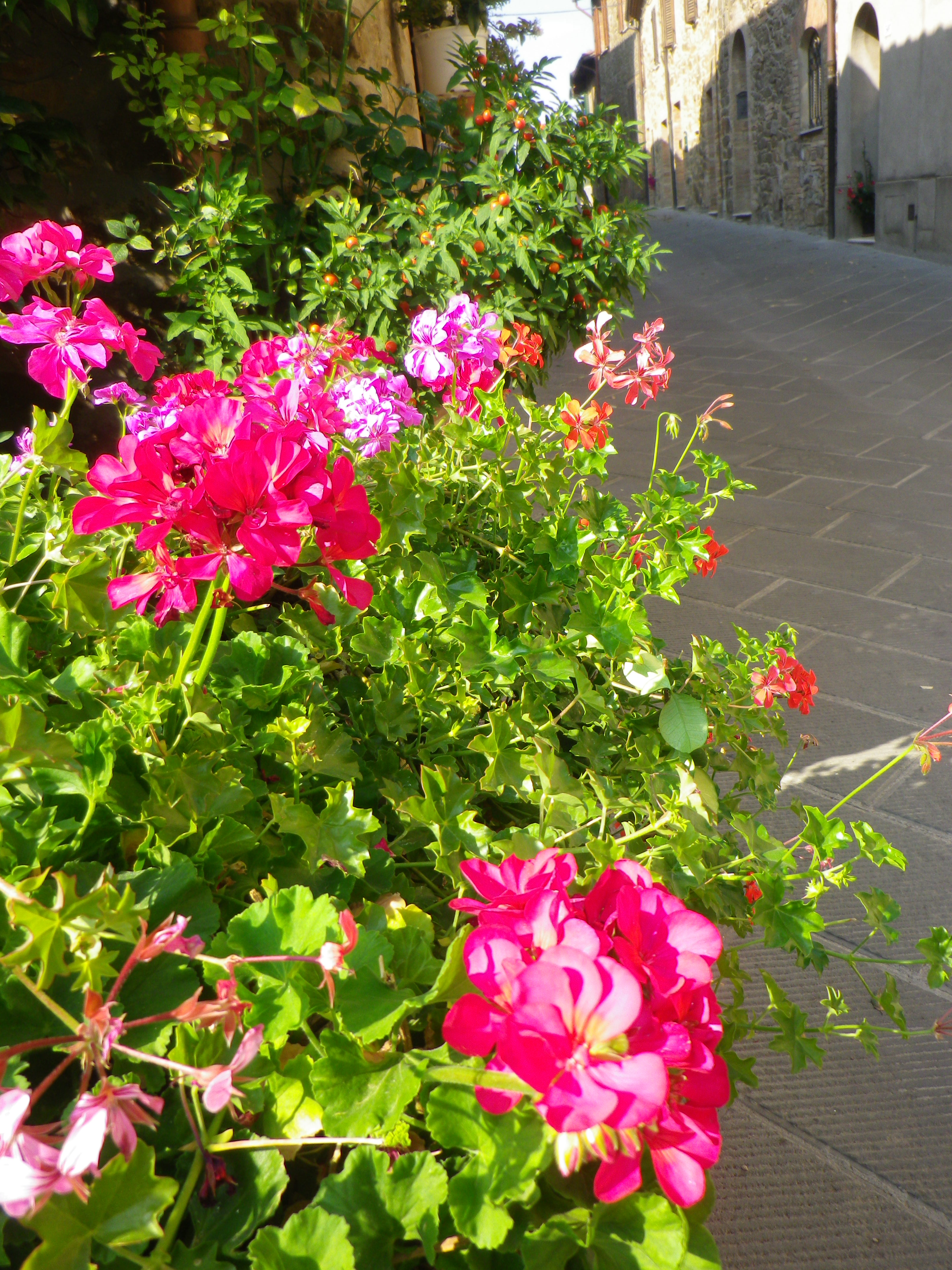
Here’s a typical balcony planting.  You can see the cactus as well as the laundry drying.  This is a plant I should know, clearly Mediterranean, but I’m blanking.  The most amazing thing is that, as far as I can tell, it’s planted in two terracotta pots, one on either side of the doorway.Bougainvillea??  Here’s a closeup.  The flowers have almost a papery quality.Lots of succulents, as you might imagine in this Mediterranean climate.  Here is a window pot in Volterra,and another one.  This array of xeri-plants including cactus and yucca was outside a house in Montalcino on our way into the main piazza.  Below is mandevilla in a windowsill.They also had some beautiful geraniums.  I know, you don’t usually think of geraniums as beautiful, but in this case they are perfectly proportioned and fit the color scheme of the shutters just right.  I like this shot of sprawling ivy geraniums against the view of a narrow street in Montalcino.

This picture was taken from the bus coming back into Florence on our last day.  I’m not sure how the gardener waters these plants — does she crawl through that tiny little shuttered window, or does the low wall really hide an inset terrace? 

The Etruscans and their museums

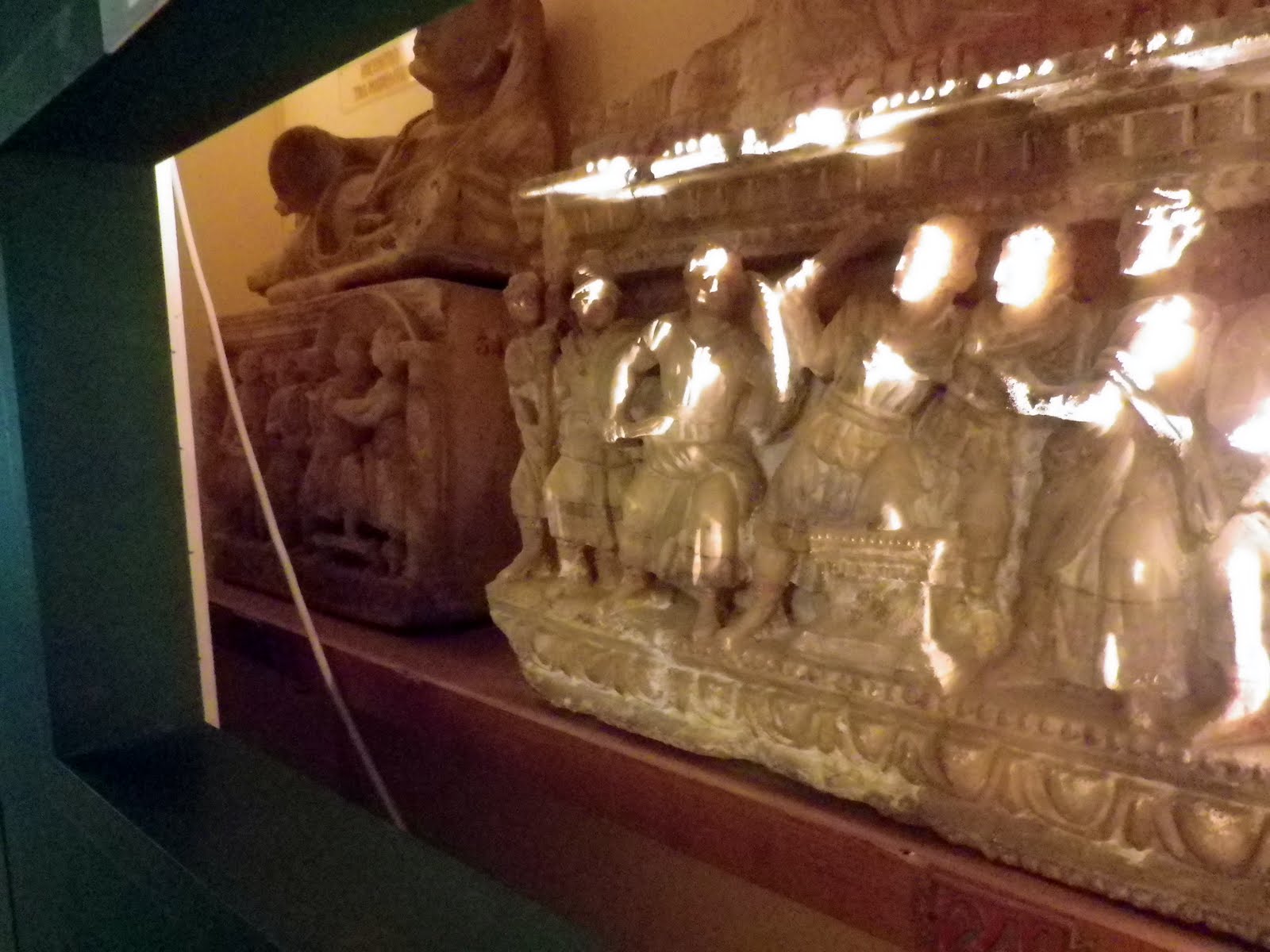
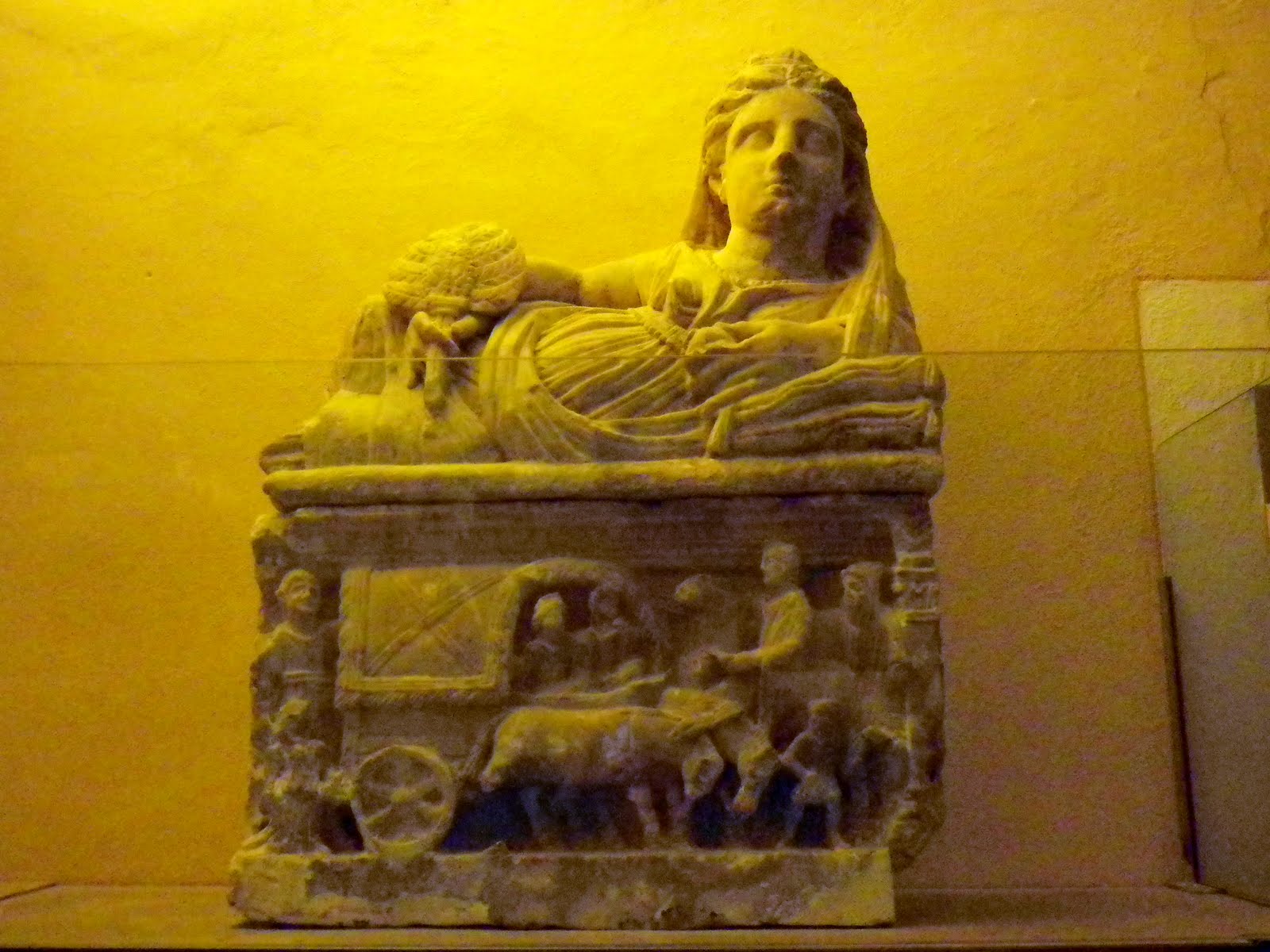
This part of Italy was settled by the Etruscans, or the mysterious Etruscans, as they were better known.  They liked food and drink, and to prove it they left behind funerary urns decorated with what look like real people, portrayed lounging on couches as they eat and drink.  They also made tiny animal statuettes and alabaster vases, especially in Volterra, which is known for its alabaster.  Their language has yet to be completely deciphered.  After a thousand years of prosperity in Tuscany, they were defeated by the Romans.

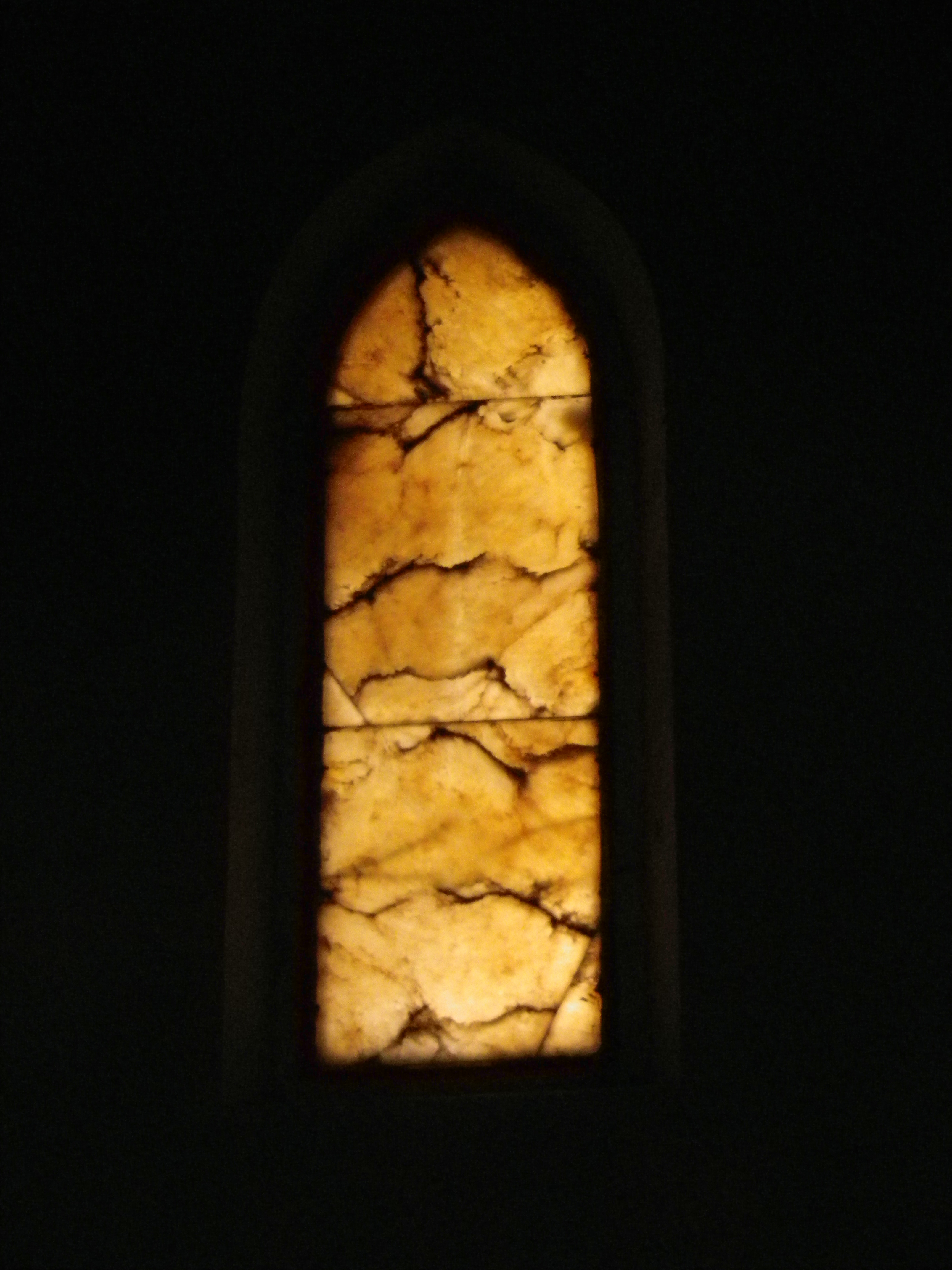
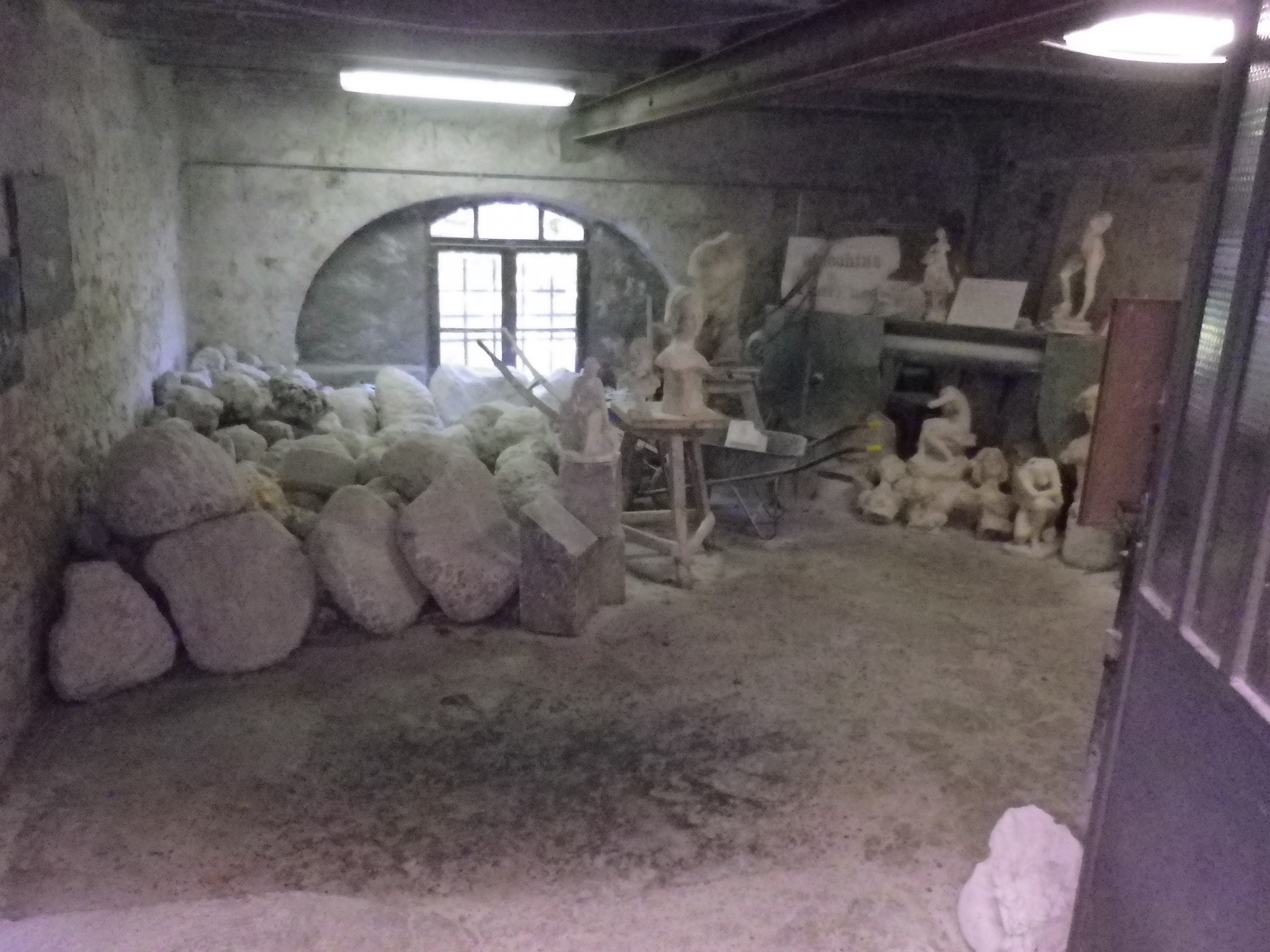
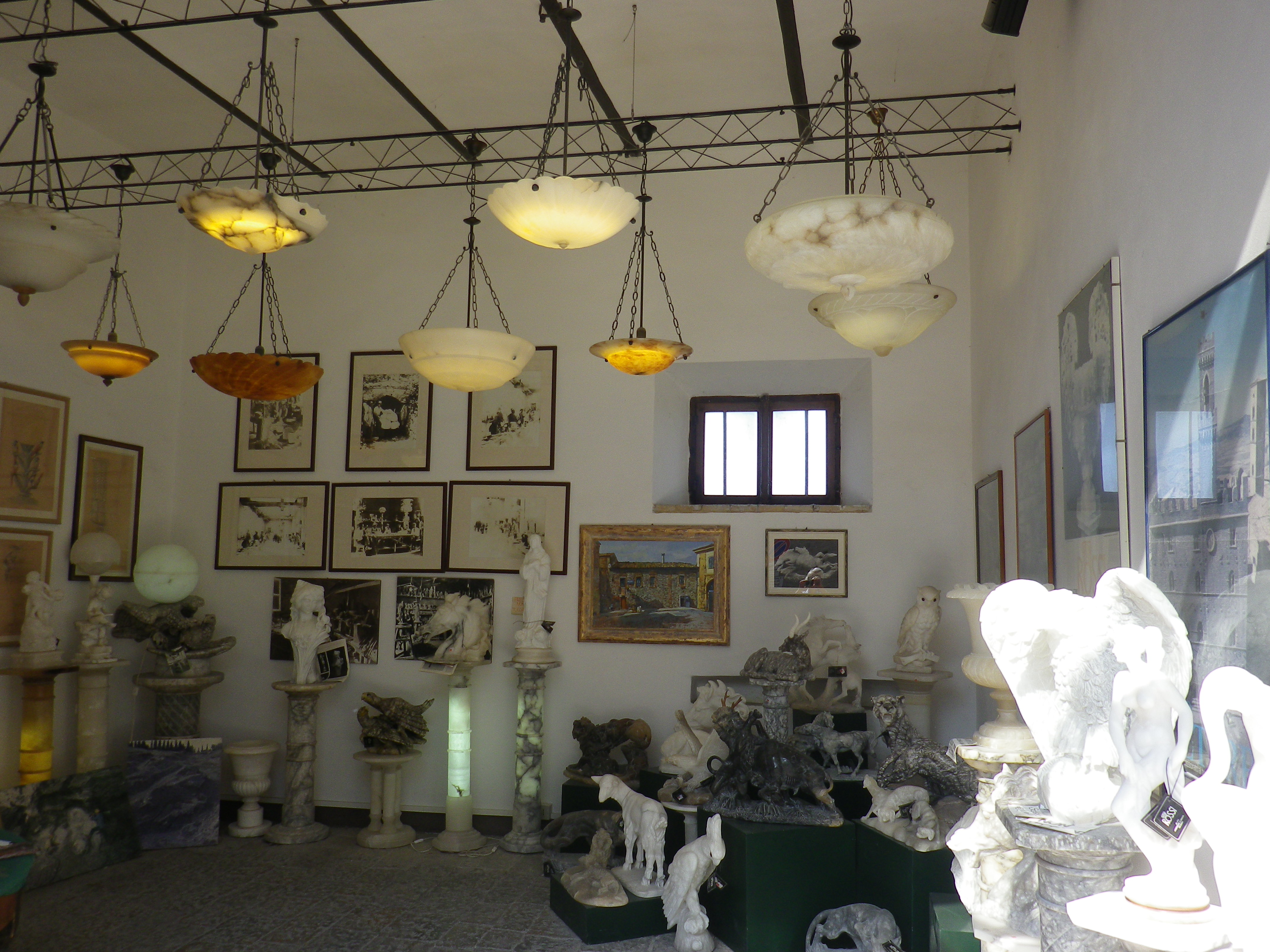
A side note on alabaster:  the windows in Volterra’s cathedral are made of alabaster, letting through a milky, soft light.  We visited an alabaster shop with attached workshop.  As you can see, everything was covered with a fine, talc-like dust.  The shop had some beautiful lamps and vases, but the message here was, buy something large, gorgeous and light-filled, or just pass it by. 

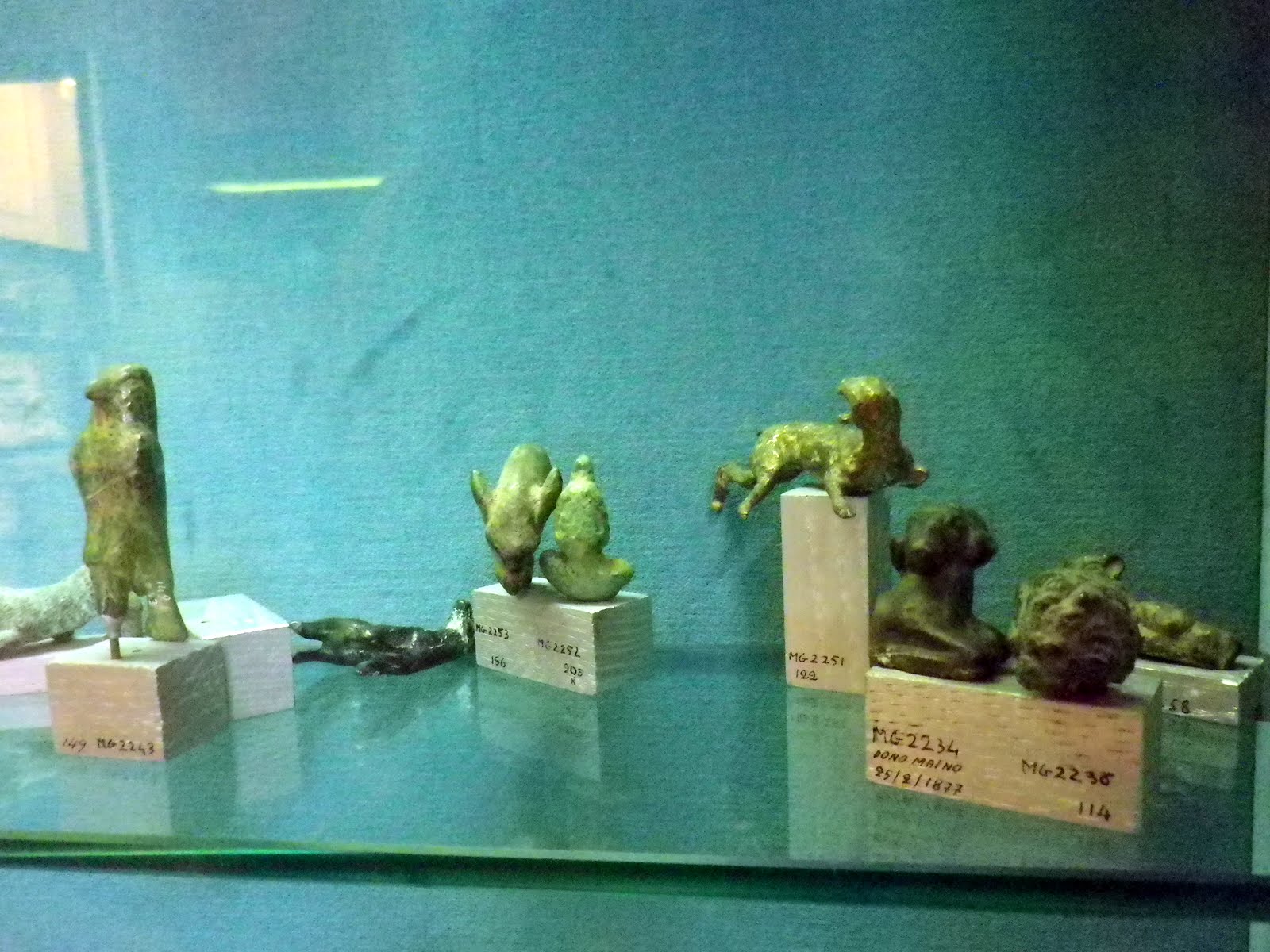
Back to the Etruscans.  Volterra is known for its Etruscan Museum, founded in the 18th century by an abbot who was fascinated by their civilzation, and touted as the third greatest collection after the Louvre and London’s National Gallery.  Well, they certainly had lots of things.  Here are lots and lots of alabaster vases.  And here are lots and lots of terra cotta vases.  There were lots and lots of everything, in fact.  This museum may have had a great collection, but it was exhibited without much art.  Here are some little animals – look closely and you’ll see that one of them has fallen over.  How long ago?  Some of the object were quite oddly displayed.  Here were two funerary urns placed behind a rectangular hole in the wall.  If you peered inside, you could see the second one, but otherwise not.  What was that all about?  Still, there were some objects that really gave a sense of the culture. The funerary urns with their all too human statuary were very appealing.  Best of all was the famous Shadow of Night statuette.  Since there is currently an exhibit in Paris called “Giacometti and the Etruscans,” this was on loan and we were actually looking at a copy.  Oh, well, it was still quite wonderful and clearly must have influenced Giacometti, who saw it here in the 1960s.

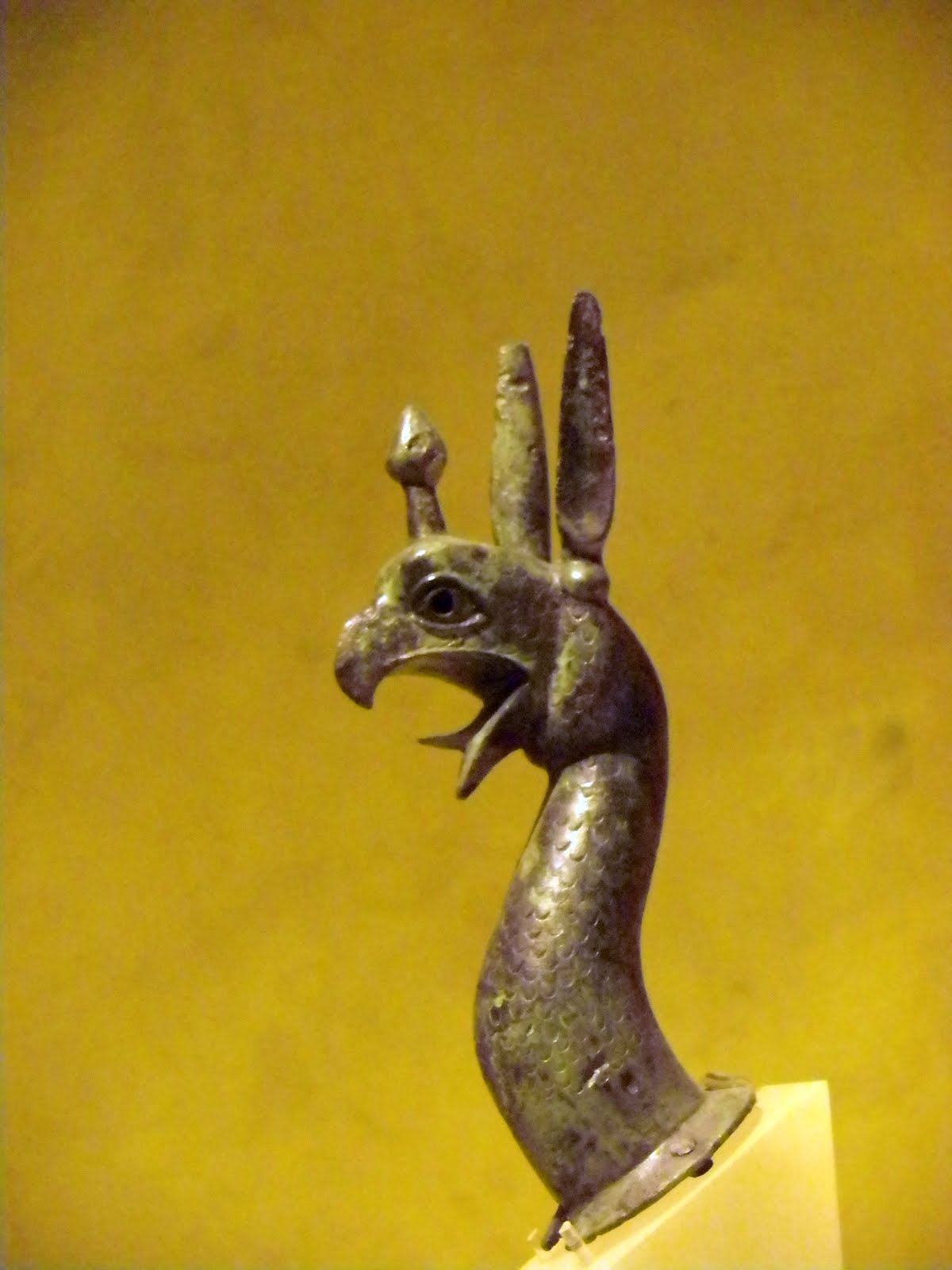
Cortona has an Etruscan museum, too, not quite so extensive but much more creatively displayed.  Here are some metal pot decorations that caught our eyes.  One odd thing about these museums and most others in Italy:  once you come to the end, the only way you can leave is by retracing your steps back to the entrance. Hmmm.

Hill towns

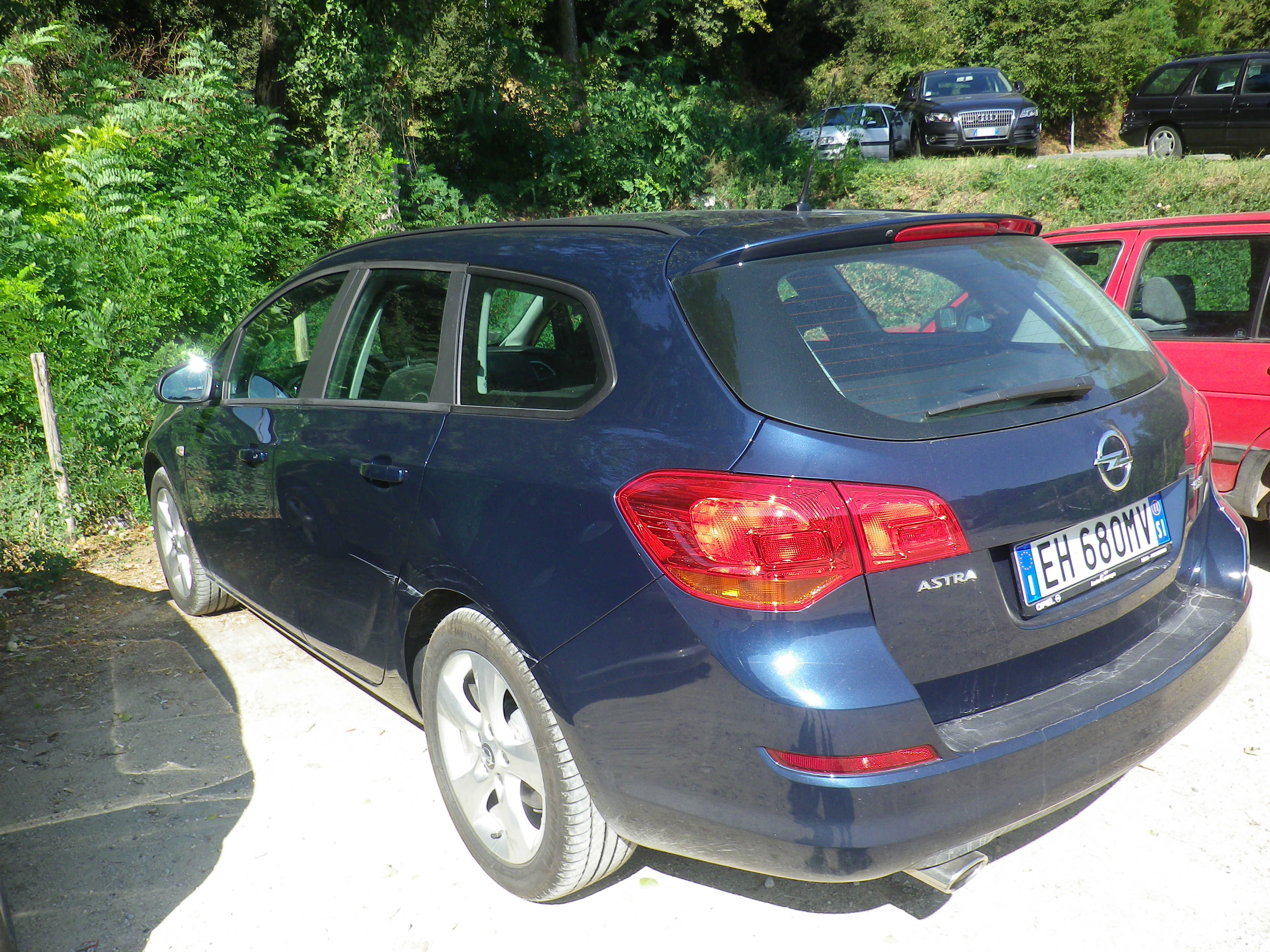
On Monday, we picked up our car, an automatic because of the HILL towns we were planning to visit.  A bit molto grosso, but that’s what you get when you ask for the exotic automatic transmission in Europe, and it served us quite well.  (We had to take its picture so we could find it again in the parking lot.)We were equipped with an atlas of Tuscany, a map of Siena from the B&B, another map of Siena from the Avis office, and Alison’s map of Tuscany, plus some Google maps directions that I sent to Alison’s phone.  Even so, we found that the route numbers on the maps rarely matched the route numbers on the roads.  The best way to navigate was to determine the next town and look for signs.  We asked directions a few times, too, and people were quite helpful.  You need to know sinestra (left), destra (right) and diritto (straight ahead), and you’ll manage just fine.

Once we got out of town, always interesting in a foreign city, we were soon on a boring but safe divided highway and made our way to Volterra (Monday), Cortona (Tuesday) and Montalcino (Wednesday).  Since hill towns are all unique but all share the same elements, I’m combining them here.

First, the approach:

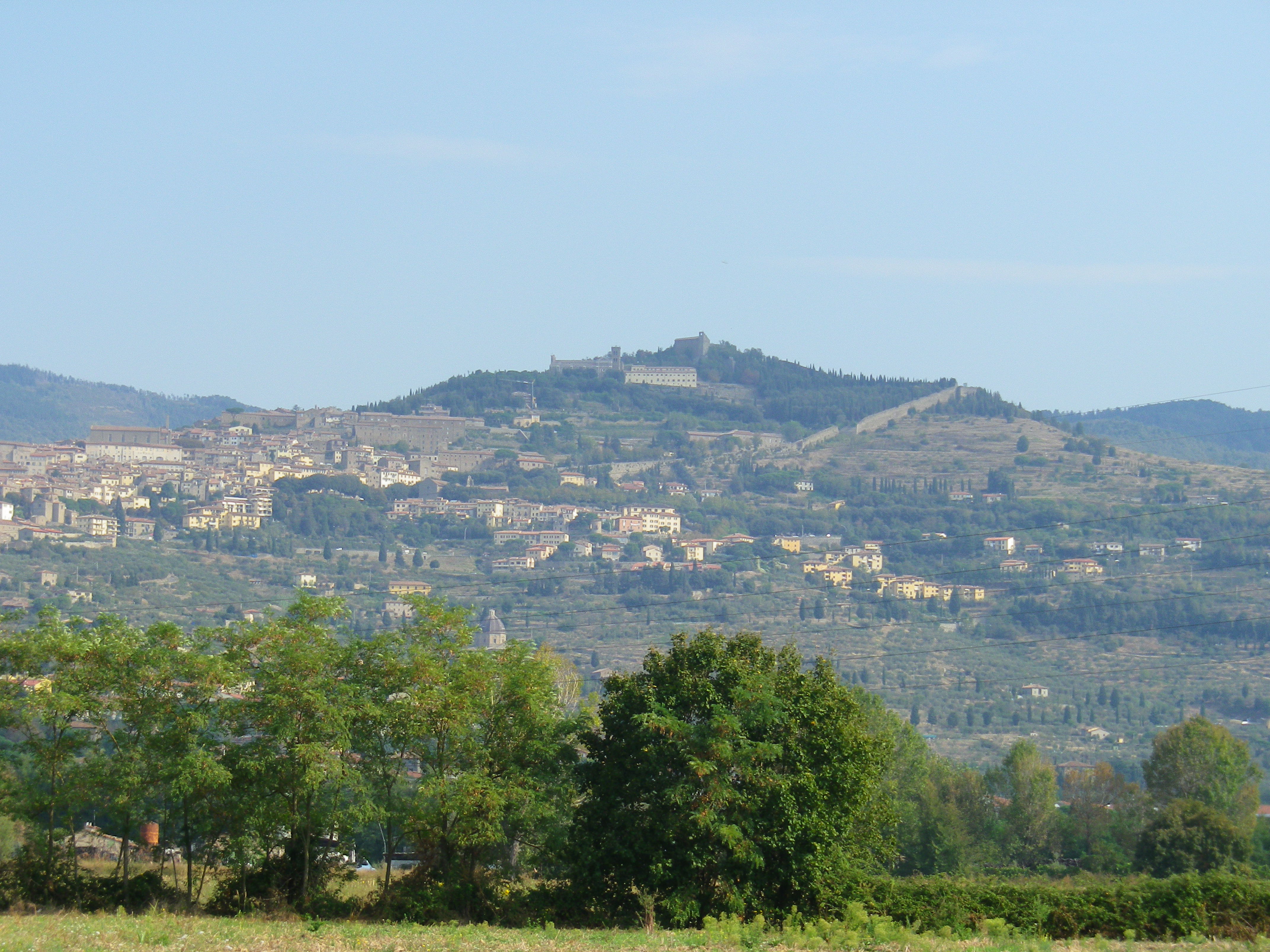
You wend your way along the valley floor, looking at the bare hills (did they just harvest sunflowers??), grapevines, and olive trees.  As you approach your destination, you see it looming ahead of you, like this view of Cortona.  You can see why the feuding Tuscans chose hills for their cities.
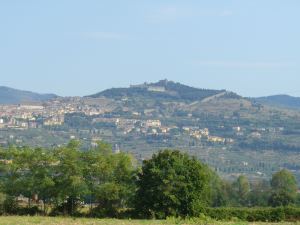
Then you navigate up hairpin turns, of which I have no pictures because it was all I could do to keep my hands on the wheel and avoid the cars barreling down the hills at a great rate of speed.  Some of the approaches were just a bit scary, but if you don’t look over the guard rail you don’t have to know that it’s a sheer drop to the valley floor.

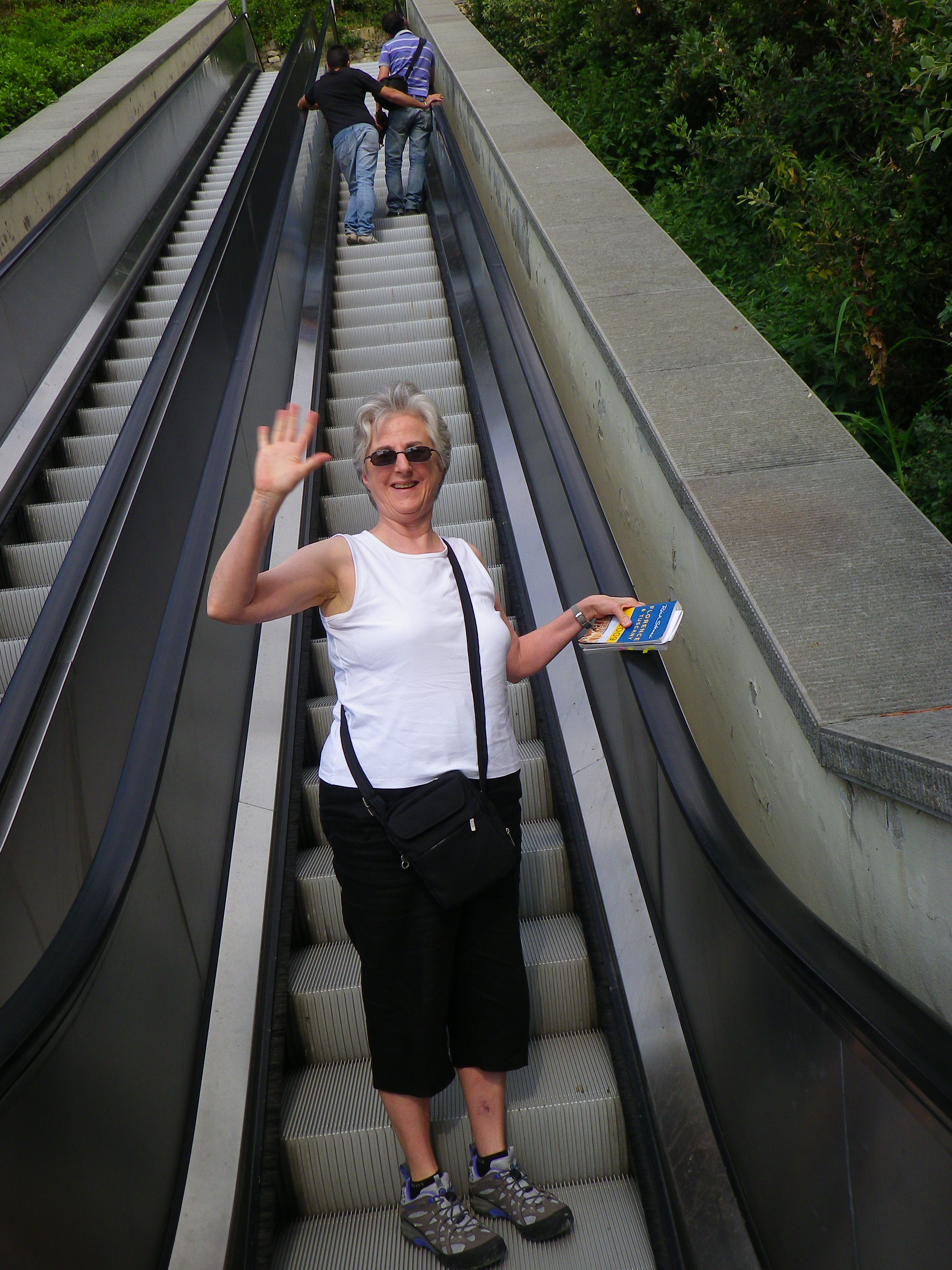
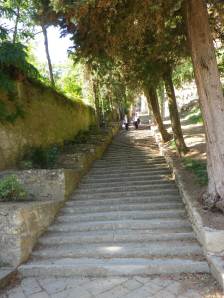
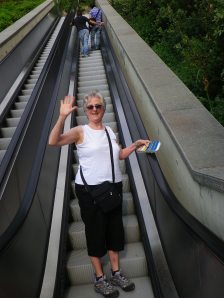
Next you find a parking place (easy) in a nearby lot and take another picture so you can remember where you parked.  Then you climb the steep stairs to the town itself.These were the 200 steps up the hill to Volterra.  On the other hand, if you visit Cortona, you can take the escalators!Much easier…
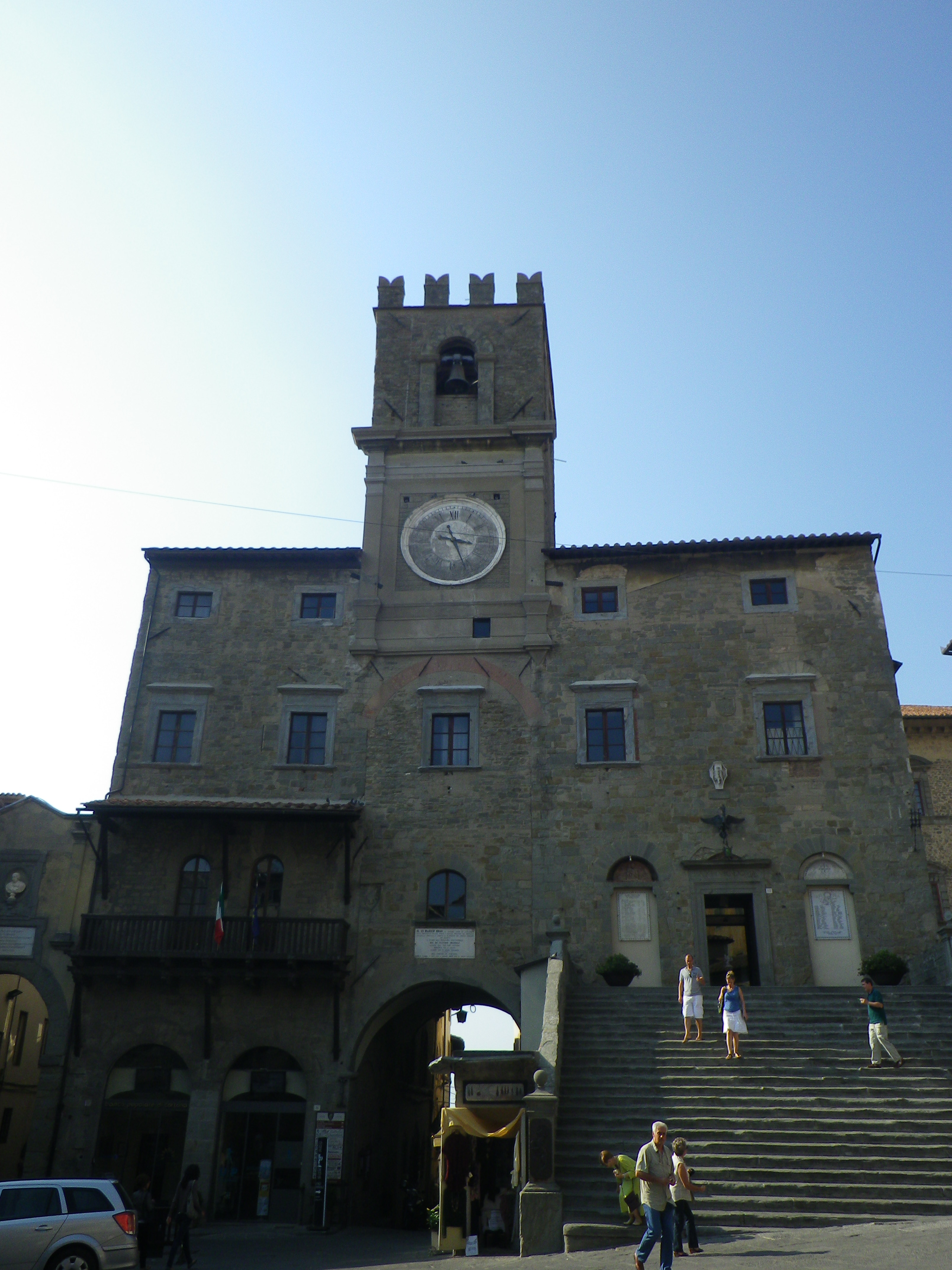
Then you find your way through the narrow streets to one of the several main piazzas in town.This is the Piazza Pubblico in Cortona, with its imposing town hall.  As in Siena, these often include a civic museum.

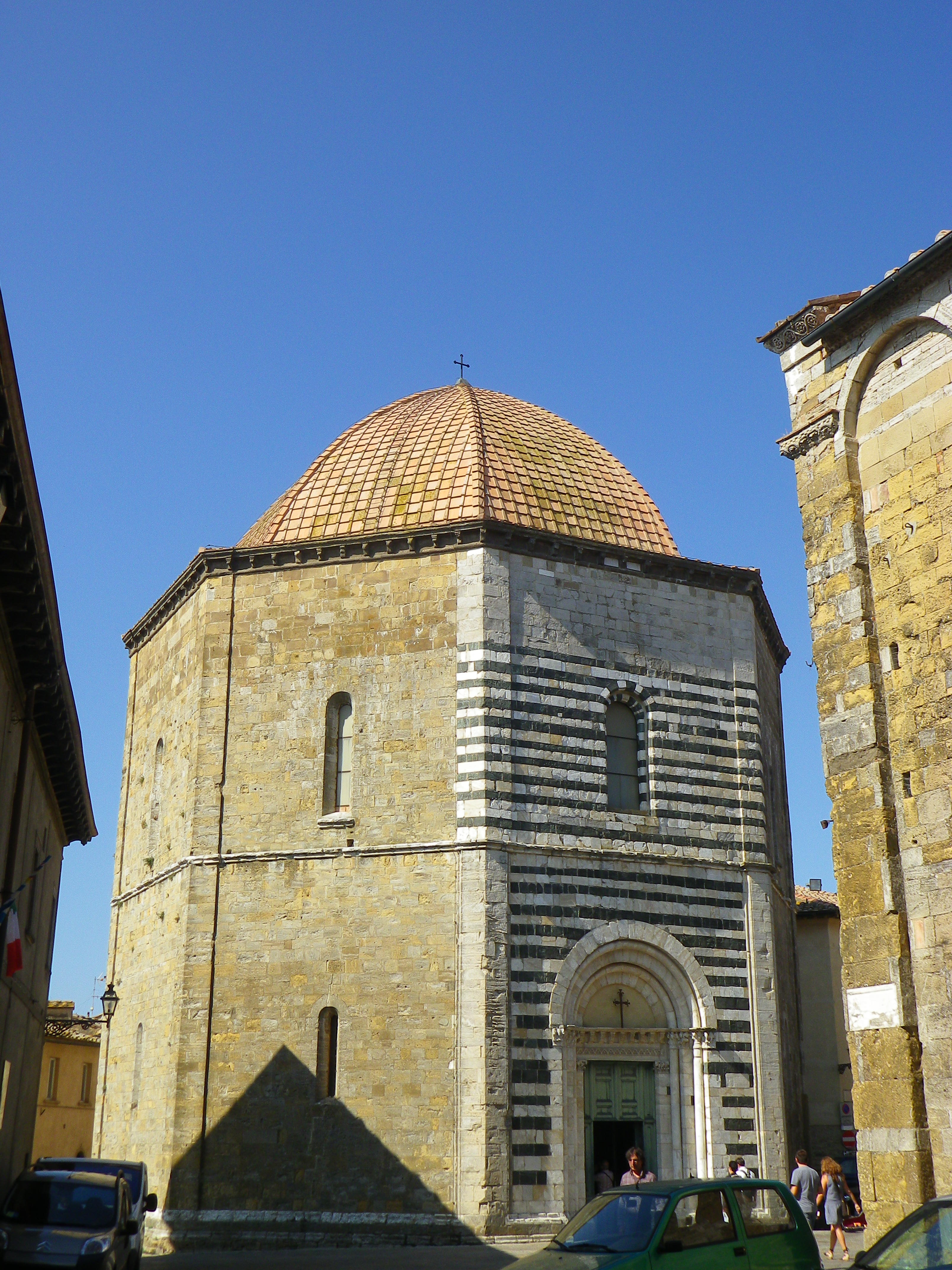
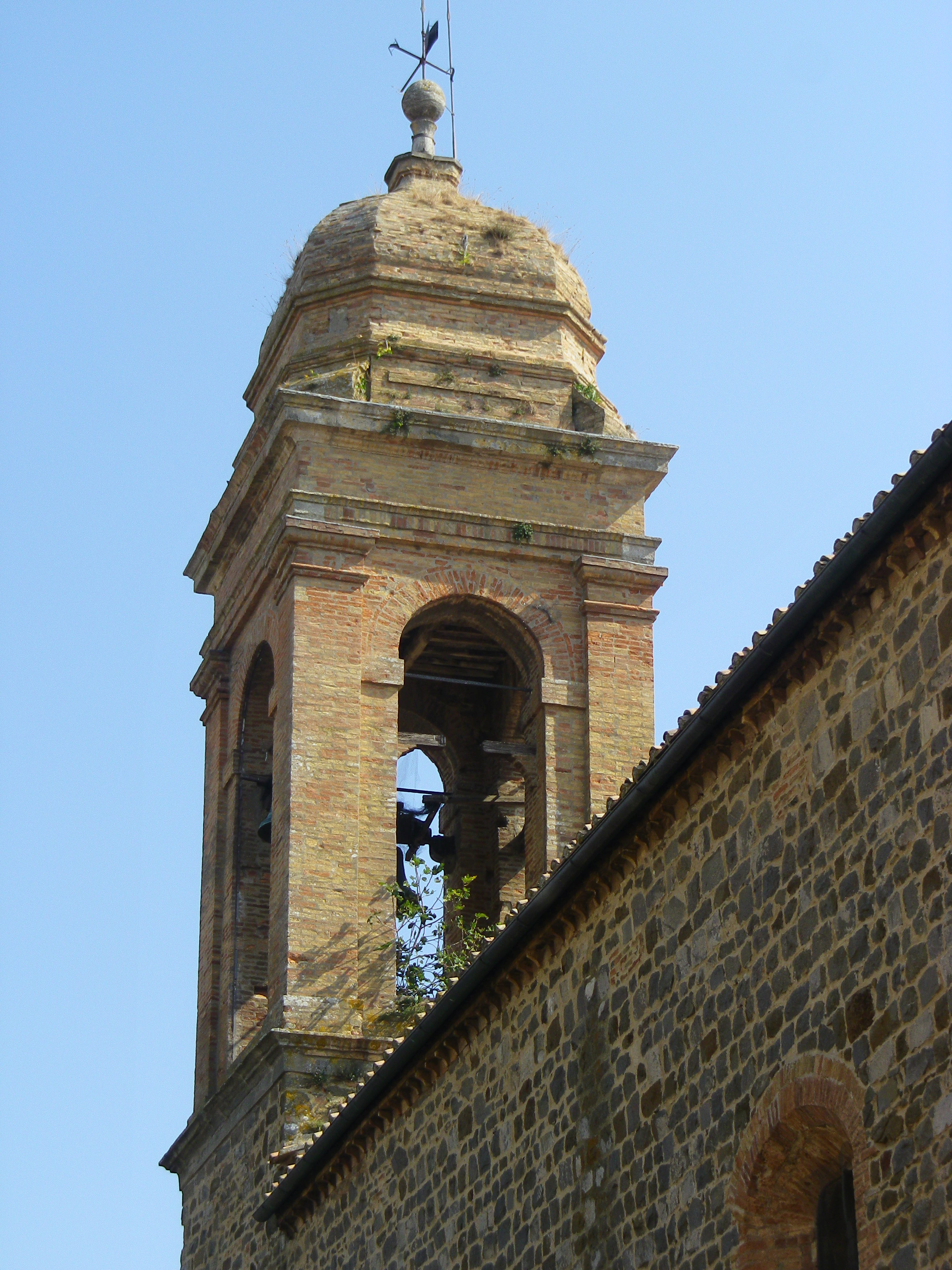
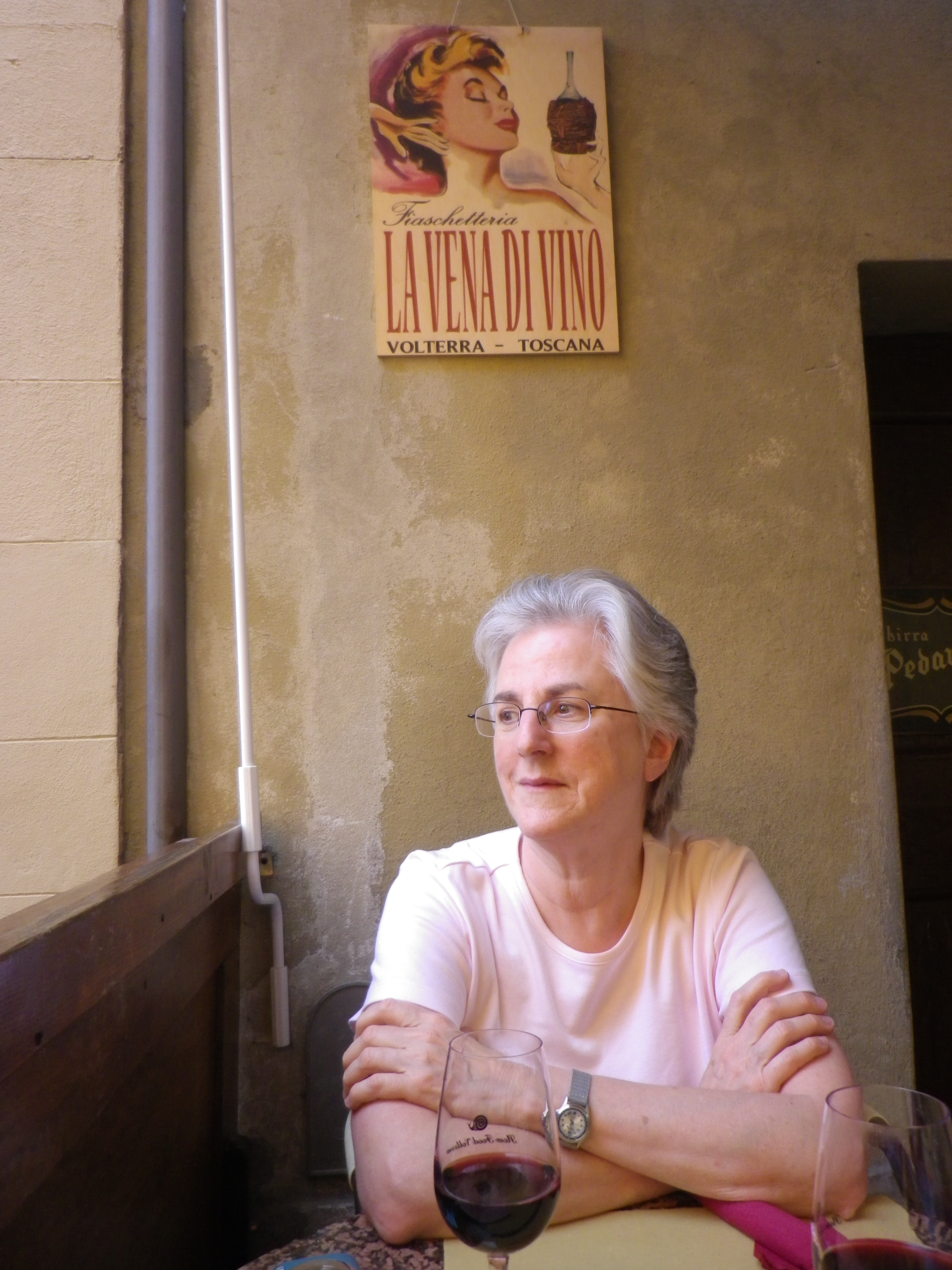
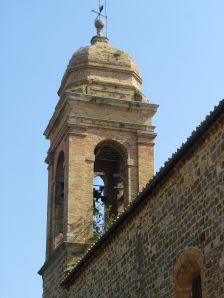
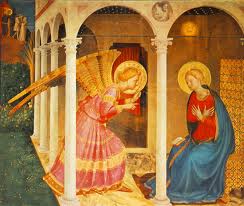
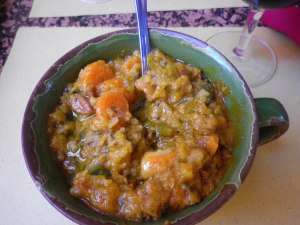
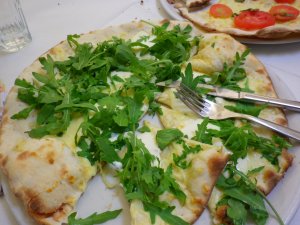
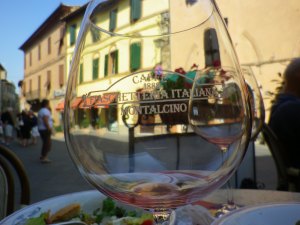
There is also usually a Baptistery, octagonal of course, often faced with marble like this one in Volterra.  And, of course, a cathedral.  The one in Montalcino had a small tree growing in its campanile (bell tower).  We were still in search of ART, and we saw some great things in Volterra and Cortona.  I must confess that, by Montalcino, we were all wore out and didn’t set foot in a single museum or religious institution.  But first, we saw this thirteenth century deposition of Christ in Volterra.  We paid 50p to have the light turned on so we could see it clearly for three minutes.  The Diocesan Museum in Cortona is known for its art by local Luca Signorelli, whom Frances Mayes adores but we found a bit melodramatic.  Both of us much preferred Fran Angelico’s Annunciation, also here.Then, of course, there is lunch.  In Volterra, we went to a hole in the wall recommended by  Rick Steves and enjoyed it mightily.  La Vena di Vino had a nice red wine and delicious zuppe de pane, the local equivalent of ribbolitta.  In Cortona,  we had delicious melone e prosciutto, so perfectly ripe and delicious that it must be the food of the gods, followed by thin crust pizzas.  Mine had rocket (arugula) and stracchino.In a fit of snobbery, we were somewhat appalled when a group of loud Americans plopped down and proceeded to order cheeseburgers, French fries and diet Coke.  IN ITALY!  What is the point??  And in Montalcino, which is all about wine, we had indifferent salads and antipasto accompanied by a glass of quite good Brunello.  Next: the Etruscans.
Saturday in Siena

On Saturday morning we bid farewell to Gorgio at Residenza Giotto – Silvia had bid us an effusive goodbye complete with two kisses the day before – and took a cab to the bus station.  Everything worked swimmingly and in an hour and a half we were in Siena.
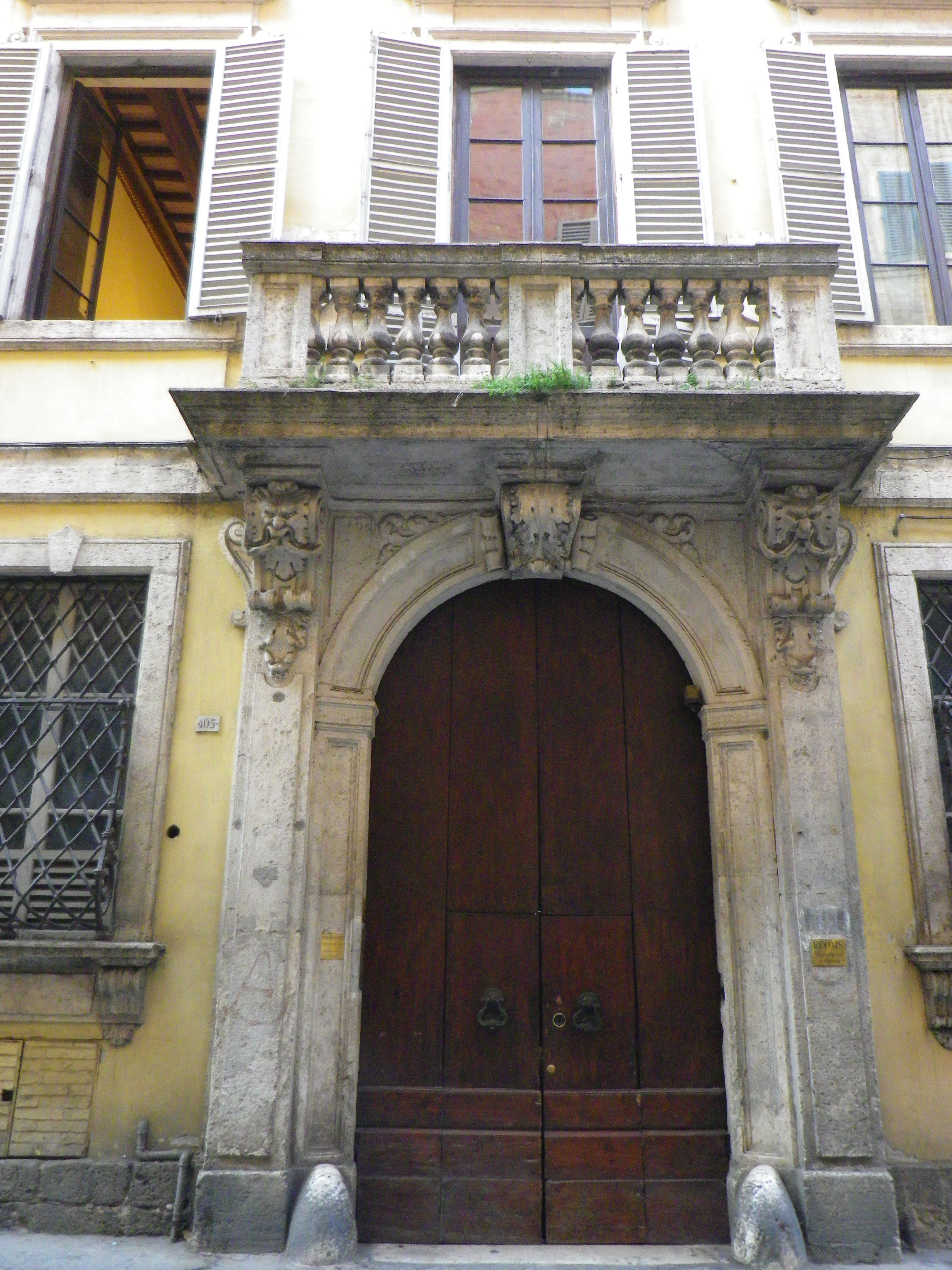
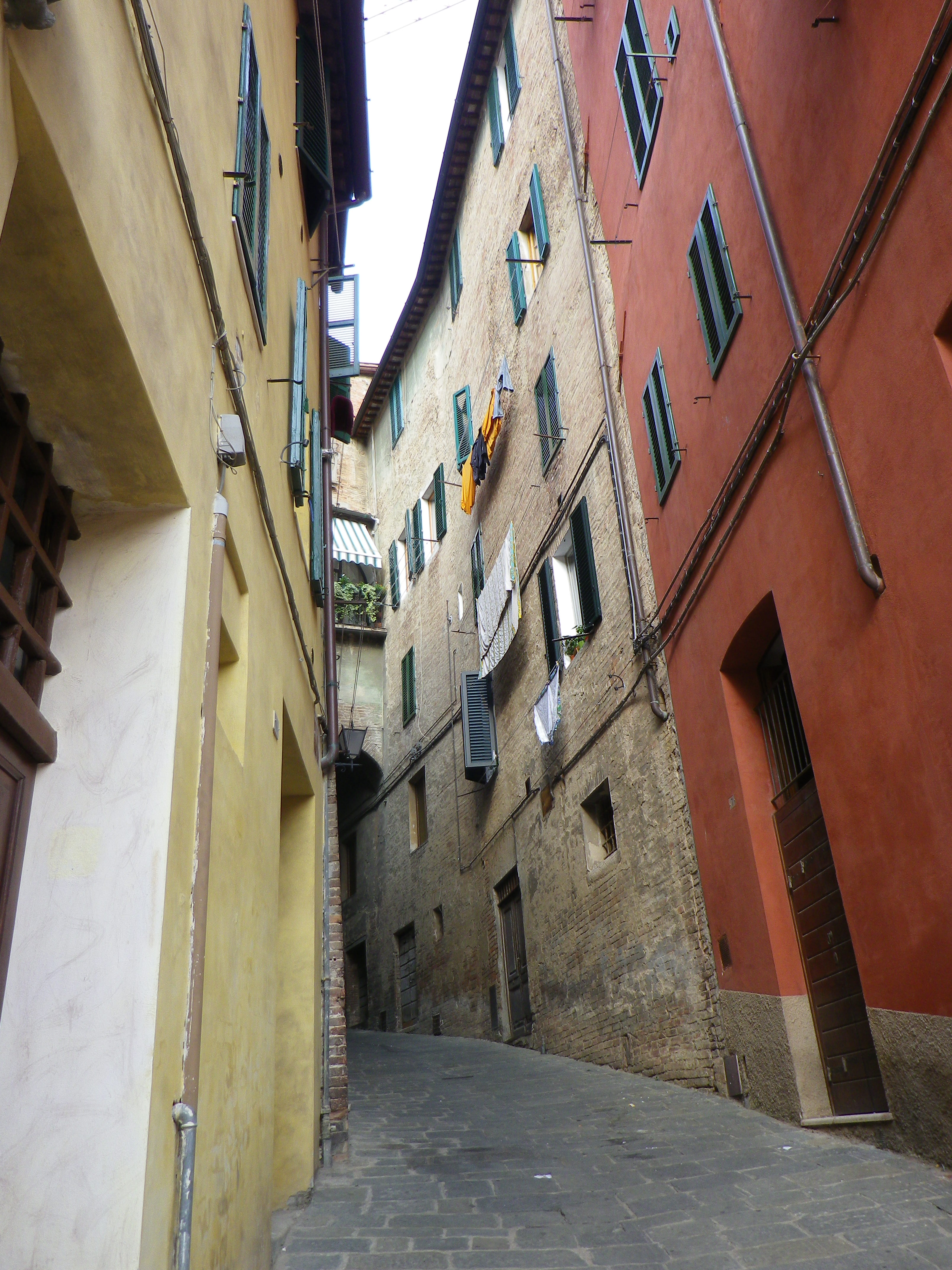
Palazzo Bruchi is in one of the medieval streets with barely enough room for cars to pass.  Pedestrians scatter in various directions, or don’t even bother, when they hear the angry Vespas coming up behind them, or the local buses lumbering along.  It’s very different from Florence: many fewer tourists and a much more medieval feel.

Our room is not big but the two double windows are generously sized, reaching the timbered ceiling and looking out on the courtyard below.  The Palazzo has seven B&B rooms and the rest is apartments, a few belonging to Camilla’s aunt, sister and cousin and the others rented out, I guess.  We’ve witnessed a few quarrels in the courtyard as well as chalk drawings by children, so I guess it’s a family affair.
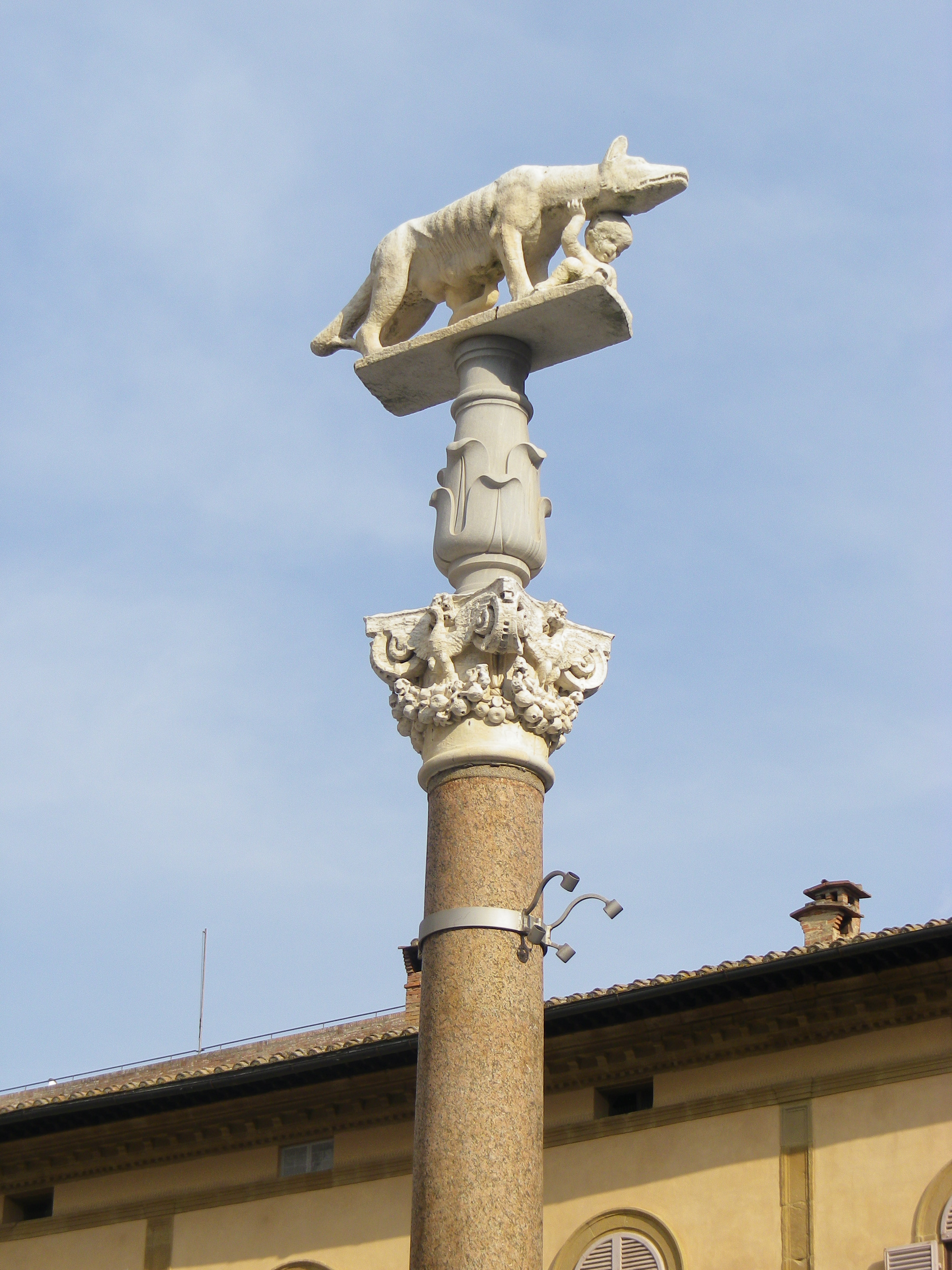
We went out in search of lunch and eventually, with lots of help (either the address was wrong or we were just confused), came upon the so-called skyscraper, a little hole in the wall where we ordered a mixed plate by pointing at what looked good – mashed cauliflower, prosciutto, etc., and a glass of red wine.  Fortified, we walked through town, always uphill, stopping at a few ceramics shops and noticing the ubiquitous wolf – Siena’s symbol like its arch-rival Florence’s lion.  
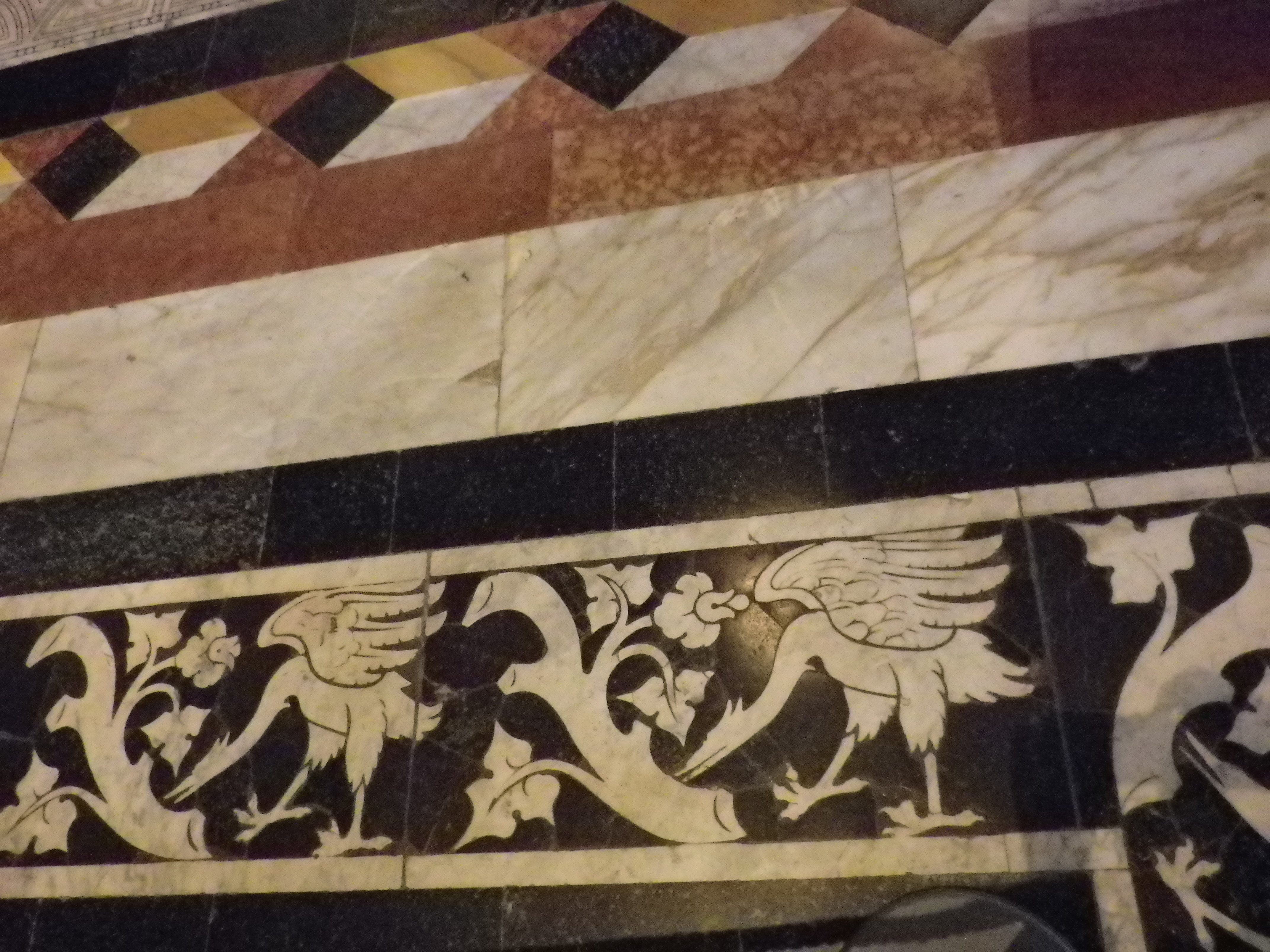
Though the Campo was beckoning, we continued on to the Duomo.  This was very different from Florence’s bare Duomo.  It’s famous for its gorgeous mosaic floors with mythological scenes as well as intricate border designs like this one,and for the Piccolomini Library, decorated with frescoes detailing the life of a the Sienese Pope Pius II who started out a bad boy but had a change of heart. Here he is looking back at us as he sets off for the Council of Basel.

The library is not large, and with the frescoes and other decorations covering every inch, it’s a beautiful space.
We walked over to the Duomo Museum to see yet more ART.  Duccio is the big name here, with his Maesta the big draw, along with his original stained glass windows.
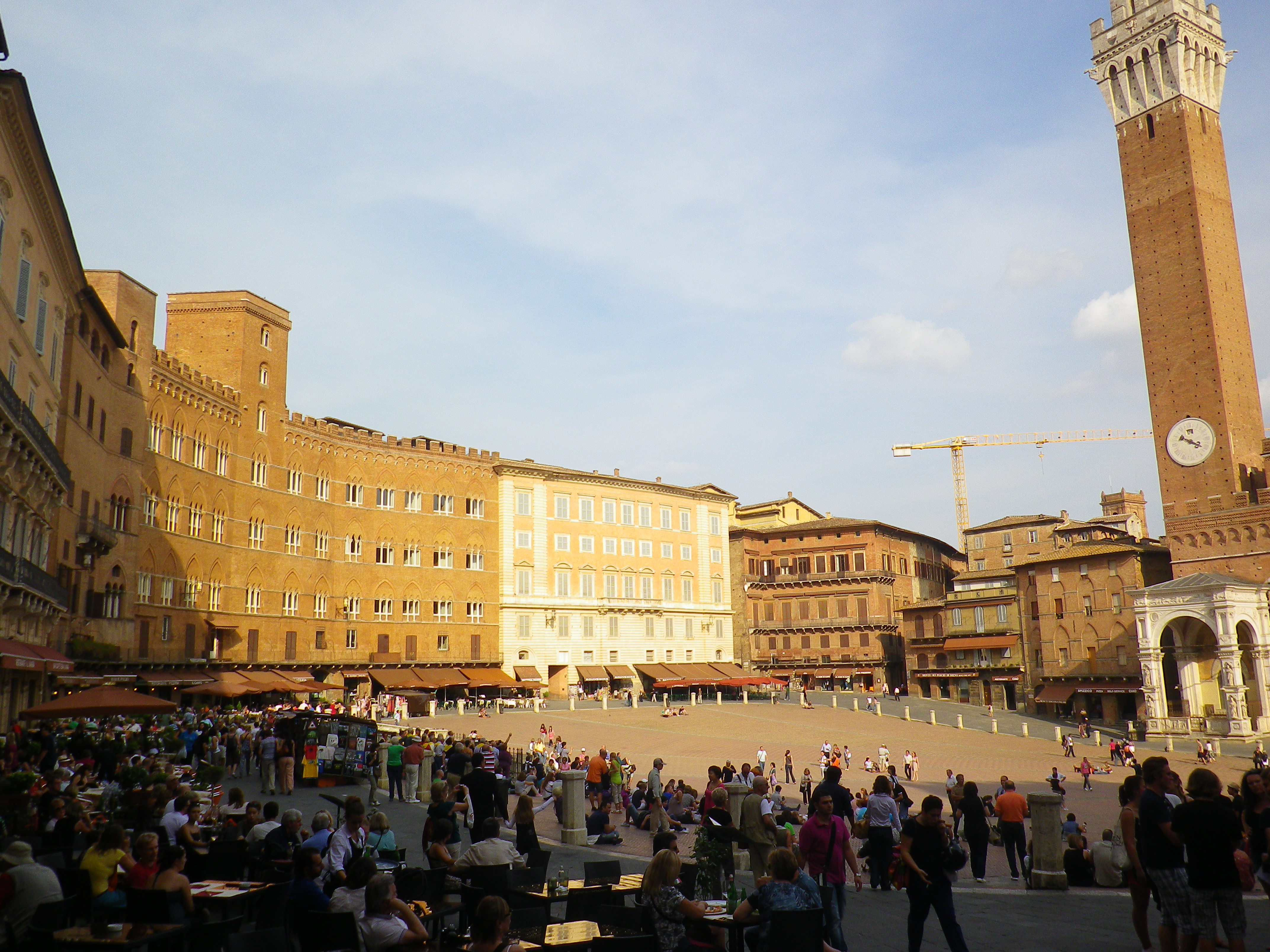
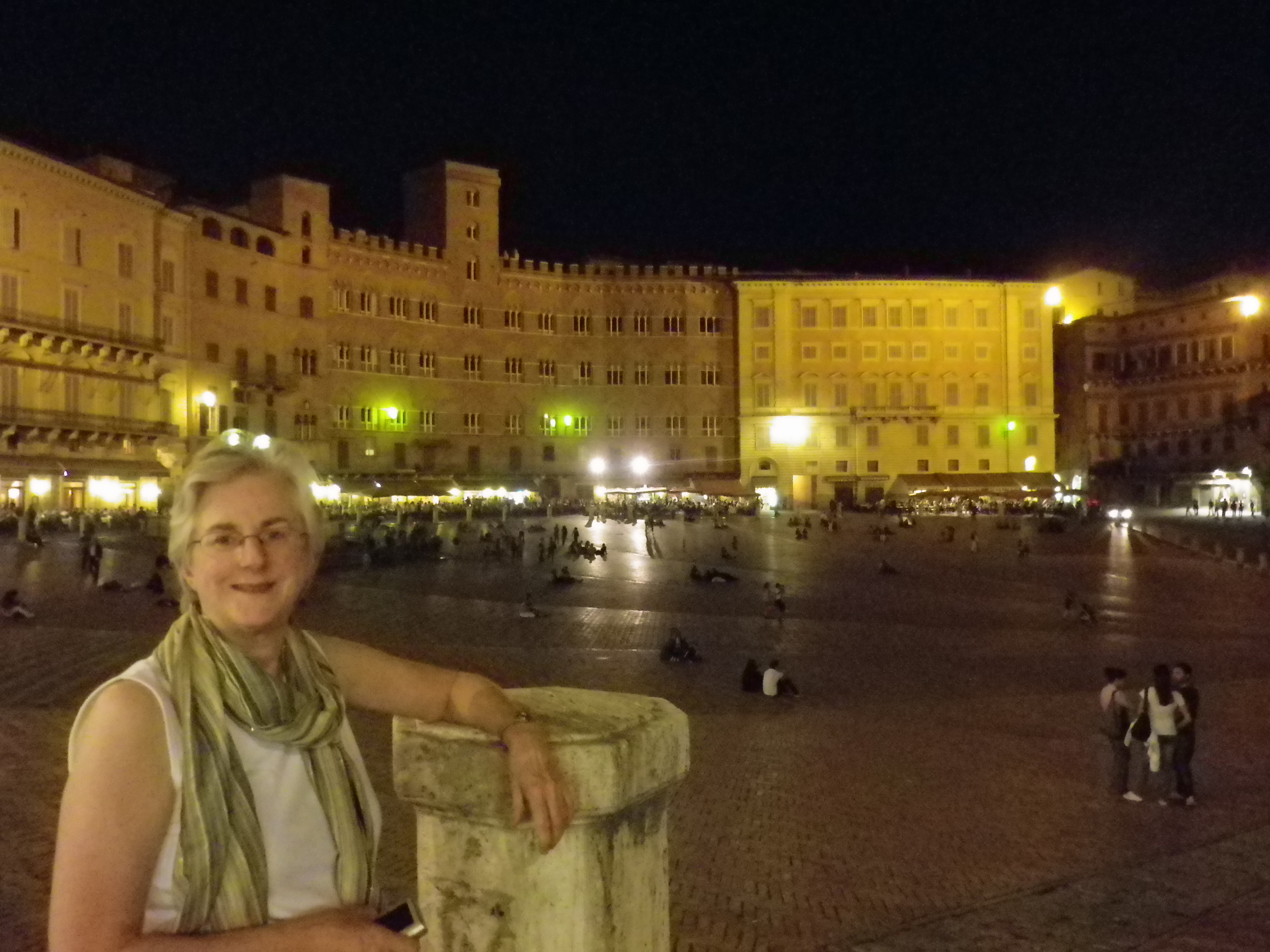
We finally walked down to the Campo and were not disappointed. It’s a huge space, made even larger because you come to it through narrow streets with no vistas at all.  It’s comfortably full of people at all hours.
Dinner this evening was at La Torre, which came highly recommended somewhere or other.  It was a great experience.  You sit down in the brightly lit room and the lugubrious owner comes over and recites a list of pasta dishes.  No asking you what you want, just the assumption that you’ll start with that.  So of course we did – pici for me and ravioli for Alison.  Then Alison had the wild boar stew and I had pigeone, more genteelly called squab.  This was accompanied by fiaschetti of plain red wine.  All of it was delicious, and all of it was dished up in the small kitchen in the front of the restaurant, where four people took care of everything.  We knew we would be back!
David, but first, Savonarola

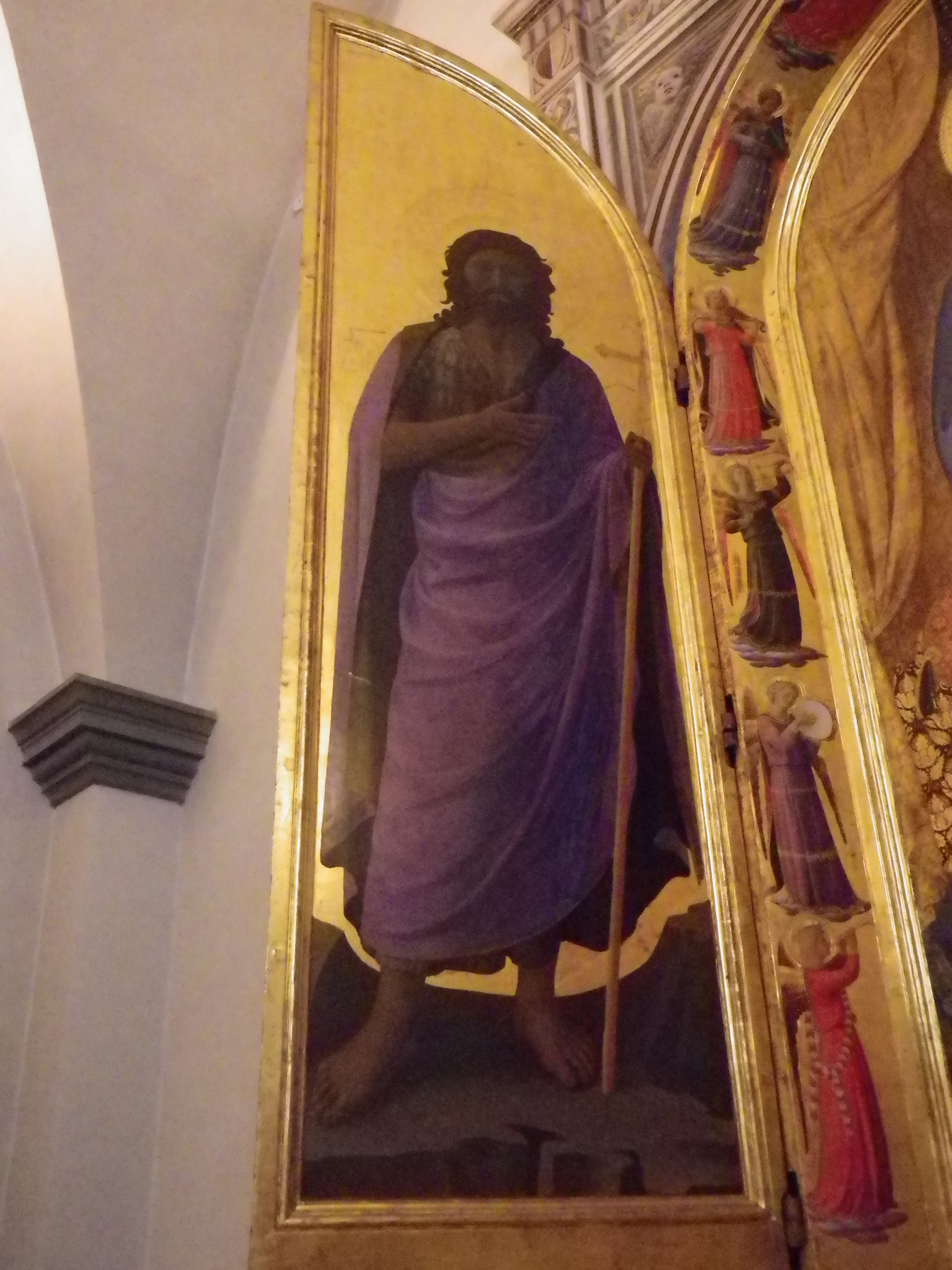
A slightly relaxed schedule today, with only two stops on the agenda.  But first to the bus station to get our tickets to Siena for tomorrow. It was surprisingly easy and seems straightforward enough.  Then we walked through the back streets to the Museum of San Marco, where the former dormitory of the Dominican monks is now open to the public.  The cloister is quiet, pretty, with a classic cedar of Lebanon (?) and a bell tower in the corner.  The walls all around are painted with frescoes by Fra Angelico, but the picture I liked best  was the Virgin and Child with St. John the Baptist looking particularly striking in a sumptuous purple robe over his furry tunic.
Upstairs are the cells of the monks, each decorated (if I can use such a secular term) with scenes designed for prayer and contemplation.  St. Dominic with the tell-tale star over his head figures in many of them.  The cells are small and bare – one wonders if there was even a little bed or if they just slept on the floor.

Then, at the end of the next corridor, are the cells that belonged to the prior, Savonarola, the man who became more and more fanatical, staged the Bonfire of the Vanities where who knows how many great pieces of art were destroyed, briefly ruled Florence and finally was executed. This eerie portrait of him hangs on one wall.
Also on display are his chair, his desk, and a few garments he wore to get closer to God through pain.  I know I see him through 21st century eyes, but he really is a most unpleasant fellow.

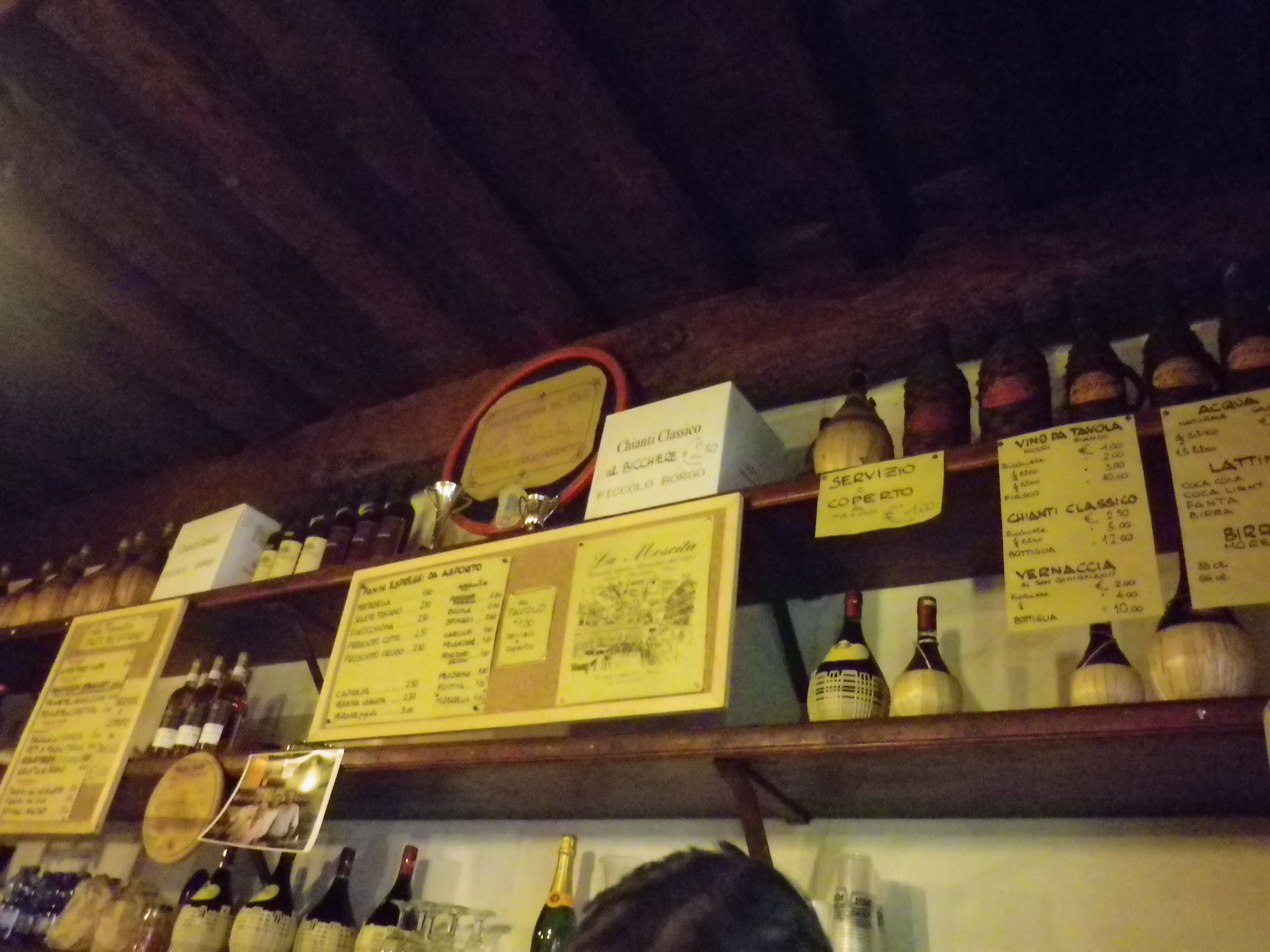
Lunch was in a little hole in the wall described as a family place, and indeed it was.  We chose pasta from the list on the wall after looking at our neighbors’ plates and declaring them good, and they were.  We followed (in backwards order) with mixed prosciutto, etc.  The Signora (Mama) served the food, while the boys took the orders and ladled it out.  I was too shy to photograph the place in action, but here’s a look at the menu board and the fiascos of wine.
Alison had an adventure when she asked the Signora for the bathroom. Pulling a key off a high hook, she gestured to Alison to follow her out of the restaurant and through a doorway, up a flight of stairs to a tiny door.  “Poco, poco,” she explained.  Ducking her head, Alison entered what looked like a storage closet only to find  the bathroom hidden behind a screen.  Rightly assuming that if she locked the door she’d never get out again, she successfully concluded her interlude, finding her way back down and back into the restaurant.  Grazie, Signora!Part Two of our day was the Accademia, which loomed as large logistically as the Uffizi but proved to be easy.  There’s not really a lot to see there, but what you see is enough to reduce a strong man (or woman) to tears.
David is all over Florence  – every tourist shop sells aprons adorned with his genitals, there are tiny reproductions of him, as well as postcards, posters and more tchotchkes than you can imagine.  By the end of a day or two in Florence, you feel you’ve already seen him, and he’s just a cliche.  Even the David copy in the Piazza  is just a bit ho-hum.

But turn the corner in the Accademia and see the real statue at the end of the corridor, under a dome built just for him, all seventeen feet of him, and you’re left speechless.  So I won’t say any more except that sometimes an artistic masterpiece will live up to or exceed your expectations, and this is one of those times.Dinner on our last night was at Coquinarius, which Alison had luckily booked, since people were being turned away right and left.  More goose carpaccio, then pici for me and “roastbeef” for her, both absolutely delicious.  When we left, the nice, energetic young man (owner?) ran out of the restaurant to find us and bid us farewell.  I guess it’s true that if you visit a restaurant at least twice you’re considered a regular.  We ended with GROM gelato and wended our way home through the crowds.  Just a few more views of the Duomo at night, and then to bed.

Only the strong survive

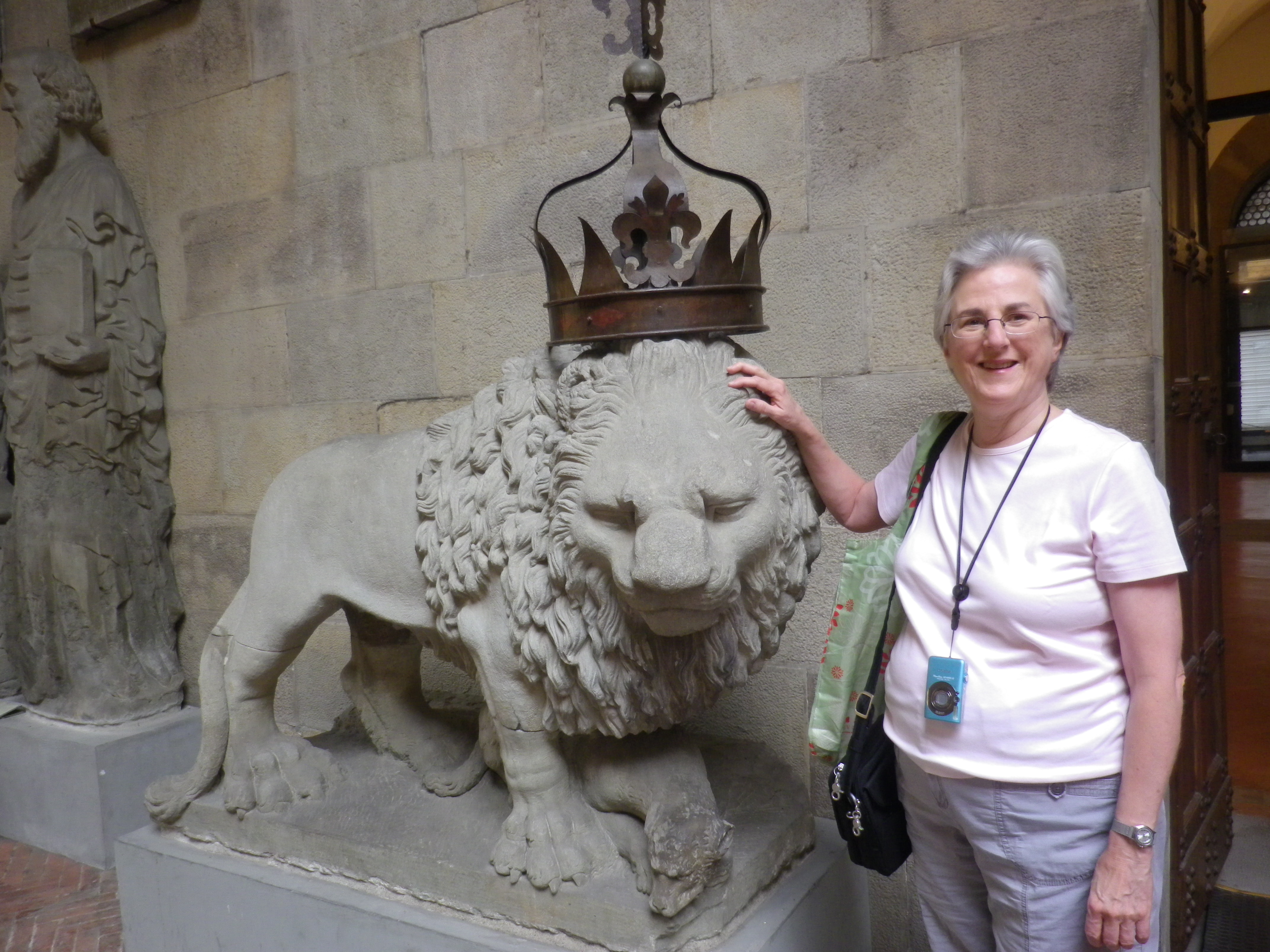
Today we visited the Bargello, the former prison that is now home to three floors of sculptures, along with majolicas and assorted other beauties.  The courtyard is lovely and plastered with an assortment of things that have been lying around Florence for the last few centuries – you know, some river gods, most of a fountain, a couple of lions, and so forth.
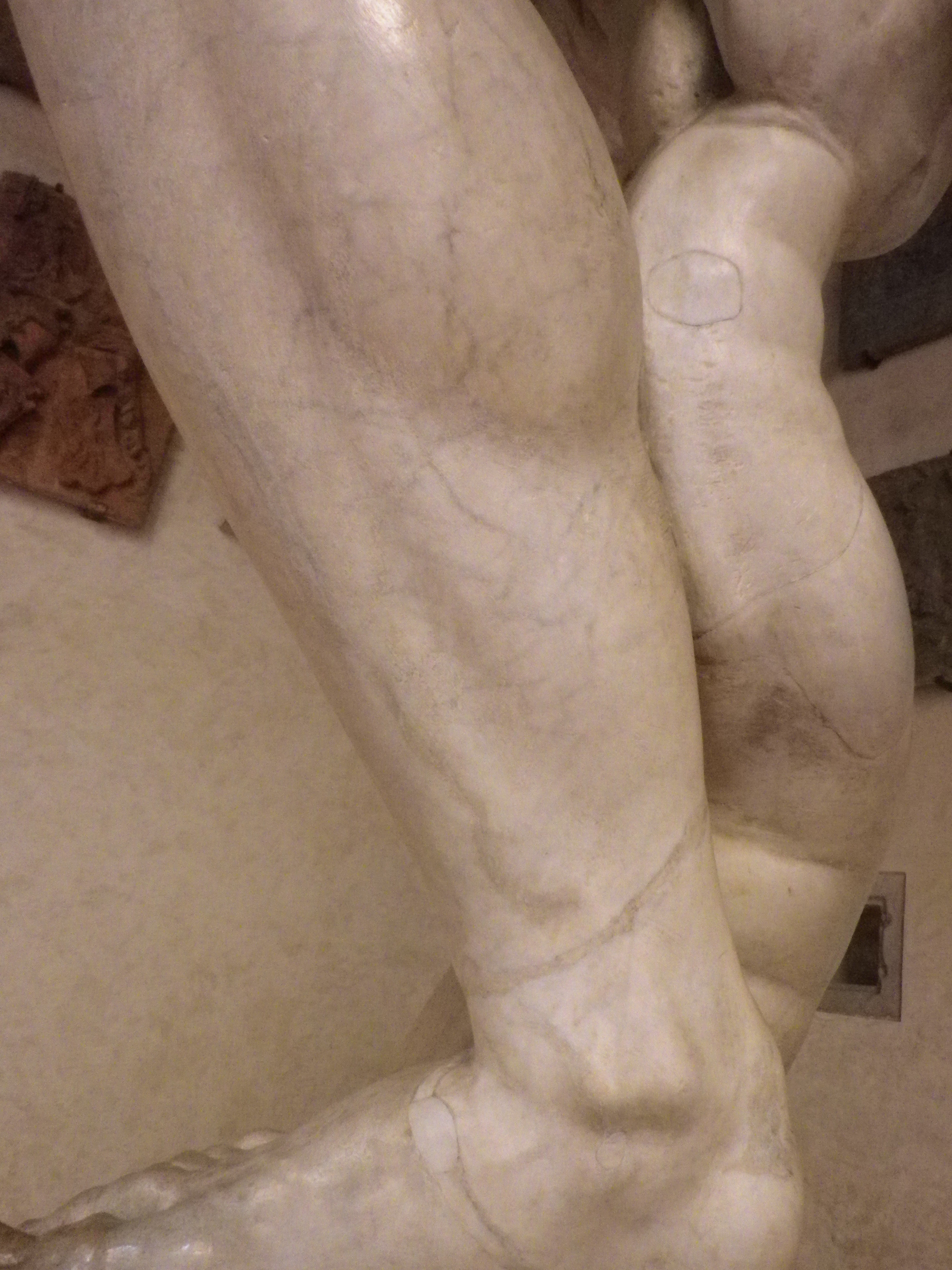
As usual, we followed Rick Steves through the museum.  He really hits the spot for first-time visitors who want to be sure to see the highlights.  For us, that included Donatello’s saucy David clad only in boots and cap, and an array of sculpted birds that I foolishly neglected to capture.  But I did admire the veining on this marble leg.
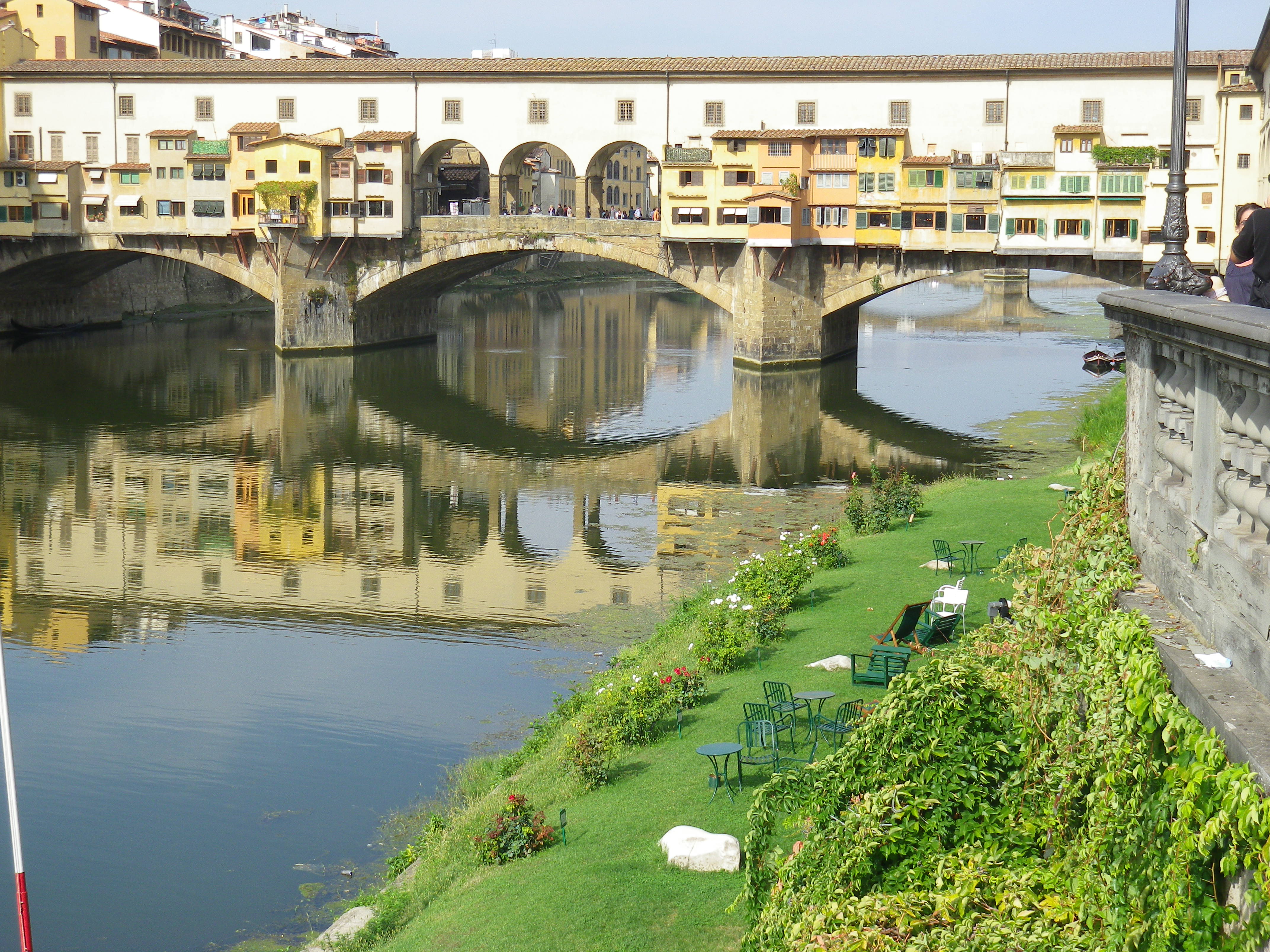
Then it was only about 10:00, and we had nothing scheduled until the Uffizi at 2:00.  Perfect time for a wander!  So wander we did, first to the Ponte Vecchio, looking swell in the morning light, with the Arno clearly feeling the effects of a hot summer.  A quick stop for coffee on the other side, the Oltr’arno, then more of a wander past the Pitti Palace and down a little street to a linen shop with beautiful tea towels.  We realized that we were close to a garden shop I had hoped to visit – good seeds, otherwise an odd mishmash of cat food, baskets, and pasta – and to the Church of Santa Maria del Carmine.
I was excited to visit the church because of the Brancacci Chapel  and its frescoes by Masaccio, Masolini and Lippi.  The “Expulsion from Paradise” shows such intense human emotion in such a small space, while “The Fall” wickedly portrays the same human face on Eve and on the snake that entwines the tree she’s holding on to.  They did not disappoint.  They are both high up on the wall and not very big, but quite wonderful.  A great treat, especially because we had thought we wouldn’t have time to fit this into the itinerary.
We finished up our wander with lunch in the Piazza Santa Croce.  A beautiful waiter with the curliest eyelashes I have ever seen served us melon with prosciutto and then a beautiful salad of hard boiled eggs, little shrimp, perfectly fresh tomatoes, and tender greens.  (The picture is lousy because I didn’t want to be arrested for voyeurism and had to be discreet.)

Back over the Ponte Vecchio with renewed strength to tackle the Uffizi Galleries.  Preparing for this is like preparing for battle.  First you book your tickets online.  Then they email you the voucher.  Then you come to the gallery at least 10 minutes ahead of your appointed time to redeem the voucher for tickets, making sure you’re in the correct queue.  Then you stand in yet another line to enter the gallery, where you go through security.  Finally, after you have tucked away your ticket, you climb four long flights of stairs to the gallery, where the final test is to find your ticket again so that the ticket taker can tear off the top.  Whew!
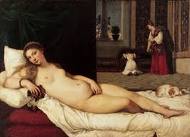
But your work has only begun. Now you are launched on your journey through some of the most amazing work of the Italian Renaissance, and it’s not for the weak.  Gorgeous altarpieces by Giotto, annunciations by just about everyone including Leonardo, Madonnas and children, usually with that wild boy John the Baptist, a whole room of Botticellis including the famous ones you’ve seen forever, and the Venus of Urbino by Titian that Mark Twain found so disturbingly erotic.
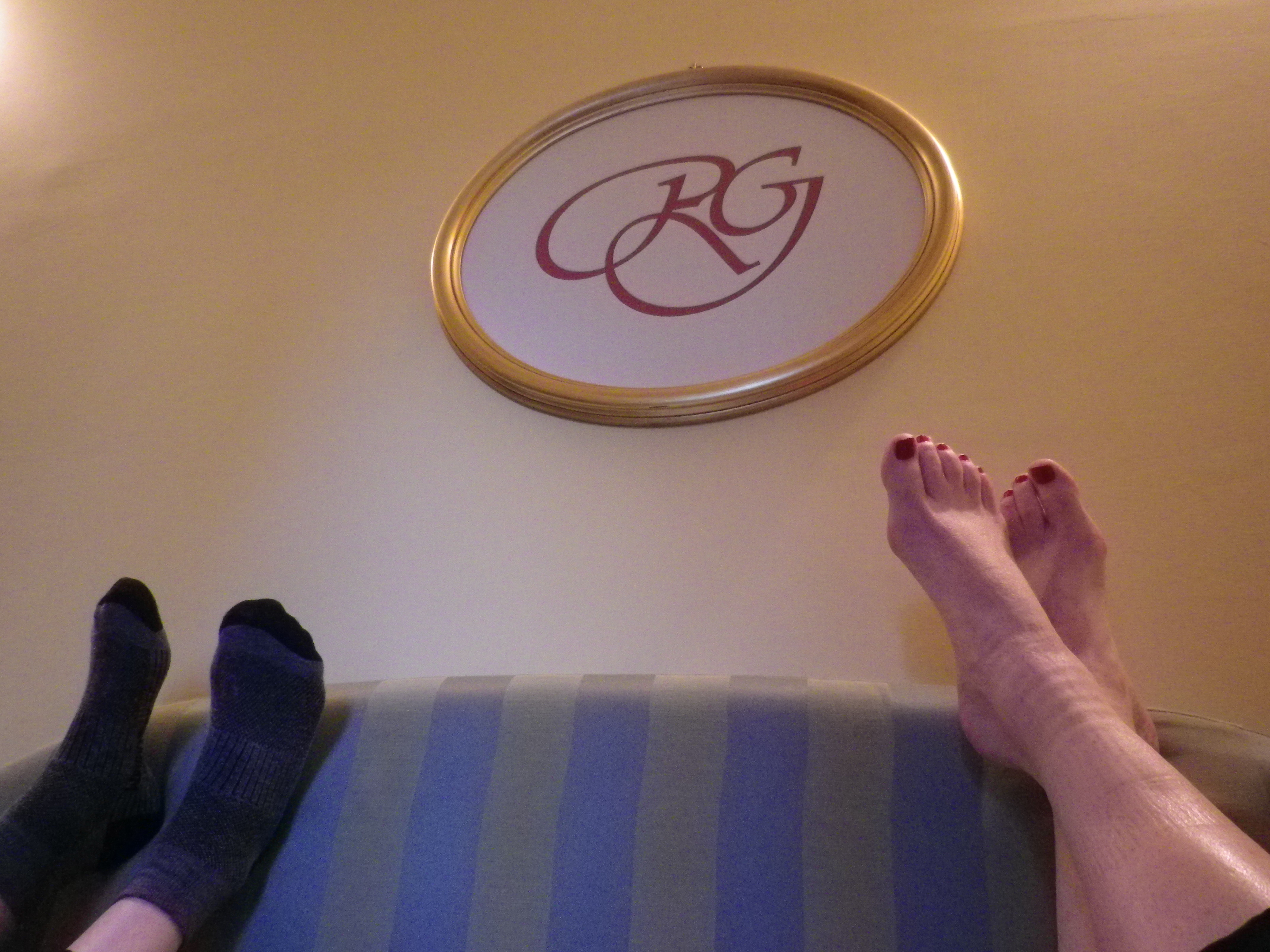
It’s an astonishing collection, and we had all we could do to see the highlights, determinedly averting our eyes  from anything extraneous lest we curl up and die before we’re done.  A brief rest on the terrace (our views from our room are actually better!) and then exit through the gift shop.  We limped home very slowly and yet again had to lie down and prop our feet on the headboard.