
 Today began with a crisis: because there is no cell service inside the apartment, Alison tried to open the front door to go outside to the courtyard and check her messages. The front door was locked, of course. Uh-oh! The long elongated key broke off inside the lock, leaving us locked in with no way out. And having no cell service made it impossible to call Lucia. First we emailed her, and then we had a brainstorm: we went up to my room, which overlooks the courtyard, and leaned out the window, where luckily Alison (but not me) had cell service. We tried to explain on the phone what had happened, and the wonderful Lucia promised to come as soon as she could. However, she was afraid that only the locksmith would be able to help and he was not available until 8:30 or 9:00. Meanwhile, this morning we had a Colosseum tour starting at 8:30. We frantically emailed the tour hoping to be able to reschedule.
Lo and behold, Lucia turned up in about 30 minutes and just put her key in the lock from the outside, which caused the broken bit to slither out and fall on the floor. You can see the remains at the top of the picture, and the truncated key on the left. 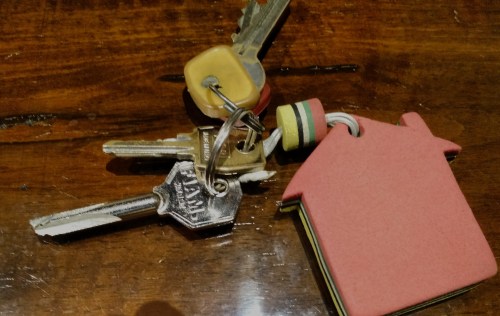 She gave us a replacement key, carefully explained how to use the key CORRECTLY and with no recriminations whatsoever left us to get ready asap for the tour.
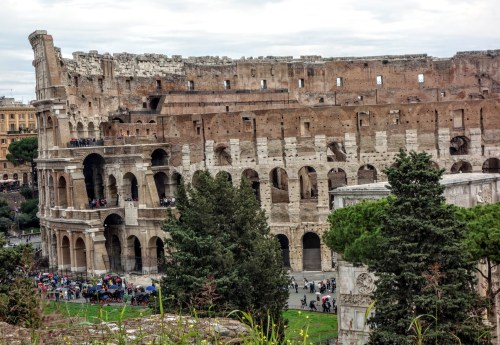
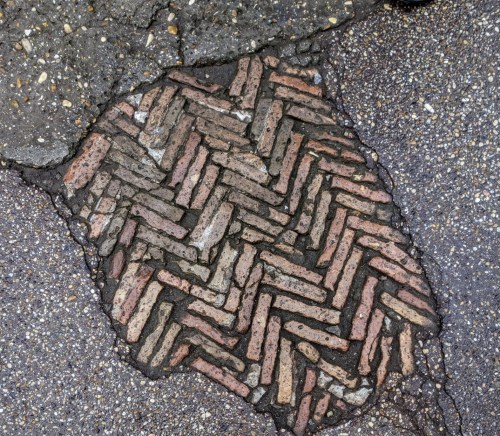
We arrived at the Colosseum Metro stop via taxi (too worried to wait for the bus, which we just barely missed) and it turned out that we were the only ones – a private tour! Andrea had a heavy accent but was very knowledgeable and friendly. He led us into the Colosseum and, well, there we were.  Looking down at the arena, we could see the reconstructed floor over part of it, while the underground areas where performers and animals stayed until needed were just beyond. (An underground tour of the Colosseum is available and would be interesting for those who want all the details.) I was glad I had read Mary Beard’s book about the building, its meaning, and how it actually worked. What I remember most, aided by Andrea’s commentary, is that it was designed for quick exits (literally a vomitorium); that women could sit only at the tippytop; that there was a nineteenth century fad for visiting the Colosseum by moonlight and reciting poetry; that the life of a gladiator was not a pretty one; and that the logistics of obtaining, transporting, and maintaining wild animals was, to say the least, daunting. Andrea filled in the blanks and gave us enough time – but not too much – to linger over a few details, including this section of original brick flooring.
  There was only a little bit of danger: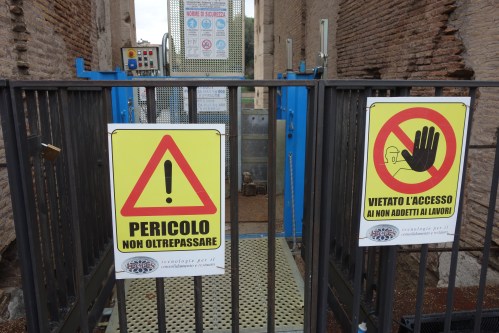
Leaving the Colosseum we made our way past the Arch of Constantine, the last triumphal arch built in Rome and, like so much in Rome, made up partly of bits from other monuments. 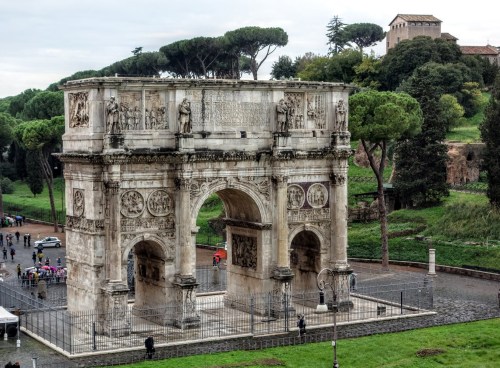 From here we walked up the Palatine Hill, which is one of the earliest inhabited places in Rome, but now home to the ruins of imperial palaces (plus some sort of temporary art installation).
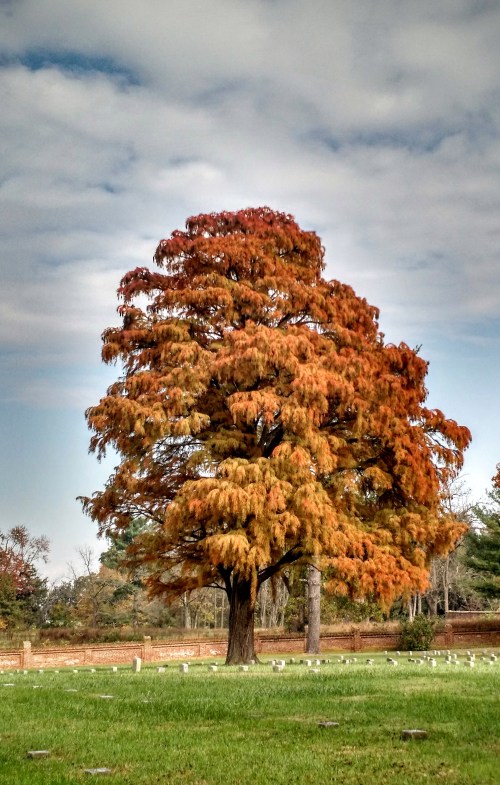
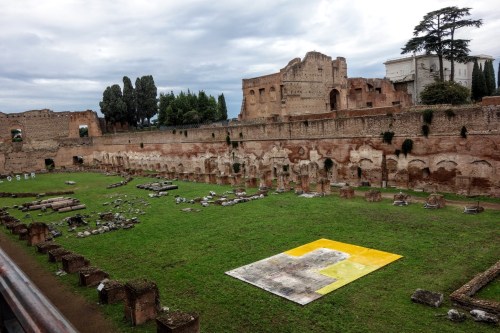 We wandered along, seeing very few other people but some beautiful trees (maybe an Atlas cedar?).
 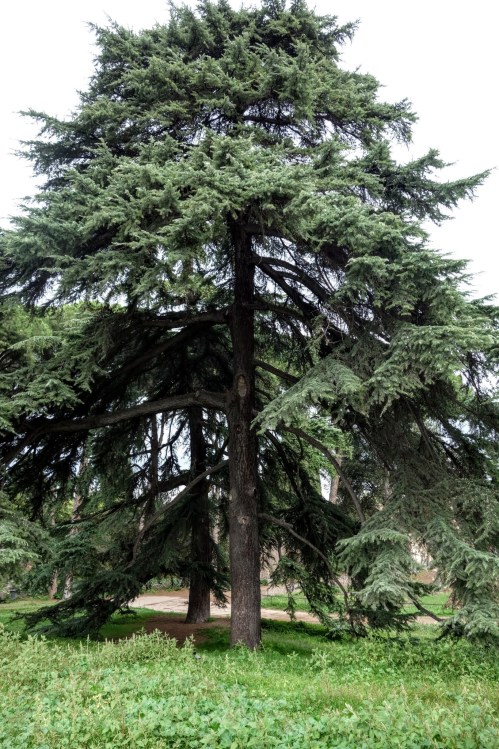 We headed downhill to the Forum, where it all made so much more sense than reading about it ever could. First off, the Arch of Titus, commemorating the siege of Jerusalem. See the menorah?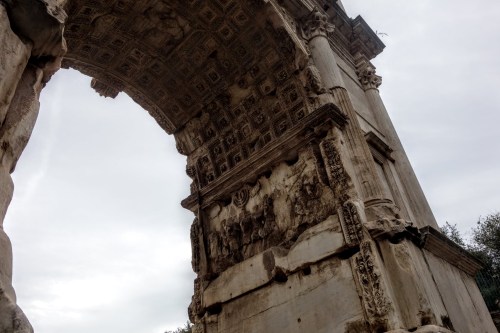
Then one monument after another (but not in a boring way), including the lovely garden and temple of the Vestal Virgins (they took a vow of chastity, and those who strayed would be buried alive). 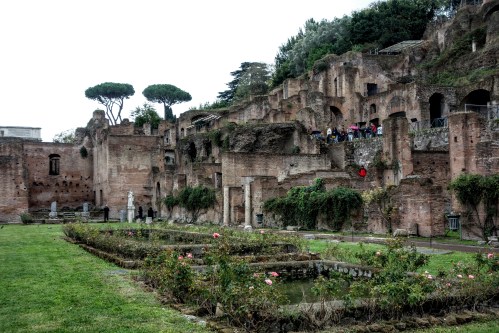 The temple of Antoninus and Faustina is quite imposing,
 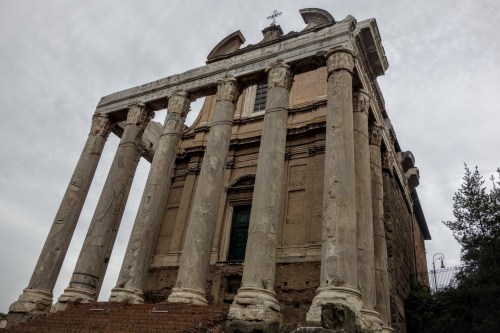 and it has a striking bronze door. At the time it was used, they say, the door was at ground level but excavations later have left it suspended in space. One reason so much of it survives is that the temple was turned into a church in the Middle Ages.
This beautiful doorway is from a neighboring temple…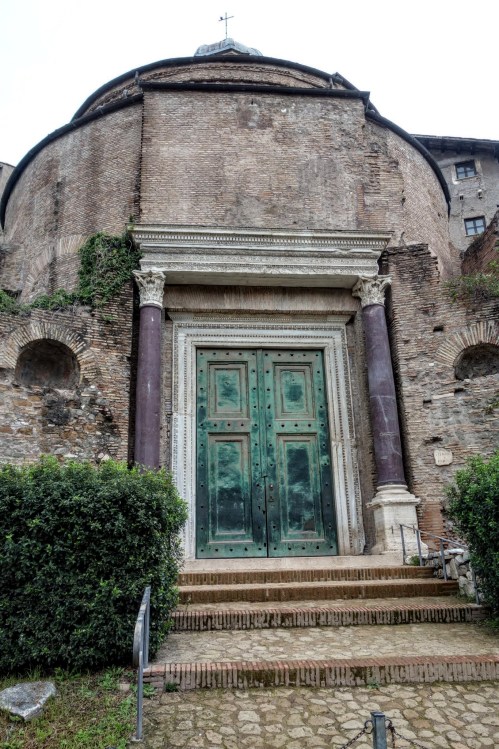 We enjoyed walking and talking with Andrea, but it was time to say goodbye. It had been a bit drizzly all morning, and we were stripped down in anticipation of the Colosseum’s new rules about no backpacks (exaggerated, as it turned out). Plus, it was not supposed to rain! But rain it did: as soon as the tour ended it began to stream down. We darted here and there trying to make our way out of the Forum, buying an umbrella on the way from one of the men who magically appear in Rome when it rains, but it was our second trap of the day. Every path was a dead end. Hither and yon we struggled in the rain until FINALLY we found the exit and took refuge in a nearby restaurant for restorative vegetable soup and a margherita pizza. It was not photo-worthy, but it hit the spot and gave us the strength to go on, or at least have a rest.
Since the nearby churches were closed for another two hours, we took the bus home and had a little lie-down to restore ourselves. After that, we valiantly bussed to San Clemente, which is famous for its many layers of religion. One of the earliest is the Mithraic Temple, from a cult much favored by soldiers (there are Mithraic remains in London, for example). The remains are, of course, underground, with many stone corridors, steps and mysterious stone altars. Unfortunately, the signage was not very illuminating but we checked it off the list. (This would have been a good candidate for a guided tour.) I was most taken with the tile floors on the main level. More quilt patterns!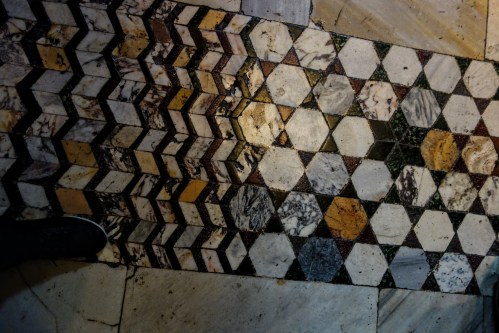
From here we trudged up a small hill to the church of St. Peter in Chains. This is famous for housing the actual chains (!) that held St. Peter when he was jailed, 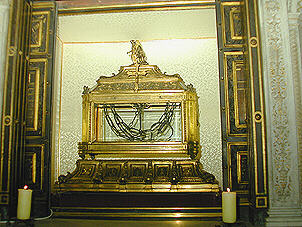 as well as the Michelangelo Moses.
 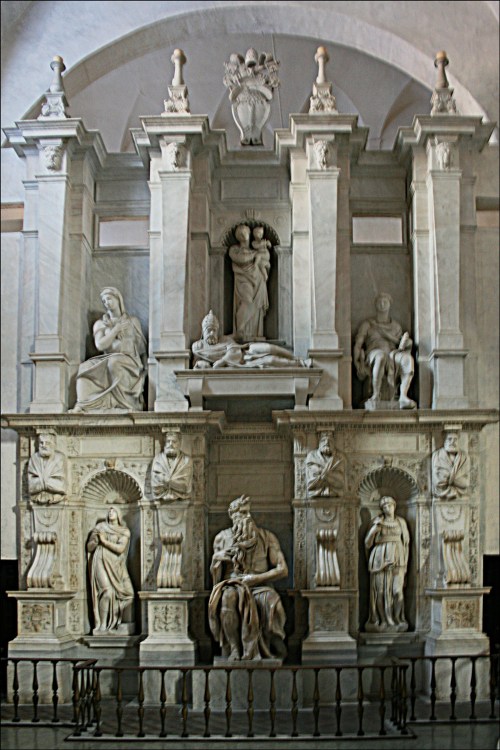 The latter was covered in scaffolding while we were there so we had to crane our necks, but here’s what it looks like normally. (Both photos from the web since I failed to take any pictures.) From here we walked down to the Via Fori Imperiale for the bus home, the 76 as I remember, which has become our old friend.
After a quick drink and a peek at the news (CNN International, so we cannot escape Trump), we meandered over to the Campo for dinner and some delicious fish.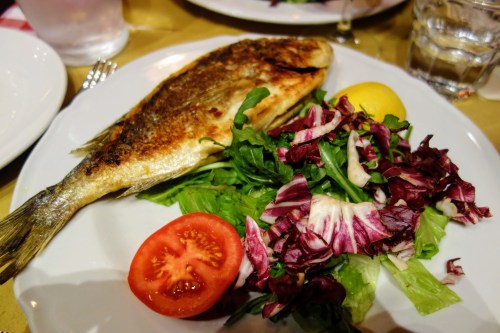
And so to bed.



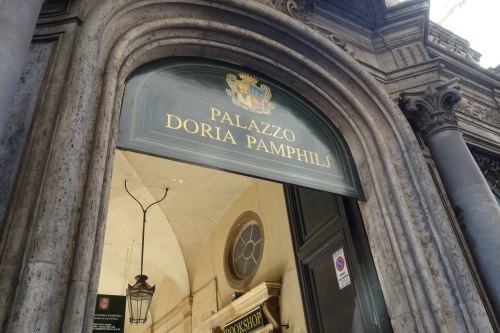 Next on the agenda was the Palazzo Doria Pamphilj, which in typical Roman fashion was not on the corner as depicted on the map but several buildings in. Never mind, we found it despite the map. Here is its serene courtyard.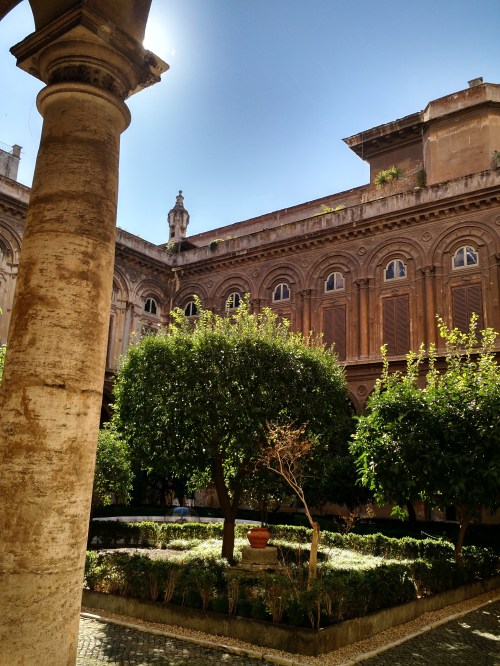

 The big attraction to us was the Caravaggios, many of which can be found in Rome (as you will see in a later post) and two of which are famously found in Malta. The Flight into Egypt from the Pamphilj may be my favorite.
 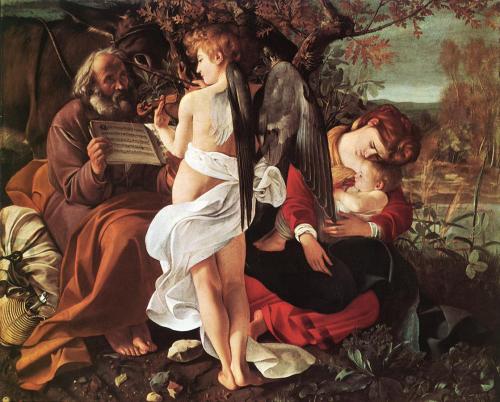 The musical angel’s black wings divide the picture in half – on one side the mother and child, on the other Joseph and the big-eyed cow (he does animals exceptionally well). The music Joseph is holding was played in this gallery at a concert not too long ago, according to the Prince.
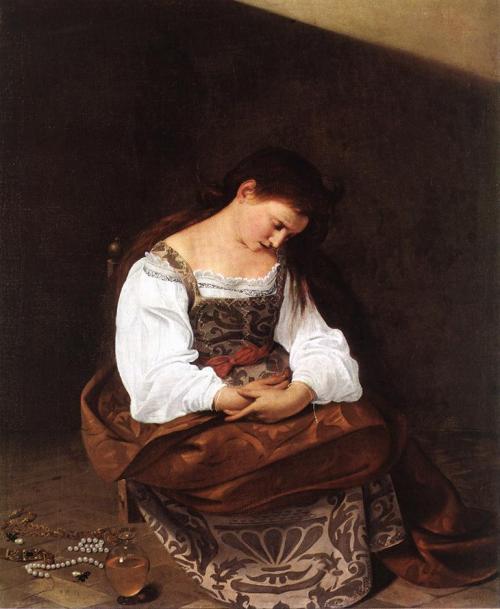 The model for Magdalene was one of Caravaggio’s favorites, a prostitute who was perhaps his mistress.
 Nearby is Trajan’s column, though it’s almost impossible to see the details from any distance, especially the higher areas. But having read about it somewhere, I was able to imagine the images of the Dacian conquest curling around the column from bottom to top. The statue of Trajan was replaced by a pope some 500 years ago with a statue of St. Peter, oh, well.
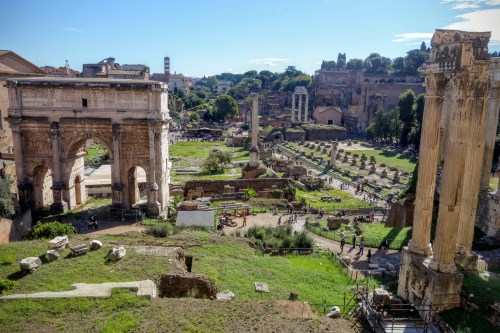
  From here we made our way up and up the steep Capitoline Hill to the Capitoline Museums. Along the way were good views of the Roman Forum, which I am only now beginning to understand despite reading about it for months. Here is the first view, showing the remains of the temple to Castor and Pollux (lots of twinning in Rome) and the ubiquitous umbrella pines.
 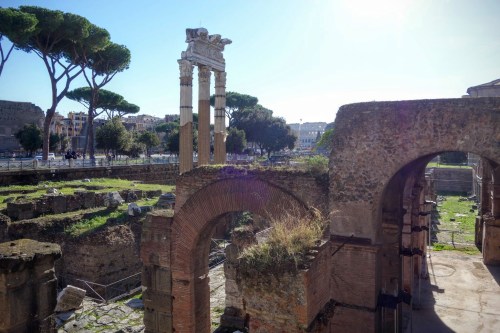 Next up is the Arch of Septimius Severus, celebrating victories over the Parthians.
 When you finally reach the top of the Capitoline Hill, you are rewarded with Michelangelo’s Campidoglio, featuring the marvelous statue of Marcus Aurelius (a copy) in the center.
 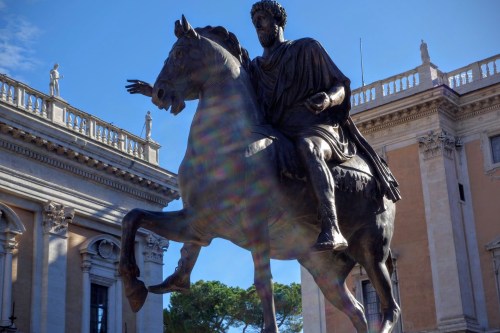 Once inside the courtyard of the museum, we saw bits of the enormous statue of Constantine (we saw the original location of the statue on Thursday) and posed next to a foot, a bicep, a toe.
 oh, and a view of the city through an old wavy window;
  a death mask of Michelangelo;
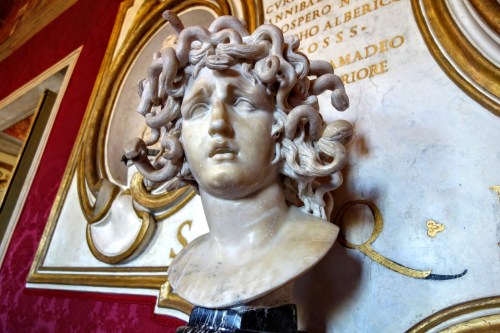
  and Bernini’s Medusa.
 Walking further along, we came to a modern wing that houses the original Marcus Aurelius, beautifully displayed in a vast open space with lots of light pouring in. Note that his hand gesture indicates that he is pardoning the barbarians, one of whom originally was crouched at his feet. Stirrups had not yet come to the Roman Empire, so you will see his feet dangling free.
 He really is breathtaking.
 Returning to the Capitoline, we revisited the Dying Gaul (whom we saw in the National Gallery in DC when it was on loan a few years ago), complete with his Gaulish hair and torc;
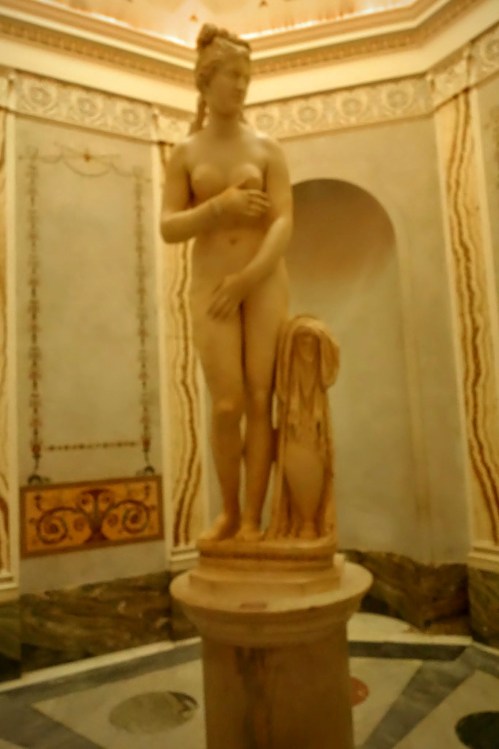
  some gorgeous ladies with very special hair;

 and the mosaic of doves from Hadrian’s villa.
 On our way back down from Michelangelo’s Campidoglio we saw the insulae tucked under the hill. These were the original apartments lived in by so many Romans. The higher up you were (some were more than five stories high), the poorer you were – less safe in case of fire, for example. Like so many ancient buildings, these are now many feet below the current ground level.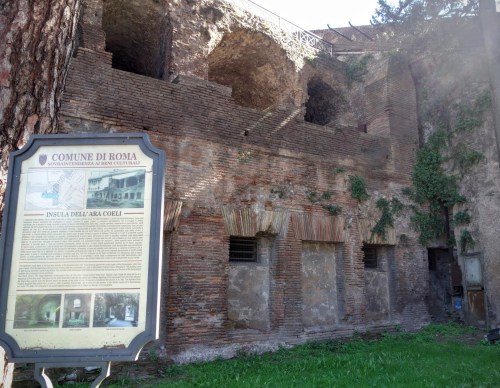
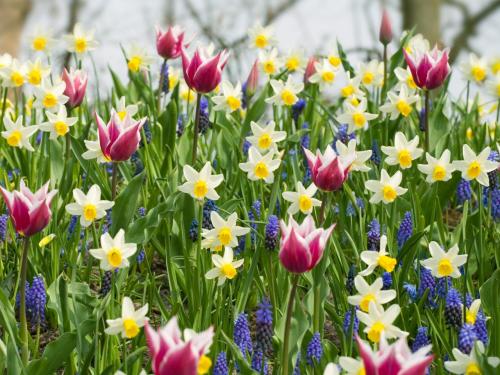 As usual, my eyes are bigger than my – well, than my ability to plant bulbs in the hard clay soil that abounds here. But here is what I have.
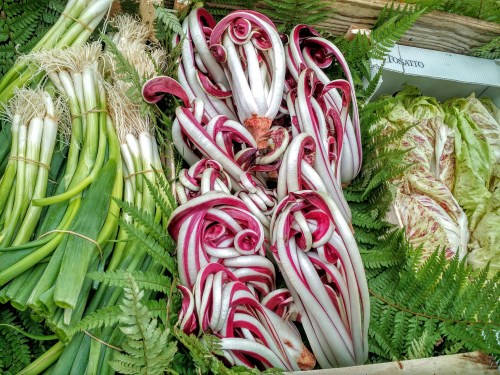
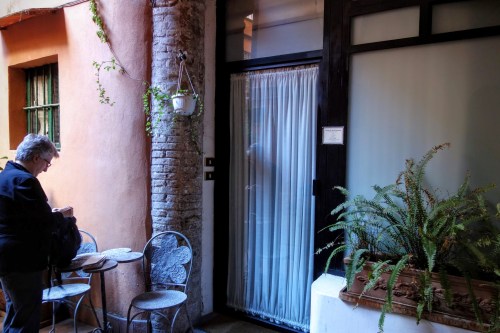 It was not quite ready, so after our tour Lucia gave us the keys and we went out for a short wander through the Campo de’ Fiori nearby. We stumbled around the beautiful market for a while,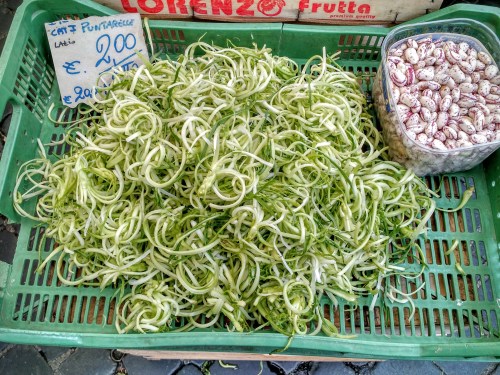
 then returned to eat the two kinds of delicious pizza Lucia had left for us,
 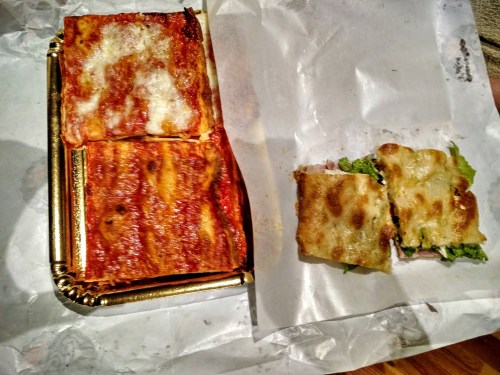 followed by a deep two-hour nap.
 At least, that’s the story. As Wikipedia says, “A legend, common with tour-guides, is that Bernini positioned the cowering Rio de la Plata River as if the sculpture was fearing the facade of the
 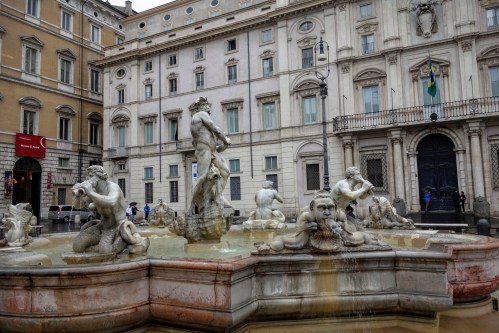 is the Fontana del Moro, featuring the Moor sculpted by Bernini. A whole book could be written (and undoubtedly has been) about the fountains of Rome. They are justly proud of their abundant water, much of it still arriving via aqueducts, and you can find fountains monumental and simply useful, all over the place.
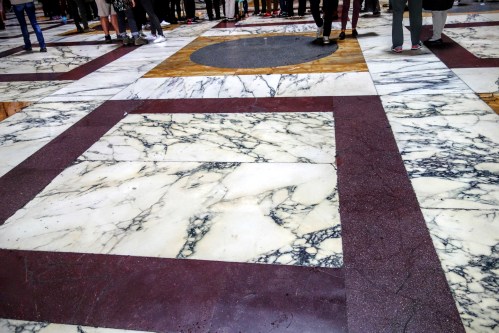
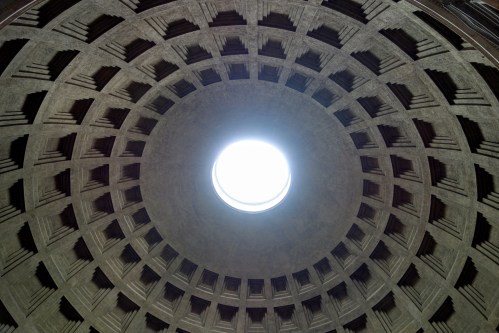
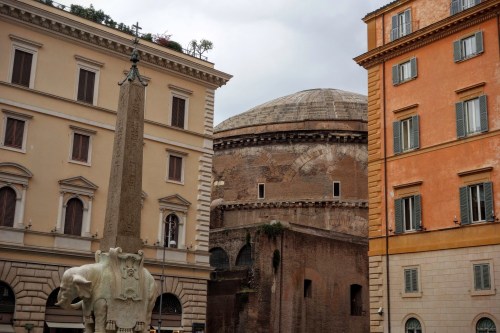 because Rome has gradually built up around all these amazing places. It was full of people but we still loved the space, the ceiling, the oculus, the pillars, the floor pattern.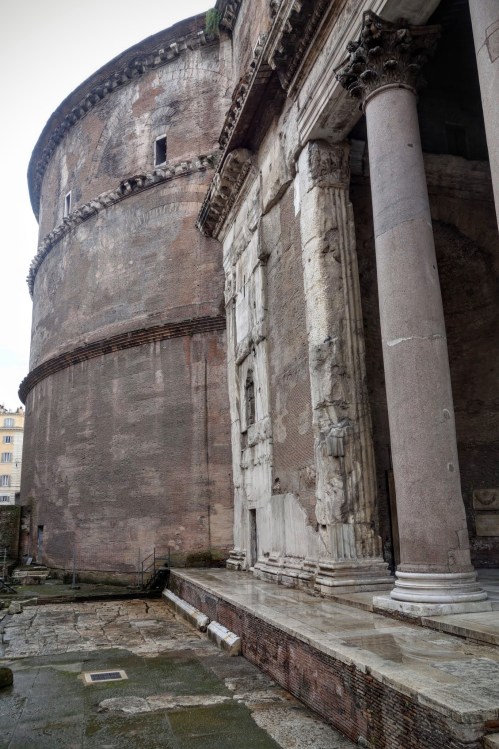
 From here we went to Santa Maria sopra Minerva with the delightful
  On the wall outside were markers of floods through history (the Tiber frequently overflows its banks).
  Inside was Rome’s only Gothic church, built on a previous temple to Isis (not actually Minerva). Michelangelo’s muscular Christ is the star of the interior. Someone famously said the knees alone are worth all the art in Rome – me, I didn’t quite see it.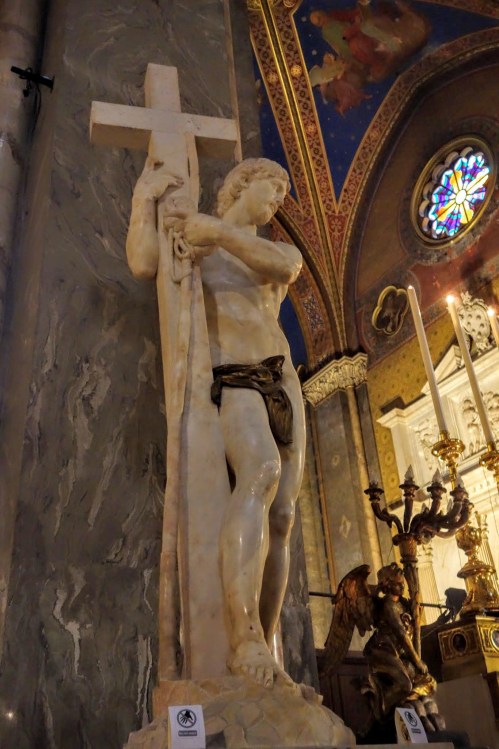
 Find out more at
  Well done but not my cup of tea. No matter how often I read about analogous and non-analogous color schemes, I can’t keep it in my head. And occasionally I would look at a picture and think it was fine only to discover this was the bad “before” picture. So, not too helpful for my limited visual skills.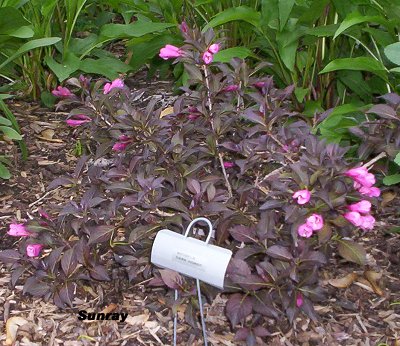
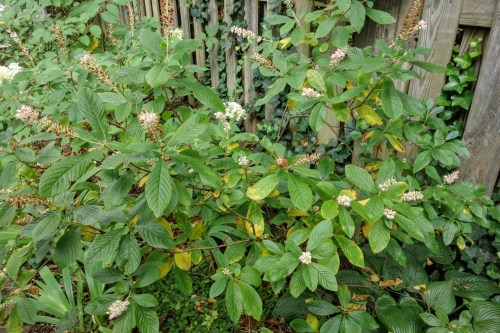
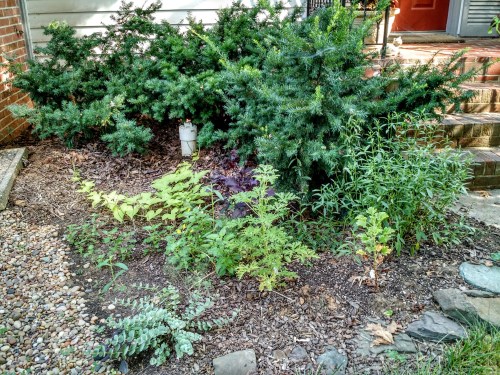 I was thinking of a low-growing viburnum or maybe this dogwood, Cornus sanguinea ‘Cato’ Arctic Sun, that Sweet recommends. But I think it needs a more prominent spot to do well.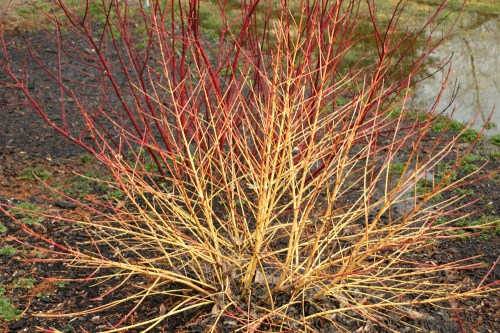
 Caroline's Garden and Travel Record