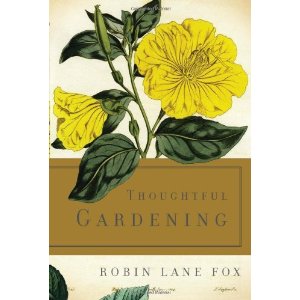
 Robin Lane Fox is known for his books on the classical world, but for decades he’s written a gardening column for the Financial Times, collected here and arranged by season. He comes across as a deeply conservative man who does not suffer fools gladly. He scoffs at concerns about pesticides, encouraging readers to use them widely and to calm down about environmental concerns. On the other hand, he frequently notes the longer hotter summers we’re experiencing now, so he’s hardly an ideologue. Be careful if you’re his friend: his essay on Rosemary Verey is a perfect example of cattiness disguised as admiration. Not terribly likeable, but interesting. My (library) copy is studded with bookmarks.
Gardens to visit: Castello in Florence, accessible from the city on a number 28 bus. “…the box parterre has charm and the wide range of lemon trees in their terra-cotta pots…are a stunning spectacle.” The Villa Gamberaia, also in Florence (take the number 10 bus from the railway station), was described by Edith Wharton as “the most perfect example of the art of producing a great effect on a small scale.” Has gorgeous views “fit to be included in a great Florentine painting from the fifteenth century.”
Planting lore: start lavender cuttings in August. He recommends using a razor to make a clean cut, to root them in a mixture of 50% compost and Perlite, and to cut off the bottom of a plastic soda bottle to make a mini-greenhouse for the new cuttings. I want to try this with my lavender in hopes of getting enough plants for a little hedge.
Which roses to choose: pink-flowered Jacques Cartier can be pruned to about three feet and grows well in dry conditions, also features a second flush of bloom in fall. Louise Odier has fragrant pink-rose flowers and flowers on and off through the summer (at least in England). “The classic duo for dryness are the tall, scrambling Rose d’Amour and the thorny lower-growing Rose d’Orsay…fresh pink flowers…”
Plants to investigate: “Cicerbita plumeria is an indestructible plant that gives great pleasure in high summer at a height of about four feet.” Like chicory but with darker coloring, thrives in dry shade. Other dry shade lovers include Symphytum cooperi and phlomis russeliana. Try planting Clematis Petit faucon with roses. Blue Diadem cornflowers for the sunny bed? Agrostemma Milas, with tall lilac pink flowers.
Miscellaneous: He hates squirrels enough to include a recipe for them. He refers to “blind” bulbs, those that send up leaves but do not flower (time to divide them).
His list of further reading is good enough to save. I was pleased to see that one of them, a collection of Vita Sackville-West that he edited, is in my personal collection, thanks to Mom.
As always, we have to take English gardening books with a grain of salt. Lane Fox’s definition of hot, dry summers is likely quite different from mine!










 Caroline's Garden and Travel Record