Monthly Archives: June 2011

Thoughtful Gardening

Robin Lane Fox is known for his books on the classical world, but for decades he’s written a gardening column for the Financial Times, collected here and arranged by season.  He comes across as a deeply conservative man who does not suffer fools gladly.  He scoffs at concerns about pesticides, encouraging readers to use them widely and to calm down about environmental concerns.  On the other hand, he frequently notes the longer hotter summers we’re experiencing now, so he’s hardly an ideologue.  Be careful if you’re his friend:  his essay on Rosemary Verey is a perfect example of cattiness disguised as admiration.  Not terribly likeable, but interesting.  My (library) copy is studded with bookmarks.

Gardens to visit:  Castello in Florence, accessible from the city on a number 28 bus.  “…the box parterre has charm and the wide range of lemon trees in their terra-cotta pots…are a stunning spectacle.”  The Villa Gamberaia, also in Florence (take the number 10 bus from the railway station), was described by Edith Wharton as “the most perfect example of the art of producing a great effect on a small scale.”  Has gorgeous views “fit to be included in a  great Florentine painting from the fifteenth century.”

Planting lore:  start lavender cuttings in August.  He recommends using a razor to make a clean cut, to root them in a mixture of 50% compost and Perlite, and to cut off the bottom of a plastic soda bottle to make a mini-greenhouse for the new cuttings.  I want to try this with my lavender in hopes of getting enough plants for a little hedge.

Which roses to choose:  pink-flowered Jacques Cartier can be pruned to about three feet and grows well in dry conditions, also features a second flush of bloom in fall.  Louise Odier has fragrant pink-rose flowers and flowers on and off through the summer (at least in England).  “The classic duo for dryness are the tall, scrambling Rose d’Amour and the thorny lower-growing Rose d’Orsay…fresh pink flowers…”

Plants to investigate:  “Cicerbita plumeria is an indestructible plant that gives great pleasure in high summer at a height of about four feet.”  Like chicory but with darker coloring, thrives in dry shade.  Other dry shade lovers include Symphytum cooperi and phlomis russeliana.  Try planting Clematis Petit faucon  with roses.  Blue Diadem cornflowers for the sunny bed?  Agrostemma Milas, with tall lilac pink flowers.

Miscellaneous:  He hates squirrels enough to include a recipe for them.  He refers to “blind” bulbs, those that send up leaves but do not flower (time to divide them).

His list of further reading is good enough to save.  I was pleased to see that one of them, a collection of Vita Sackville-West that he edited, is in my personal collection, thanks to Mom.

As always, we have to take English gardening books with a grain of salt.  Lane Fox’s definition of hot, dry summers is likely quite different from mine!
 

Design ideas, part two

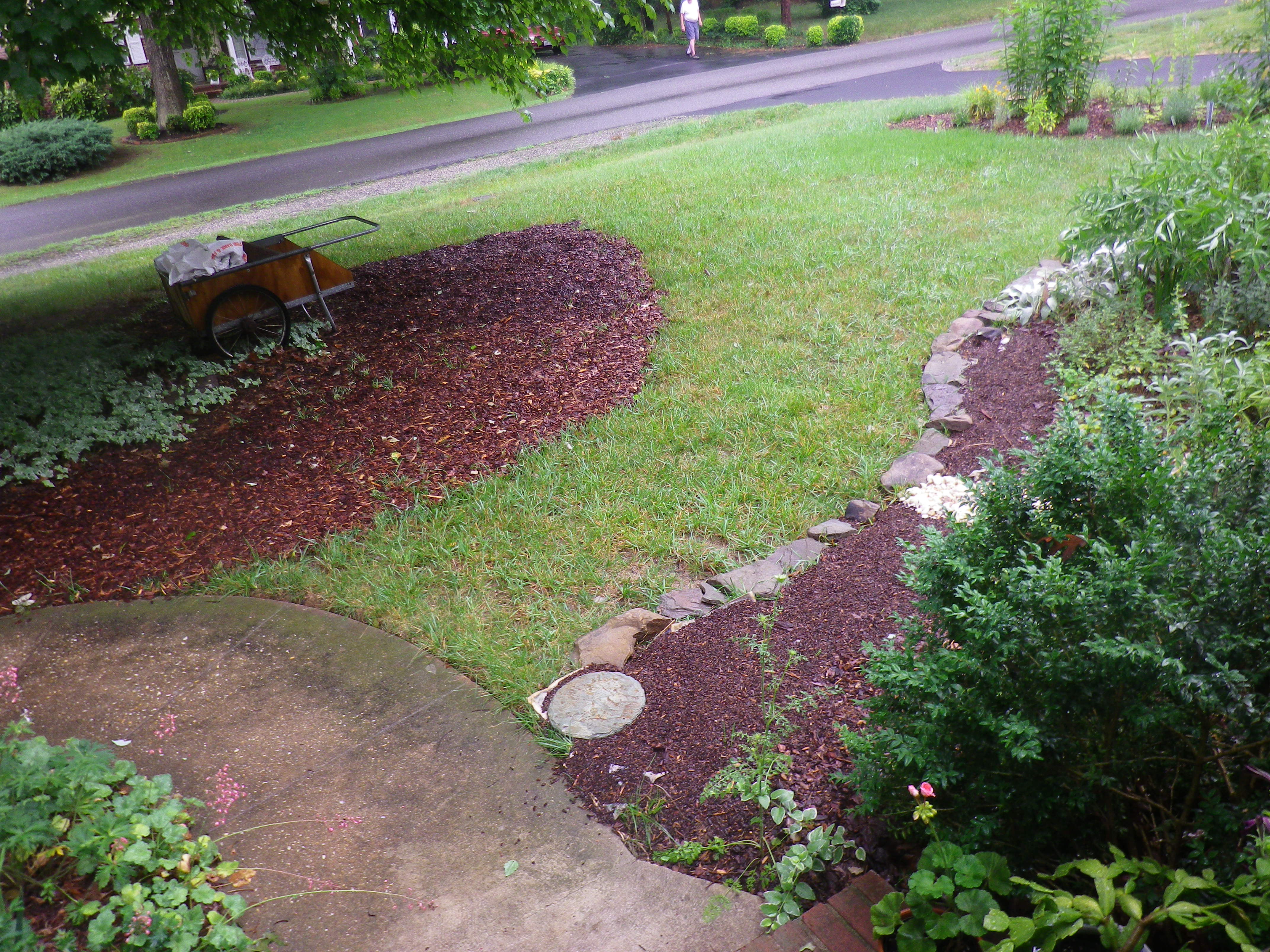
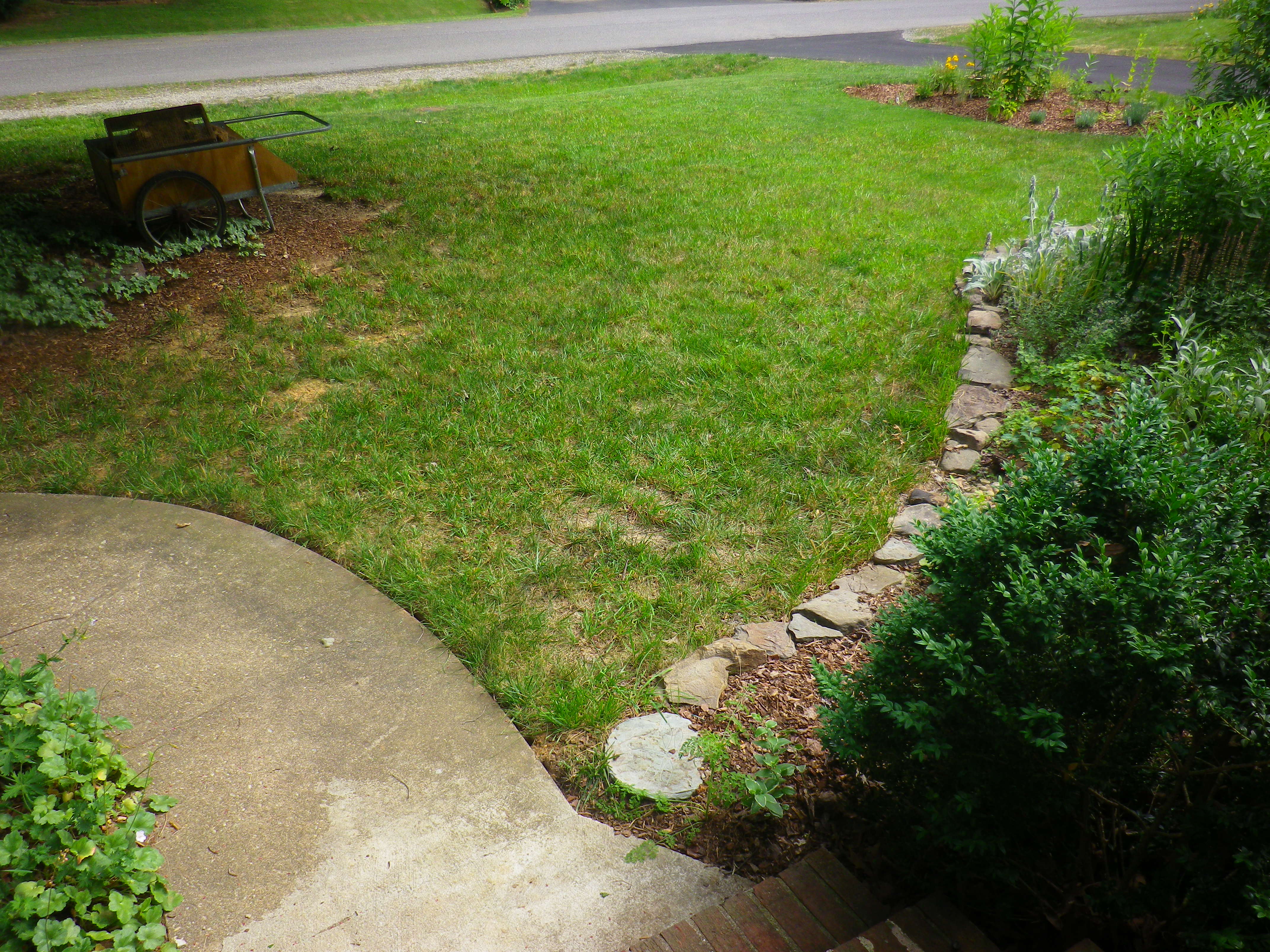
Anne advised me to put in the hardscape first, then look at the plantings.  The hardscape she suggested for the front was such a great idea that I’ve already started on it:  extend the mulched and planted area under the maple tree out to the drip line, and make a broad path from the sidewalk between there and the existing gardens, which are extended by about two feet.  Okay, here, take a look. This is what it looked like when Anne came.  Here’s what I’ve done since then.

I’m using the newspaper and mulch method of building these beds and don’t expect to do much more with them until fall at the earliest.  Every week I buy more bags of mulch and extend the bed under the tree just a little bit more.

The next part of the plan is to run the dry creek bed, already existing in the garden, across the grass path and through the maple tree bed, curling around the epimediums and woodland asters and ending at the driveway, thus drawing the eye very cleverly along.

One more thing Anne did was to suggest moving a few garden statues around.  Just one little change makes a huge difference. Here is the reading boy, who was dwarfed in his earlier spot by the rose.  The plan is to underplant him with Japanese painted ferns and run the dry creek bed just beyond that point.

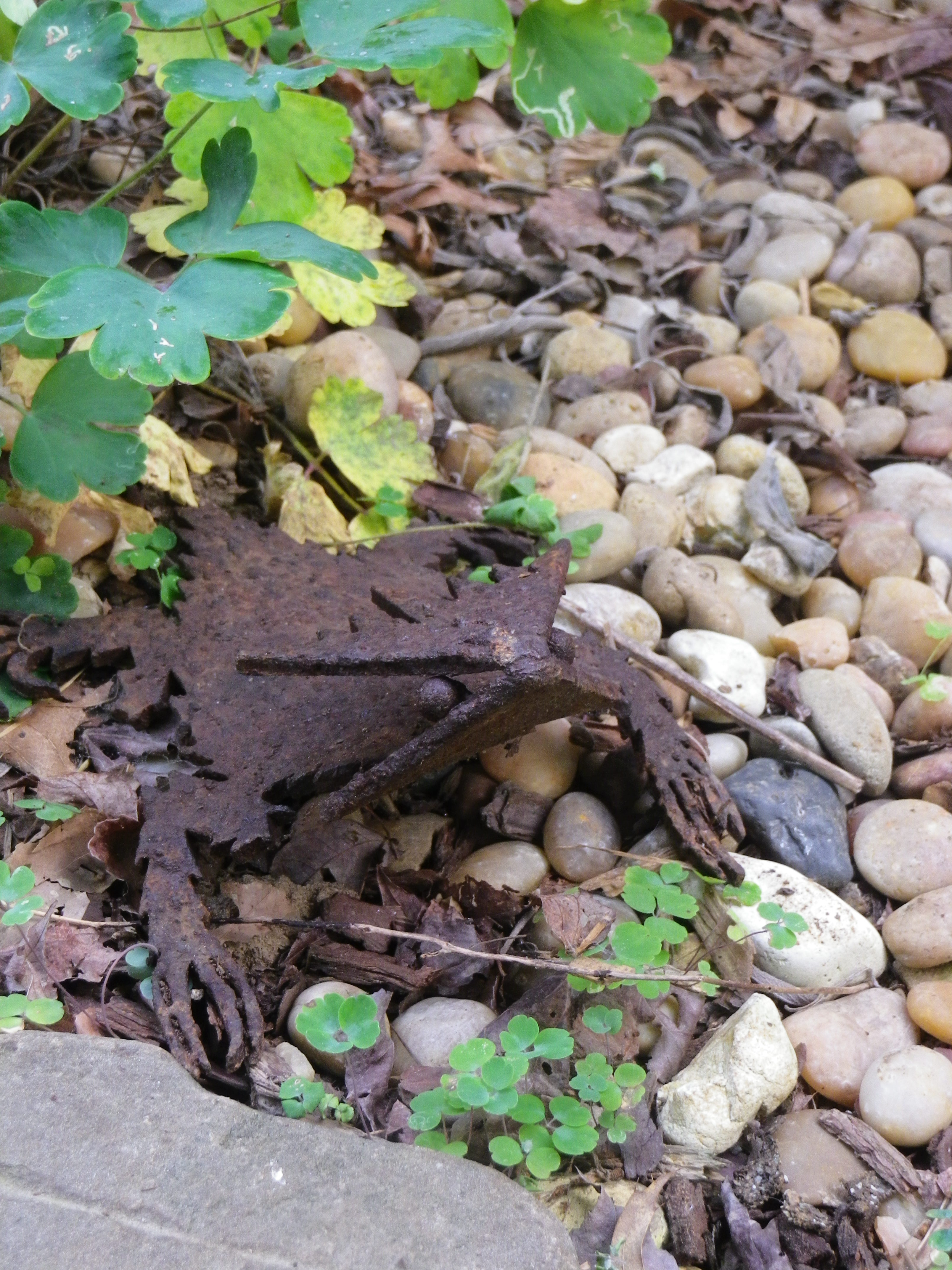
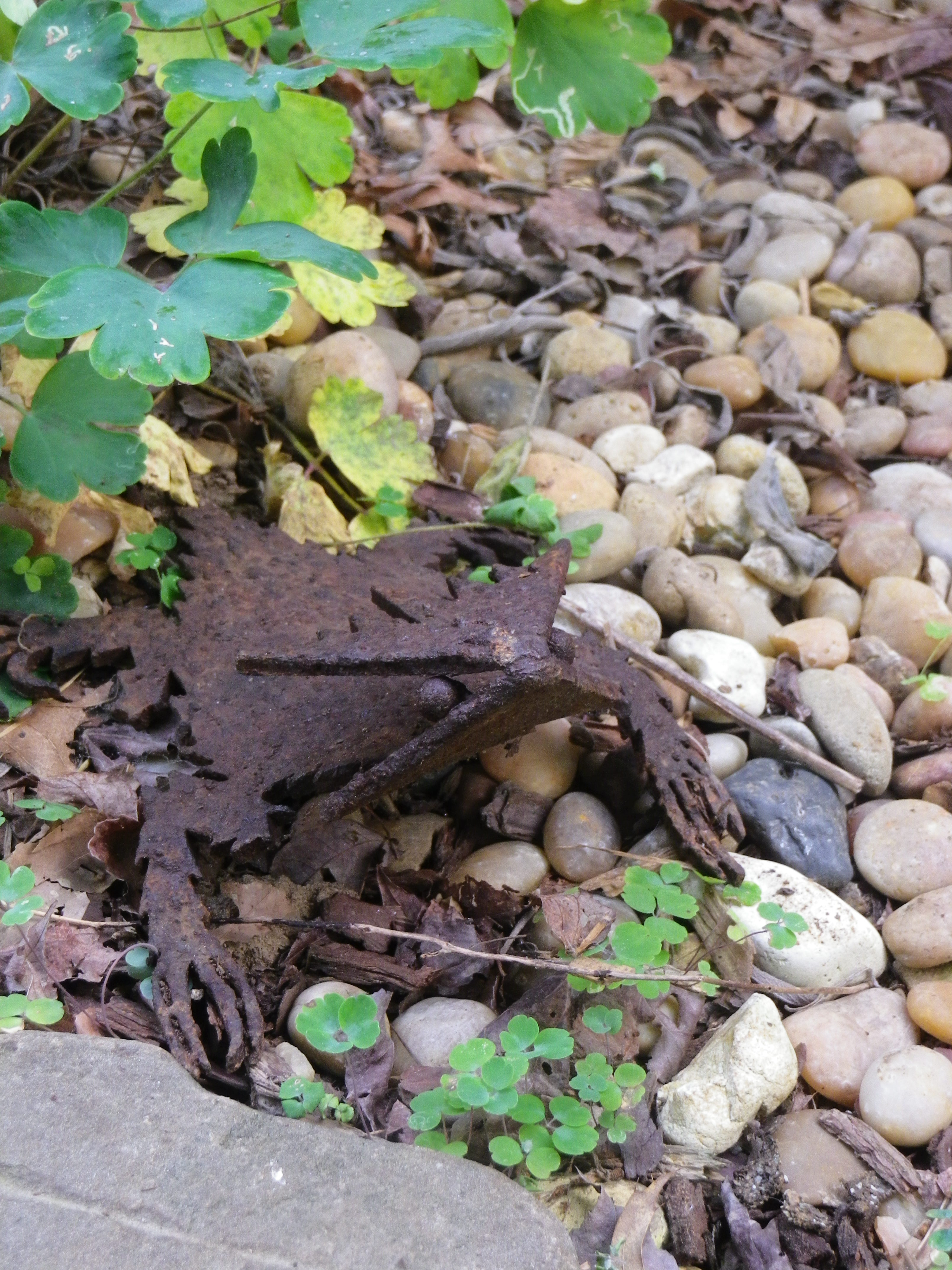
Years ago, when Mom was saddled with a frog fetish (she liked them just fine, but the family went a bit overboard in buying them), I brought her a horned toad from San Antonio. It was living in the front garden, where it could barely be seen.  Here it is by the dry creek bed, where it stands out just enough that it’s a nice surprise when you spot it.

Anne also asked delicately (though she’s pretty blunt) how much I liked the myrtle around the lamppost.  We both agreed that myrtle should be rooted out of most places it appears, so she went forth and suggested making this more of a focal point. (Another example of a new set of eyes seeing something that I had clearly stopped paying attention to 15 years ago when I finally got the English ivy out of that spot.)  She recommends a boulder or several big stones in this spot. Hmmm.  Interesting – no plants at all?  I will ponder.

Design advice, part one

I followed up with Anne Little on some garden advice.  She came out twice and gave me enough good ideas to keep me busy for years to come.  She kindly said that my garden was wonderful, by which I think she meant that the elements were good, they just need to be re-arranged a bit.  There’s nothing like having an outsider who doesn’t really know you looking at your garden and seeing it without the history and emotion you bring to it yourself.

Idea I didn’t like at first, but now I do:

In the front garden, instead of edging it with the coral bells (as Mom advised me twenty years ago, so this is close to my heart), weave them into an S curve that goes the whole length of the garden.  Move the hakenachloe towards the front.  Take out the balloonflower and plant it along the back edge of the walkway garden.

Things to move, for which I will likely hire someone:

The boxwood to the left and on either side of the steps to be planted along the fence line in back.  Feathery yews to be planted in their place.  The lone aucuba along the back fence was frizzled by last summer’s drought.  Move into the erstwhile white garden?

Farewell to the vegetable garden:

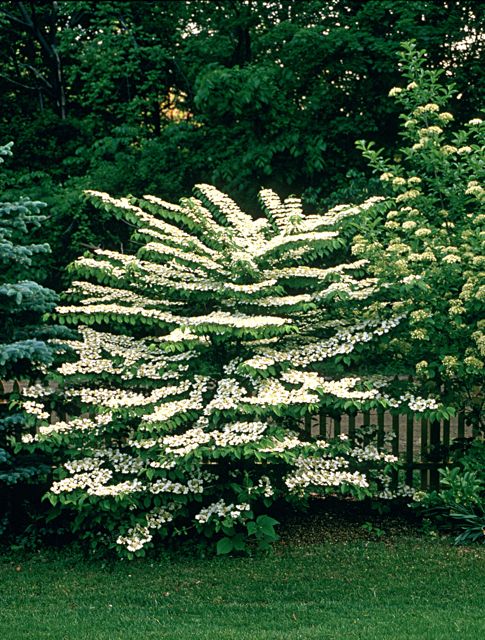
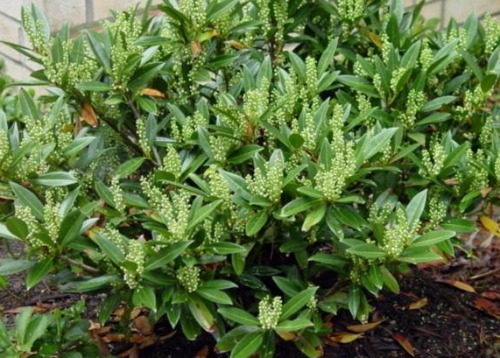
The one in back, here when I came, gets so much shade now that it doesn’t really work except as a bulb cutting garden.  Anne recommends three shrubs in that corner, such as itea, Beauty berry, or viburnum (Arrowood, doublefile, cranberry, Korean or leatherleaf).

Filling in the gaps:

Three shrubs to go between the newly transplanted boxwoods along the fence could be abelia (tho I’m not crazy about them), forthergilla gardenii, or cherry laurel Otto Luykens.  Where the line of day lilies is now (move them somewhere or give away), plant a small tree.  She recommends a trident maple (full sun, 20-30′ high?), Kousa dogwood, witch hazel, hawthorn Winterking (which sounds terrific, but does it need full sun?),

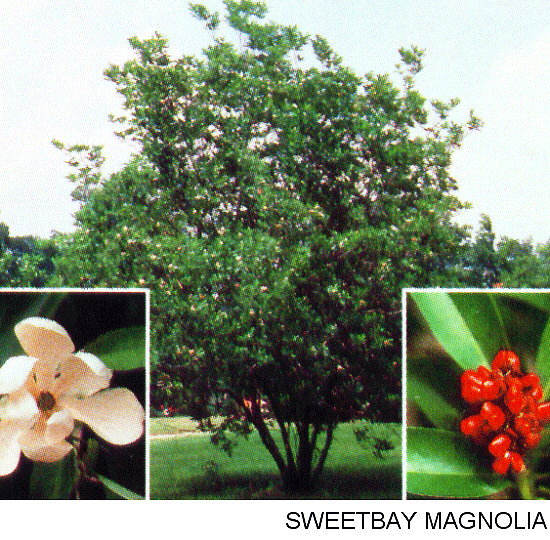
or redbud ‘forest pansy,’ ‘hearts of gold,’ or ‘Oklahoma.’  Plant St. John’s wort in front.  Put a cherry laurel skip or abelia grandoflora (6′ x 6′) where the aucuba was.  Finally, in the corner of the white garden, between the back of the shed and the fence, plant a sweet bay magnolia.  I do need to check on light needs for all of these.  No one ever believes me that the back gardens are part sun at best.

First harvest

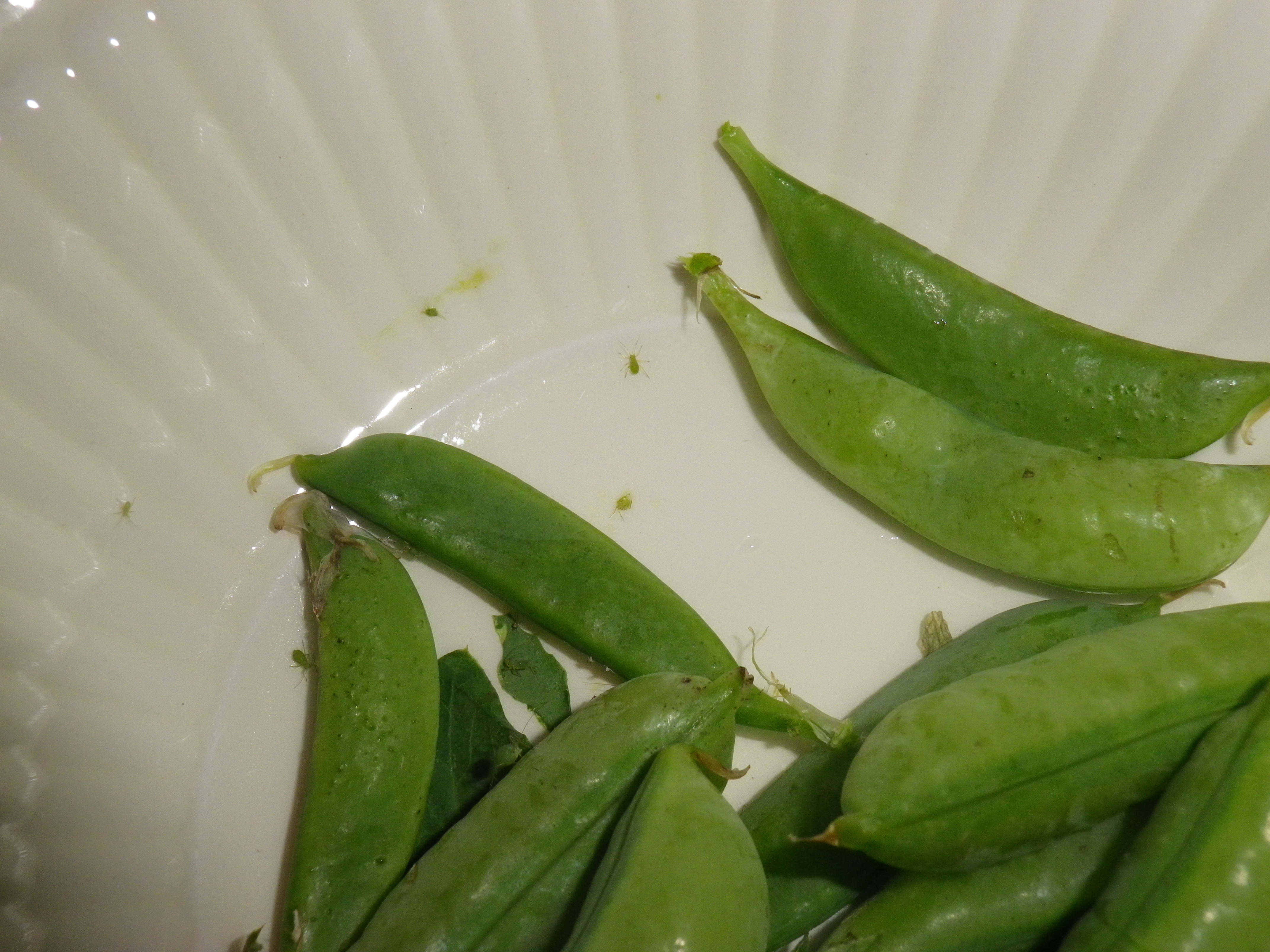
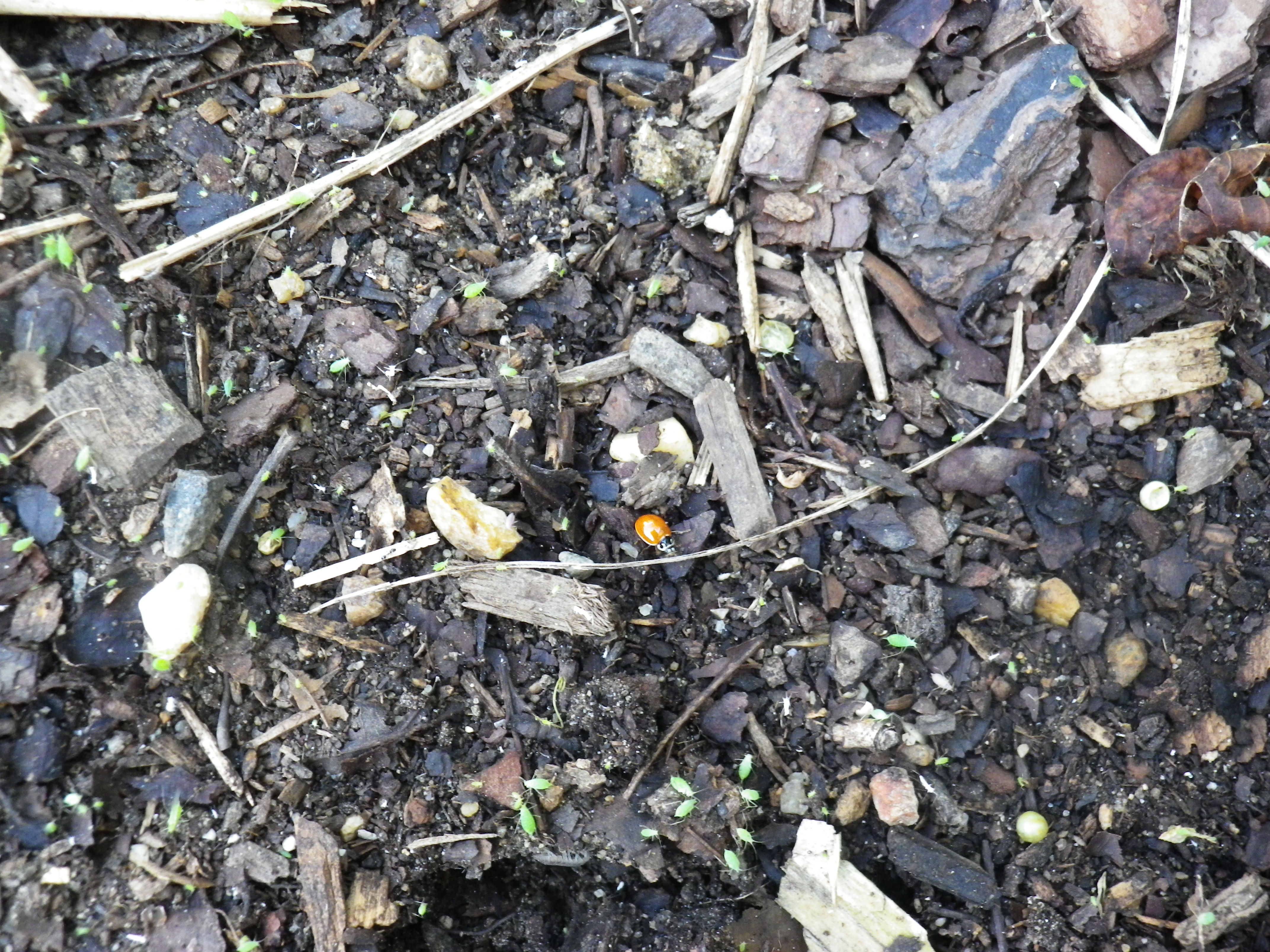
The sugar snap peas were good this year, even though for the first time I had aphids.  They washed off easily and didn’t seem to affect the crop or the flavor.  Aren’t they sort of amazing?  Here they are with a ladybug and something else common whose name I should know (sowbug??). You will have to click on the image to see what I’m talking about.


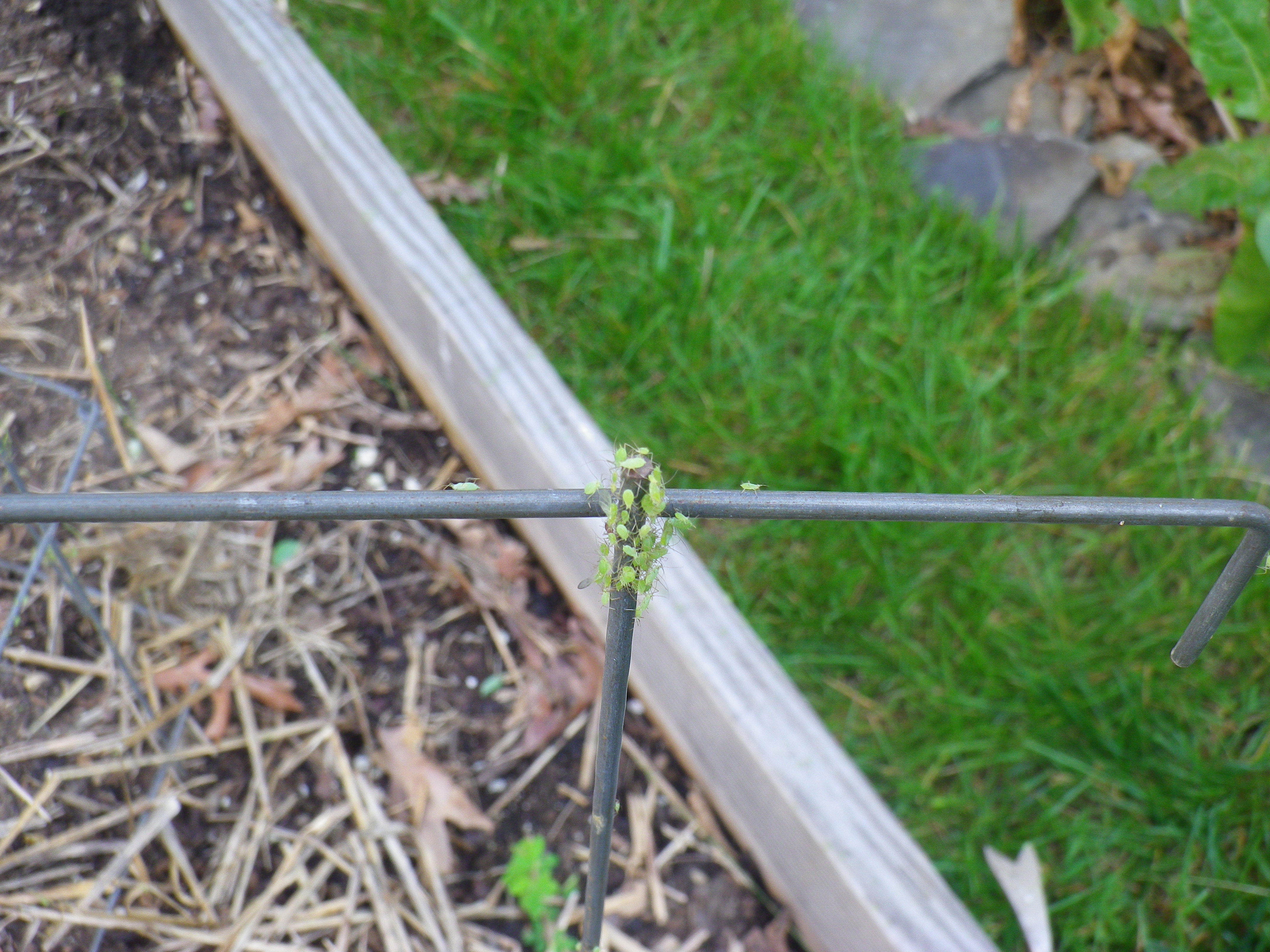
And here they are clustered on the pea trellis after the spent peas were pulled up.

Ladybugs are a natural predator of aphids, but clearly I could have used more of them.

Now that you’ve seen some bugs, whet your appetite with the delicious harvest of lettuce (bug-free).

Yesterday I added some crunchy, peppery radishes to the salad.

The carrots seem to be coming along fine – I’ve thinned them once and need to do it again.  The potatoes in a bag, an experiment, are growing exuberantly. I didn’t hill them up as soon as I should have, so we’ll see what happens.  Once they bloom, I think I can search for the harvest.

My clever tip for growing spring vegetables:  WATER.  That, and the absence of the groundhog my neighbor relocated to the wilds of Stafford County, have made  this a successful harvest season so far.  But when I plant my beans later today, I’ll enclose the seedlings in netting, just in case.